SF Courts Won’t Show Their Work
For five years, SF courts haven’t reported a single data point to the state—even as they resolve fewer and fewer cases.

Source: garryslist.org
Source: garryslist.org
TL;DR
SF’s public defender got a 27% budget increase by claiming a case surge that never happened. Criminal filings dropped 35%. And SF courts haven’t filed clearance data with California since 2020.
San Francisco’s Superior courts appear to resolve only 32 percent of cases filed in fiscal year 2023-24. That ranks 52nd out of 56 California counties. For comparison, San Mateo clears 95 percent. Santa Clara clears 88 percent. And Alameda clears 86 percent.
How did this happen?
First, the courts are not clearing cases or are hiding how they are resolved. Cases expire before trial — 70 misdemeanor cases were dismissed in 2024 simply because the clock ran out.
Second, SF courts have not submitted a single data point on resolved criminal cases to the California Judicial Council since 2020. Five consecutive years of non-compliance with Article VI, Section 6 of the state constitution — the provision that requires every court in California to report its judicial business to the Council. The SF Superior Court’s own Biennial Report (FY 2022-23 & 2023-24), subtitled “Data-Driven Decision-Making: Our Way Forward,” confirms this gap — a court that brands itself “data-driven” has submitted zero data to the state in five years. The 32 percent figure comes from the California Judicial Council’s 2024 Court Statistics Report, labeled “incomplete” because the courts stopped reporting before anyone could see how bad it really got.
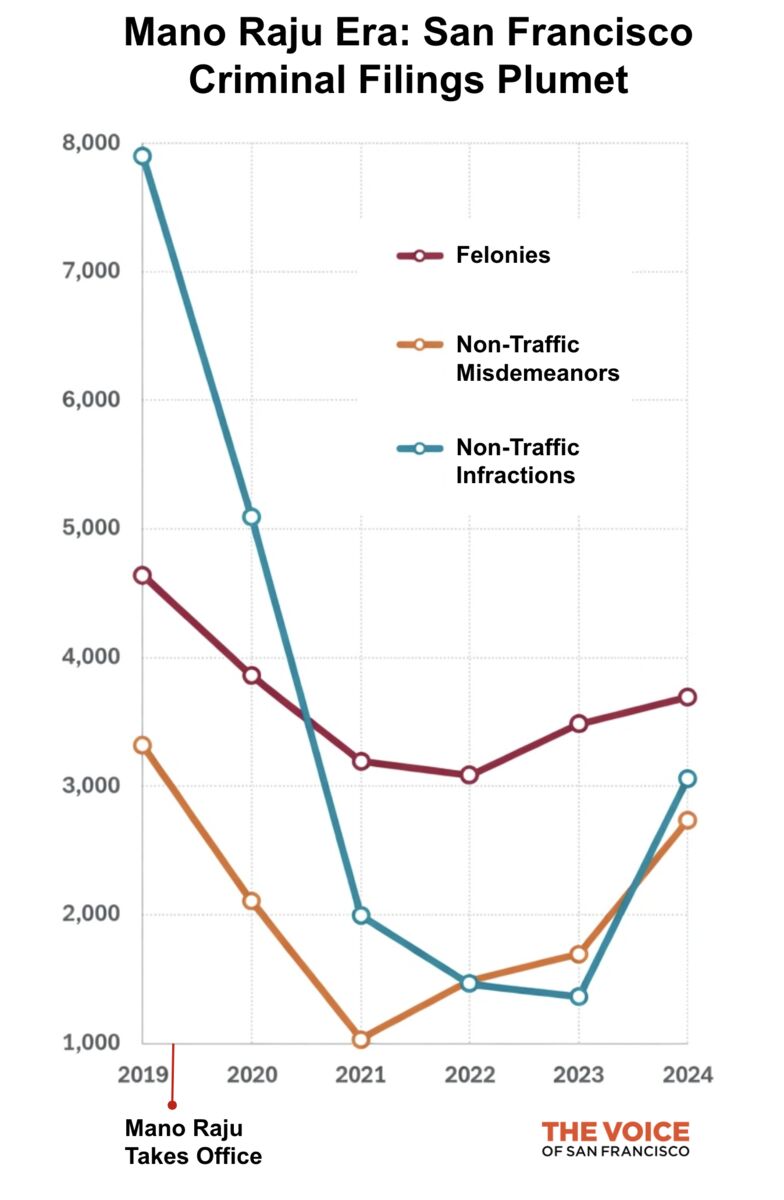
Third, the public defender’s budget grew 27 percent during this period of failure — from $41 million to $52 million, now heading to $57.6 million — justified by a claimed caseload surge that state records directly contradict. Criminal filings actually fell 35 percent. All of this during a projected $2 billion city deficit.
These aren’t three separate problems. They’re one system operating exactly as designed: don’t clear cases, don’t report the results, and keep the money flowing anyway.
The Budget Grew. The Caseload Shrank.
SF Public Defender Manohar Raju told city hall his office was underwater. He claimed a “31 percent surge” in criminal filings over three years. The Board of Supervisors kept his $52 million budget intact and approved increases to $57.6 million in future years, all while the city faces a projected $2 billion deficit.
The California Judicial Council’s own fiscal-year data says the opposite. According to the 2024 Court Statistics Report, criminal filings dropped 35 percent from 2019 to 2024 — as The Voice of San Francisco also documented. Raju’s claimed surge doesn’t exist in state records.
But here’s what makes it worse: Raju isn’t just wrong — he’s running two contradictory stories at once. To the Board of Supervisors, his office is drowning in cases, and the budget must grow. To the public, it’s someone else’s fault the cases aren’t getting done. On August 15, 2024 — the same day more than 70 misdemeanor cases were dismissed — his office issued a press release blaming the dismissals on a “harmful, avoidable, years-long trial backlog” caused by the courts. Not his office. Not the continuances his attorneys request. The courts. These two explanations are mutually exclusive. You cannot tell the budget committee that your caseload is surging beyond capacity and tell the press that the real problem is a court backlog you had nothing to do with. If the cases are overwhelming your office, you own the backlog. If the backlog is the court’s fault, you don’t need the money. Pick one.
The benchmark that makes this undeniable: former SF Public Defender Jeff Adachi ran the same office for 16 years before his sudden death in 2019. His team cleared 35 percent more annual criminal caseloads with a smaller budget than Raju’s office handles today. Same office, better results, less money. Whatever changed after 2019, resources aren’t the explanation.
Delay Is the Strategy
Delay doesn’t just slow cases. It erases them. The SF Chronicle reported in July 2024 that hundreds of Bay Area criminal cases were at risk of dismissal due to trial delays. Weeks later, it happened: 70 misdemeanor cases were dismissed in a single day because continuances stacked until the clock ran out and the cases disappeared from the docket entirely. DA Brooke Jenkins called it a failure of the system: “Regrettably, the system has now failed countless victims of crime who will not see justice done.” No verdict, no resolution, no accountability. Just gone.
In the Marcos Smith-Pequeno Walgreens looting case, the defense requested a continuance when cameras showed up in the courtroom, then another at the next hearing — indefinite deferral as a form of disappearance. Troy McAlister accumulated over 90 felony charges before killing two pedestrians on New Year’s Eve 2020, and the system never finished processing a single one before someone died. In the Watson case, five years of pretrial delay effectively ended the case before it was ever resolved.
The bench composition explains why this keeps working. In 2019, 29 percent of SF judges came from public defender or civil rights advocate backgrounds. By 2024, that share climbed to 38 percent, a third more anticarceral judges on the bench — a trend first quantified by The Voice of San Francisco. More judges inclined to grant continuances. More judges treating felonies with probation and diversion. DA Brooke Jenkins named this culture directly: “We are dealing with a culture in our courthouse of judges being excessively lenient.”
Five Years of Silence
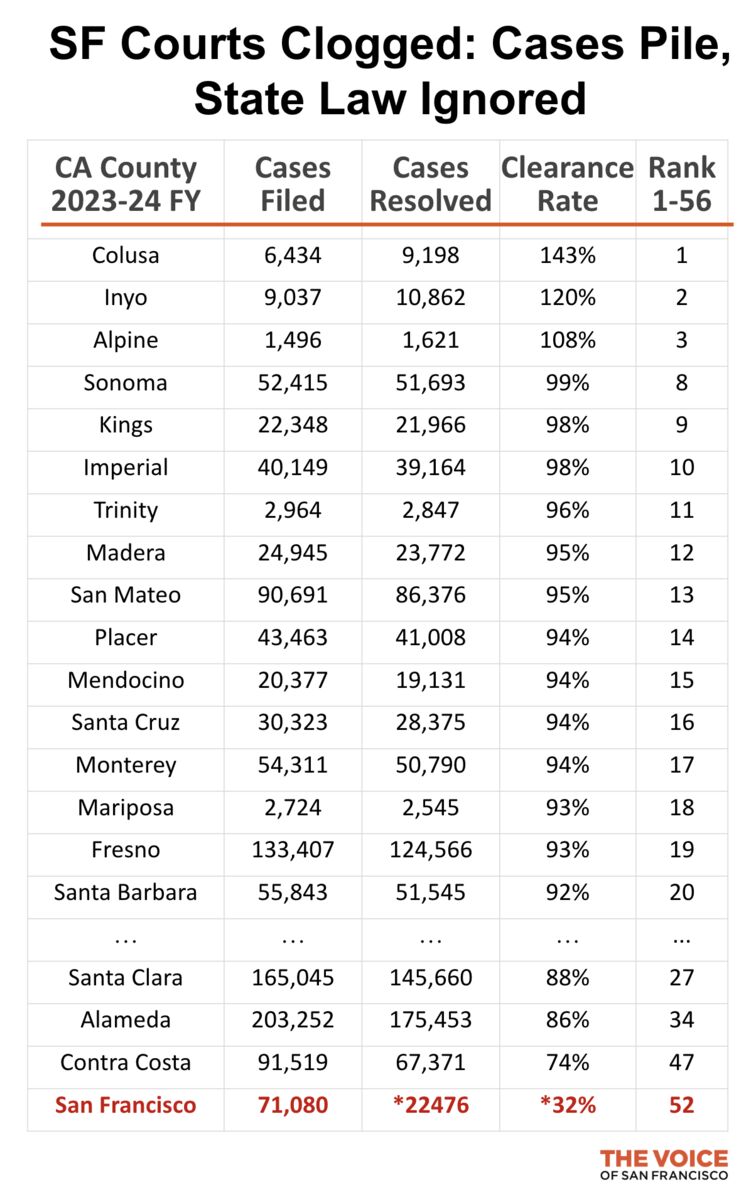
Colusa, a small rural county with a fraction of SF’s resources, clears 143 percent by resolving prior-year cases alongside new ones. SF clears 32 percent — and the real number may be worse, because the courts have submitted zero data on resolved criminal cases to the California Judicial Council since 2020. The court’s own biennial report confirms the gap; the state’s Court Statistics Report flags SF’s data as incomplete.
Almost two-thirds of SF’s total court filings are criminal cases (63 percent, N=44,381 criminal filings), and only 8 percent of those are felony filings (N=3,582). In that same period, only 55 cases were resolved by jury trials, indicating defendants got plea deals or diversion. Roughly 10 percent of these criminal felonies are pushed out for years - allowing the accrual of 2 for 1 days of time-served credits that are applied in post-sentencing. In 2024, 1,143 criminal cases were referred to Drug Court and 438 were accepted. Many criminal defendants, like Thea Brenda Hopkins, skip court dates dozens of times, pushing out resolution for Drug Court referrals for years. Both Hanako Abe and Grandpa Vicha’s case has been delayed for more than five years from public defender’s request and judicial leniency. SF averages one jury trial per judge, while Alameda county averages 11 jury trials per judge in its Superior Courts.
Why are criminal disposition reports missing for SF in these state-mandated reports? SF Superior Court’s excuse: a new case management system rolled out in 2022 that is, three years on, apparently still too difficult to use. Any engineer who has shipped production software knows what three years to build a reporting module means. It’s not a bottleneck. It’s a choice. Nobody in Sacramento has asked Presiding Judge Rochelle C. East, elected by her judicial peers in 2024 for a two-year term, why the data went dark. Yet, SF Superior Court had the time and resources to chart portions of the very same missing data in its own skewed web-based dashboard. And it’s still incomplete.
Follow the incentives: if you never have to report your clearance rate, you never have to answer for it. Five years of silence didn’t happen by accident.
Who’s Responsible. Who Won’t Act.
East oversees the administration that hasn’t filed a single data point with the state in five years. She was elected by her judicial peers, not voters, so there is no direct democratic accountability for the blackout she presides over. The Judicial Council, when asked how the public can push for compliance, pointed to a webpage for public comment, as The Voice of San Francisco reported. That’s the enforcement mechanism for a constitutional violation. A comment box.
By law, the Judicial Council must recommend fixes to the governor and legislature. Neither has acted. Liz4SF flagged the issue publicly and tagged San Jose Mayor Matt Mahan, pointing to a city executive who enforces accountability as a contrast to the silence from Sacramento on this specific failure.
Lenient judges are hurting public safety. The public knows exactly what they want. But the system is designed so nothing happens about it.

Judges in SF are not doing their jobs and upholding the law. That the worst SF judges were not ousted in this week’s election is a mega-failure. They have a duty to the people of SF, and they are failing.
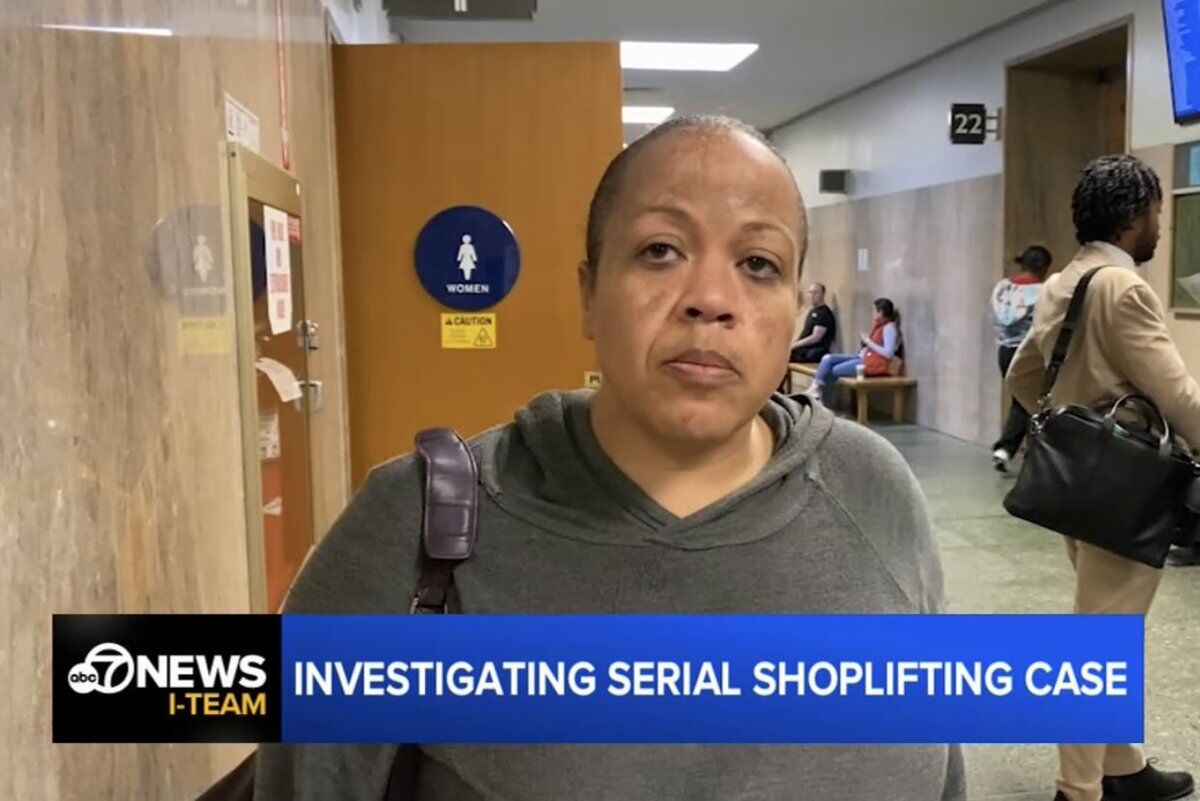
The woman accused of being a serial shoplifter, of stealing more than $40,000 from a San Francisco Target, is speaking for the first time. Aziza Graves explains why she thinks a penny is worth $100 million. I investigate how her case is dragging on after her arrest in 2021. A retired Superior Court judge says we’ve lost sight of the need to protect the public. abc7ne.ws/43b3Qvf
The 2024 elections left the worst performers on the bench. The 2026 primary puts two dozen judges before voters again. Most will run unopposed, meaning their names won’t even appear on a ballot unless a challenger files.
Criminal filings dropped 35 percent. The budget grew 27 percent. If that’s overloaded, it’s the most expensive underload in California history, funded during a $2 billion city deficit, justified by numbers that state records directly contradict.
The Judicial Council must enforce the reporting requirement. The governor and legislature need to demand it, not accept “public comment” as the answer to five years of constitutional non-compliance. Stop Crime Action has graded every judge on the 2026 ballot. Look up yours. The judges who made the Watson outcome possible are counting on voters not knowing their names.
Related Links
-
SF Court Watch: Courts evade scrutiny, fueling the blame game (The Voice of San Francisco)
-
He Killed Grandpa Vicha. Tomorrow, He Walks Free (Garry's List)
-
Two Felonies, One Essay, One Murder (Garry's List)
-
SF's Worst Judges Are About to Win Reelection—Unopposed (Garry's List)
Comments (0)
Sign in to join the conversation.