SF’s Worst Judges Are About to Win Reelection—Unopposed
Feb. 4 deadline looms. If qualified attorneys don’t file to run, voters won’t even get a choice.

Source: thevoicesf.org
Source: thevoicesf.org
TL;DR
Around two dozen SF judges face reelection in June, but most of the worst performers on public safety remain unchallenged. Without challengers filing by Feb. 4, they’ll be automatically reelected.
San Francisco’s public safety problems don’t start with crime on the streets—they often end with judges who release repeat offenders back onto them. With the Feb. 4 filing deadline days away, most of the worst-performing judges remain unchallenged.

Dozens of SF judges face reelection in June 2026—but with the Feb. 4 filing deadline days away, most of the worst performers on public safety remain unchallenged. If qualified attorneys don’t step up now, these judges will be automatically reelected.

The deadline to run is fast approaching, yet some of the worst judges on public safety remain unchallenged. Urge those w/ 10yrs of experience practicing law in CA to run.. our city depends on it. Feb 4th filing deadline. Many soft on crime judges are vulnerable twitter.com/SusanDReynolds/status/2013664815433089247
The urgency is real. If qualified attorneys don’t step up in the next few days, these judges will be automatically reelected without voters even getting a choice.
The Silent Reelection Machine
Around two dozen San Francisco Superior Court judges face reelection in June 2026. About half of those up for reelection have backgrounds as public defenders, which The Voice of San Francisco notes “can sometimes lead to more lenient approaches in areas like sentencing, favoring diversion programs over full trials.”
Here’s the catch: in most cycles, incumbent judges run unopposed. When that happens, their names don’t even appear on the ballot—they’re automatically reelected. The system is designed for incumbents to coast.
To qualify as a challenger, you need 10 years of law practice in California. The Feb. 4 deadline for the signature-in-lieu and Declaration of Intention is days away. Most of the judges voters want gone? Still unchallenged.
The Judges Voters Want Gone
A 2025 study found that most SF voters recognize judges play a key role in public safety—but they also lack information about judges’ actual records. When voters were surveyed on specific rulings, the results were damning.
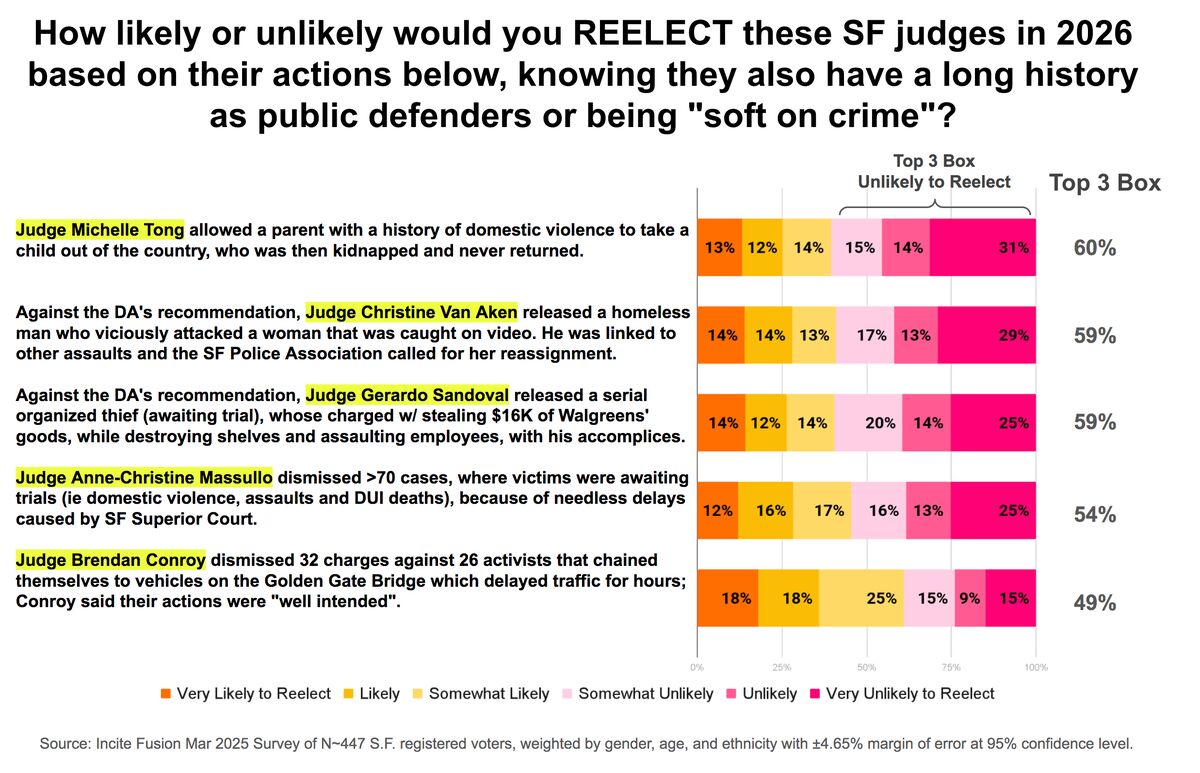
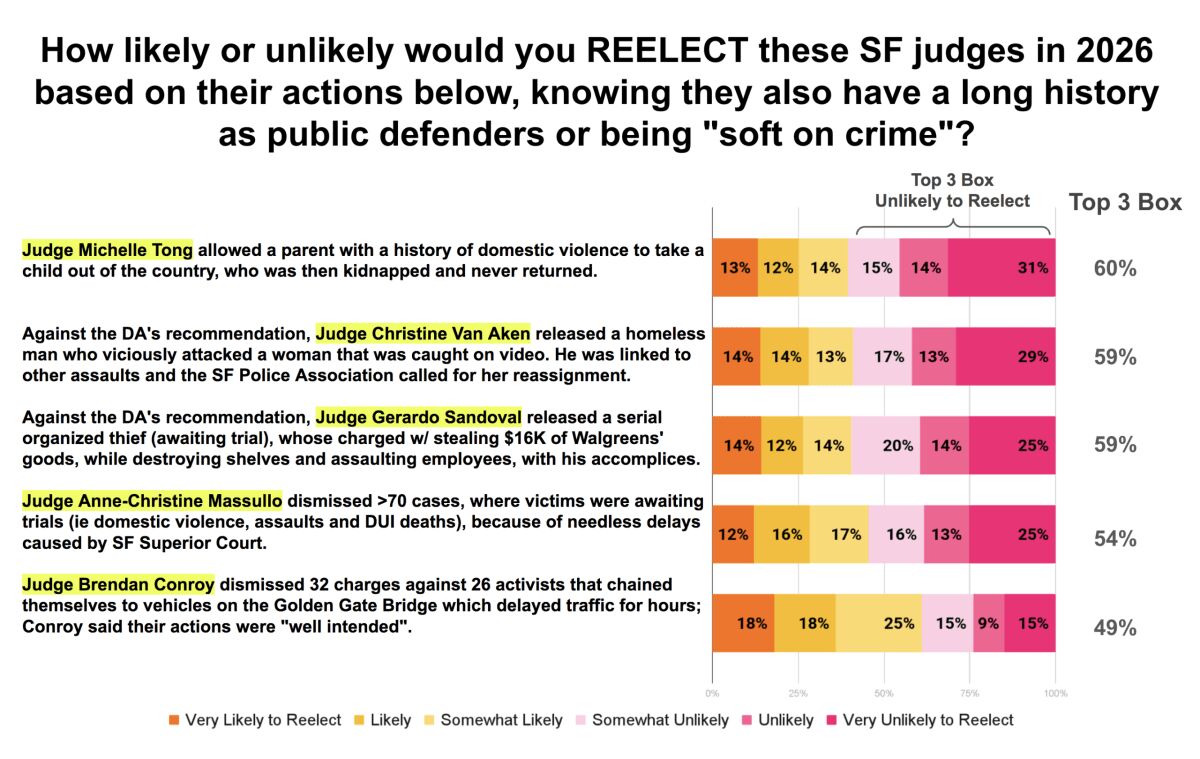
Judge Michelle Tong received 60% “Unlikely to Reelect” based on a custody ruling that allowed a parent with a history of domestic violence to take a child out of the country—the child was kidnapped and never returned. No challengers have filed against her.
Judge Van Aken scored 59% “Unlikely to Reelect” after releasing a repeat offender who was later captured on video brutally attacking a woman.
Judge Gerardo Sandoval also hit 59%. According to the Voice of San Francisco, Sandoval “granted pretrial release to a defendant who fled police with a machine gun concealed in his pants and was later arrested for murder.” He’s also faced criticism for minimizing fentanyl dealing and had to apologize for anti-Semitic comments from his time on the Board of Supervisors.
Judge Maria Evangelista accounted for almost one-third of criminal bench warrants in 2024-25 because her department kept releasing serial perpetrators on their own recognizance—who then failed to show up for court.
Frank Noto of Stop Crime Action, whose organization runs a court watch program, singled out Judge Carolyn Gold for “decisions that repeatedly endanger public safety"—including releasing a domestic violence defendant who was arrested a week later for violating his stay-away order while possessing meth.
The Diversion Pipeline Problem
The numbers tell a stark story. Drug Court referrals exploded from 192 cases in 2022 to 1,908 in 2025. In 2025, 91% of those accepted into drug court were diverted to mental health programs, avoiding full trial, conviction, and sentencing.
Some defendants in diversion programs now include those charged with violent crimes: attempted murder, armed robbery, assault with deadly weapons. According to the SF Chronicle, DA Brooke Jenkins said the program is "failing miserably” based on termination data.
The result is a revolving door that makes communities less safe while judges cite “rehabilitation” statistics that collapse under scrutiny.
Why the Candidate Pipeline Is Broken
Why aren’t more qualified attorneys stepping up to challenge these judges? SF’s fierce political tribalism makes recruitment nearly impossible.
Archived tweet@proales SF is about the size of Columbus Ohio and a common problem is the tribalism is so fierce it takes a tremendous amount of activation energy to get people to run Candidate pipeline is nontrivial difficult
Garry Tan @garrytan January 27, 2026
Running against a sitting judge means challenging the legal establishment in a city where professional and social networks overlap intensely. Attorneys with 10 years of California experience who care about public safety—that’s a small pool, and many have good reasons to avoid the spotlight.
Stop Crime SF has been grading judges and documenting problematic rulings for years. The information is out there. What’s missing are candidates willing to put their names on the ballot.
The Feb. 4 deadline is effectively a deadline for accountability. If qualified attorneys don’t step up in the next few days, San Francisco voters won’t even get the chance to vote these judges out—they’ll be automatically reelected. Know an attorney with 10+ years in California who cares about public safety? Point them to the filing requirements now. Time is running out.
Follow @garrytan for more.
Take Action
Share with attorneys who should run
Related Links
-
Few challengers in San Francisco Superior Court races (The Voice of San Francisco)
-
Stop Crime SF judge grade program (SF Standard)
-
SF Drug Court concerns (SF Chronicle)
Comments (0)
Sign in to join the conversation.