Nothing Changes Until the Bench Does
SF judges keep neutralizing every reform voters pass, from the Boudin recall to Prop 36. June 2’s Seat 16 race is the only contested judicial election on the ballot.
TL;DR
A killer walked free on sentencing day thanks to a judge. On June 2, SF voters get their only contested judicial race.
On March 26, Judge Linda Colfax sentenced Antoine Watson to eight years for killing 84-year-old Vicha Ratanapakdee. That same afternoon, she released him.
California’s 2-for-1 pretrial credit rule counted Watson’s five years in county jail as ten years of sentencing credit. Ten years of credit against an eight-year sentence means zero remaining time. The conviction evaporated on contact with the bench.
Vicha never came home from his morning walk on January 28, 2021. Watson shoved the 84-year-old to the ground in the Anza Vista neighborhood. Vicha died two days later. The surveillance video went viral and catalyzed the Stop Asian Hate movement. Five years of waiting ended with a judge ruling that “public safety would be best served” by Watson living on probation with his mother.
District Attorney Brooke Jenkins was blunt: “Justice was not served by this sentence.”
The DA prosecuted and the jury convicted. But the judge let him walk.
Voters have exactly one tool left to do anything about it: the Seat 16 judicial race on June 2. It’s the only contested bench election on the ballot, and once it’s over, the next chance is six years away.
The Bench Is the Bottleneck
Jenkins vs. SF’s judges is not a personality clash. It’s a multi-year structural conflict, and the bench keeps winning.
In 2024, she publicly called a judge’s stabbing-case sentence “reckless.” In 2025, she accused judges of ignoring voters’ will on Prop 36 and slammed pretrial releases of repeat narcotics offenders. A retired judge filed a State Bar complaint against her for “outspoken disrespect.” In 2026, she accused Judge Colfax of bias, warned a California Supreme Court bail ruling would have “devastating” consequences for public safety, and said judges “live in ivory towers.”
Her sharpest criticism targets Drug Court. Petitions tripled from 516 in 2023 to 1,909 in the first ten months of 2025. Judges approved 608. Defendants charged with attempted murder, armed robbery, and assault with a deadly weapon are now being diverted through the program, with terminations outpacing graduations. Jenkins called the expansion “destructive to the program.”
You can elect a tough DA. You can hire more cops. You can pass Prop 36. But if the bench releases repeat offenders and expands diversion to people charged with violent crimes, every other reform dies at the last mile.
What Went Wrong in 2024
In March 2024, Judges Michael Begert and Patrick Thompson faced challengers backed by Stop Crime SF. Both survived. Begert won 61.6% of the vote, 124,943 to 78,017, against challenger Chip Zecher.
This happened in the same election where SF voters approved tough-on-crime ballot measures. Voters chose accountability everywhere except the one place it matters most.
The records were clear. Stop Crime Action documented that Judge Begert released a convicted sex offender with multiple arrests four separate times. Thompson released a drug dealer arrested with enough fentanyl to kill 85,400 people, a man convicted twice before and arrested 14 times. Begert doesn’t even live in San Francisco. He lives in Piedmont. The people making these decisions don’t bear the consequences.
So why did they survive? Low-information judicial races, strong incumbent advantage, and the perennial argument that challenging judges threatens “judicial independence.”
But an independent judiciary is independent from the executive and legislative branches, not from the people. The California Constitution requires judges to stand for election. And when 90% of voters demand more transparency on judicial rulings, the independence argument looks less like principle and more like insulation.
75% of SF residents blame judges for crime. 90% want transparency. And most judges still run unopposed. The math only works if you don’t show up.
The Numbers Behind the Bench
By 2024, 38% of SF’s judges came from public defender or civil rights backgrounds, up from 29% in 2019. A one-third increase in five years, driven primarily by gubernatorial appointments, not elections. SF voters never voted for this shift. Governors appoint. Voters rubber-stamp. And the bench drifts further from the city’s actual priorities on public safety.
The performance numbers are brutal. SF courts manage a 39% case clearance rate compared to Alameda County’s 96%. SF judges handle seven bench trials per year. Alameda handles 342. That’s not overwork. That’s dysfunction.
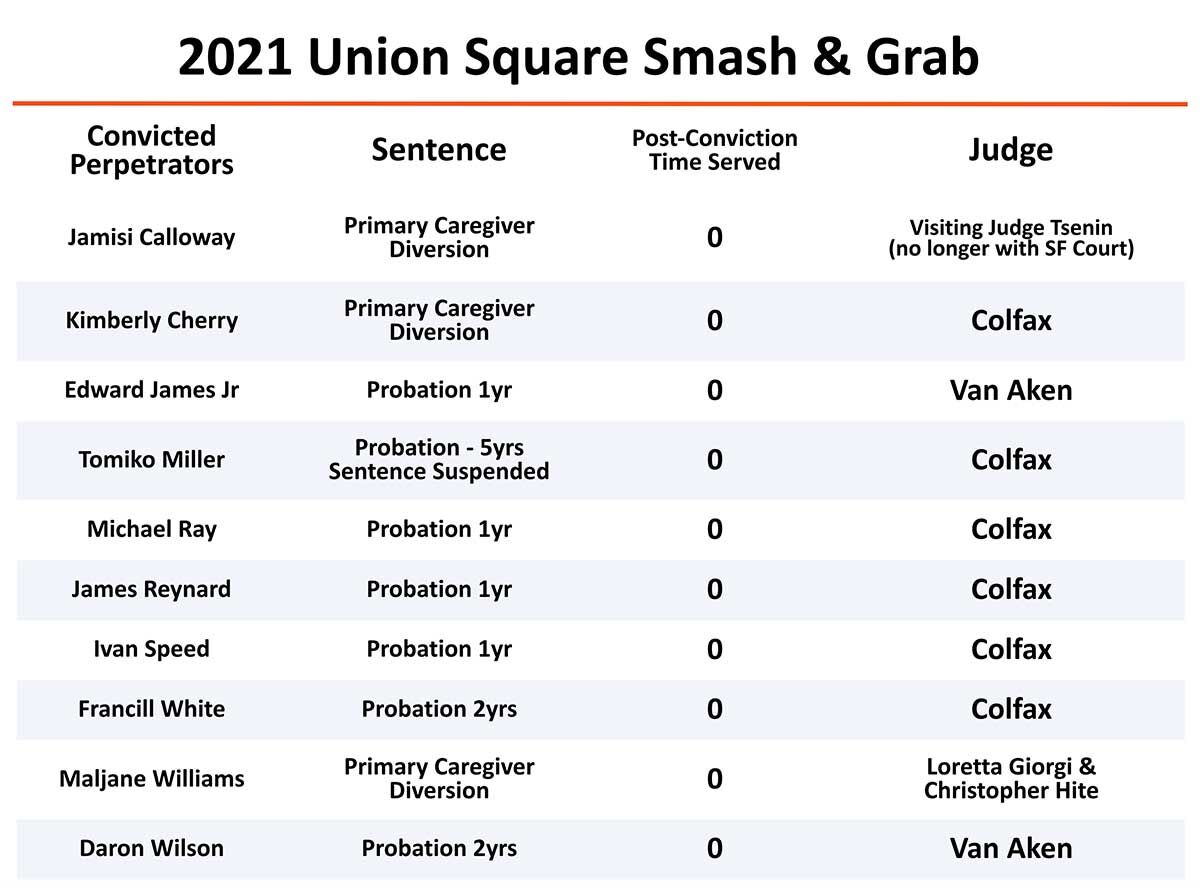
Not a single Union Square looting felon received jail time post-conviction in 2023. The 2-for-1 pretrial credit mechanism is the system’s quiet kill switch: defense attorneys request continuances to run up pretrial detention time, which converts to double sentencing credit. Frank Noto of Stop Crime Action identified this as a deliberate structural exploit. Watson’s case is proof: Five years of county jail became ten years of credit.
The parallel to the Boudin recall is telling. Voters recalled a DA because the failure was visible, dramatic, and easy to understand. Judges operate in near-total obscurity. Local television news reaches only one-third of voters, and only ABC7’s Dan Noyes regularly covers sentencing. The invisibility is the incumbent’s greatest weapon.
Seat 16: The Race That Matters
Judge Gerardo Sandoval faced sustained backlash for releasing Marcos Smith-Pequeno, accused of stealing more than $16,000 from Walgreens, against the DA’s explicit objections. He’s not running for reelection. That gives SF voters an open seat and a real choice.
Phoebe Maffei is a 15-year assistant district attorney who prosecuted the David DePape/Paul Pelosi hammer attack. Thirty-four jury trials. Endorsed by the SF Police Officers Association, the Deputy Sheriffs’ Association, and the SF Democratic Party. Outraising her opponent 5-to-1. She’s pledged to publish judicial performance metrics, a transparency commitment no sitting SF judge has made.
Alexandra Pray is a deputy public defender since 2010 with 50+ jury trials, including three homicide acquittals. Endorsed by the Harvey Milk LGBTQ Democratic Club, the League of Pissed-Off Voters, and the SF Tenants Union. She frames herself as non-political and focused on “root causes.”
The endorsement lists alone tell the story. This is a proxy fight for the direction of SF’s bench. Prosecutor vs. public defender. Accountability vs. root causes. About 24 other SF Superior Court judges are up for reelection in June 2026. Most will run unopposed. This is likely the only contested race where voters get an actual choice.
Why This Is the One That Counts
Judges serve six-year terms. Most run unopposed. Once seated, they are nearly impossible to remove.
SF voters recalled Boudin, elected Jenkins, and passed Prop 36. The judges can neutralize all of this progress from the bench. And they have.

The judges in SF Superior Court are one of the primary reasons why SF lets repeat offenders walk the streets with minimal accountability We need to replace the judges in SF via election. Follow @StopCrimeSFnews for public safety grades for judges.

LaDoris Cordell doesn’t want judges held accountable for their bad decisions. Unbelievable. She needs to 🤐 sfchronicle.com/politics/article/retired-judge-blasts-da-jenkins-criticisms-s-f-20238988.php
We’ve been covering this. We warned in early 2025 that the worst judges were about to win reelection unopposed. Now there’s one real race. The 2024 Begert result proved that low attention is the incumbent’s best friend. If voters don’t show up for judge races, the bench stays static no matter what happens in every other election.
June 2 primary. Seat 16. Phoebe Maffei vs. Alexandra Pray. If you care about what happened to Vicha Ratanapakdee, if you’re frustrated that Prop 36 hasn’t changed courtroom outcomes, the bench is where that frustration belongs. Vote, and bring someone with you. California’s Constitution gives you the right to choose your judges. The judges are counting on you not using it.
Related Links
-
San Francisco Court Watch: Voters in the Mist (The Voice of San Francisco)
-
This Is the Judge Who Let Grandpa Vicha's Killer Walk Free (Garry's List)
-
SF's Worst Judges Are About to Win Without a Vote (Garry's List)
-
Phoebe Maffei Races to Court (The Voice of San Francisco)
Comments (0)
Sign in to join the conversation.