SF’s Worst Judges Are About to Win Without a Vote
The Feb. 4 deadline to challenge soft-on-crime judges is days away—and almost no one has stepped up.
Source: x.com
Source: x.com
TL;DR
About two dozen SF Superior Court judges face reelection in June 2026, but most will win automatically without appearing on the ballot unless qualified attorneys file to challenge them by Feb. 4.
Dozens of San Francisco judges face reelection in June 2026—but with the Feb. 4 filing deadline days away, most of the worst performers on public safety remain unchallenged. If qualified attorneys don’t step up now, these judges will be automatically reelected without ever appearing on a ballot.

The deadline to run is fast approaching, yet some of the worst judges on public safety remain unchallenged. Urge those w/ 10yrs of experience practicing law in CA to run.. our city depends on it. Feb 4th filing deadline. Many soft on crime judges are vulnerable
The stakes couldn’t be higher. When judges repeatedly release violent offenders, dismiss charges, and funnel criminals into failed diversion programs, San Franciscans pay the price.
The Feb. 4 Deadline Nobody’s Talking About
Here’s how judicial elections actually work in California: the signature-in-lieu and Declaration of Intention are due by Feb. 4. To qualify as a judicial challenger, you need at least 10 years of law practice in California right before the filing date. That’s it.
Archived tweetYou dont have to live in SF to run, Judge Begert lives in Piedmont
Liz4SF @incitafusio January 20, 2026
You don’t even have to live in San Francisco—Judge Begert lives in Piedmont. If no challenger files against an incumbent, their name never appears on the ballot and they’re automatically reelected. If an incumbent doesn’t file for reelection, challengers get an extra five days to submit paperwork. According to The Voice of San Francisco, “In most cases, incumbent judges in San Francisco run unopposed, meaning their names don’t appear on the ballot and they are automatically reelected.”
A 2025 study of SF voters found most recognize that judges play a key role in public safety—but voting decisions are complicated by limited information about judges’ records. That’s exactly what these incumbents are counting on.
The Judges Voters Would Fire—If They Had the Chance
Polling data from The Voice of San Francisco reveals just how vulnerable these judges are—if anyone bothers to challenge them.
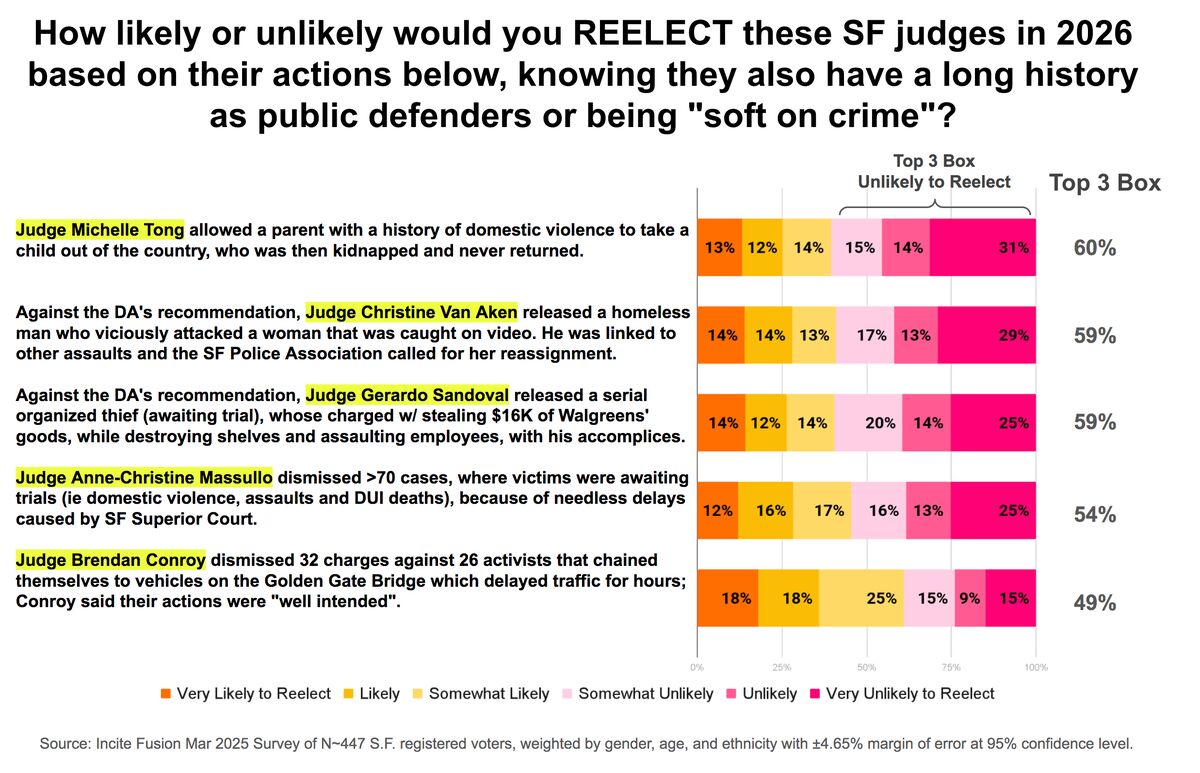
Judge Michelle Tong received 60% “Unlikely to Reelect” based on her custody ruling that “allowed a parent with a history of domestic violence to take a child out of the country, who was then kidnapped and never returned.” Currently, no challengers have filed paperwork against her.
Judge Christine Van Aken scored 59% “Unlikely to Reelect,” stemming from a case where she released a repeat offender who was later captured on surveillance video brutally attacking a woman.
Judge Gerardo Sandoval also hit 59% “Unlikely to Reelect” based on releasing a serial thief charged with stealing $16k of Walgreens goods. The Voice of San Francisco reports that Sandoval also “granted pretrial release to a defendant who fled police with a machine gun concealed in his pants and was later arrested for murder"—and had to publicly apologize for anti-Semitic comments made as a Board of Supervisors member.
Judge Anne-Christine Massullo garnered 54% "Unlikely to Reelect” for dismissing over 70 cases awaiting trials caused by court delays. She’s rumored to not be seeking reelection.
The Repeat Offender Revolving Door
The numbers are damning. According to Stop Crime Action’s Judge Report Card, Judge Maria Evangelista accounted for almost one-third of criminal bench warrants in the 2024–25 San Francisco Superior Court because her department was “continually releasing serial perpetrators on their own recognizance.” These perpetrators then failed to reappear in court.
Frank Noto of Stop Crime Action singled out Judge Carolyn Gold for decisions that “repeatedly endanger public safety.” In one case, she released a domestic violence defendant with a stay-away order—a week later, he was arrested for violating the order and possessing methamphetamine. She also granted pretrial release to a repeat offender charged with firearm possession and drug dealing, despite a prior judge deeming release dangerous.
The DA’s office has filed 373 motions to detain “the most serious drug dealing suspects” pending trial. The court granted only 38—about 10%. There are currently 517 defendants with open bench warrants who failed to appear for narcotics cases after being released by judges, missing on average more than 30 months.
The Drug Court Pipeline to Nowhere
Judge Begert received a FAIL grade from Stop Crime Action for good reason. Under his oversight, Drug Court referrals surged from 192 cases in 2022 to 1,908 in 2025. In 2025, 91% of those accepted into drug court were diverted to mental health programs, avoiding full trial, conviction, and sentencing.
About half of the judges up for reelection have backgrounds as public defenders, which The Voice of San Francisco notes “can sometimes lead to more lenient approaches in areas like sentencing, favoring diversion programs over full trials, and allowing trial delays that help defendants earn ‘2-for-1’ credit for time served in pretrial detention.”
The data is clear: diversion programs, granted by judges, have been linked to higher rates of recidivism in San Francisco. We’re not rehabilitating offenders—we’re recycling them back onto the streets.
How to Track Judicial Performance
You have a right to know how your judges perform. Here are the resources:
Archived tweet@markdfabela @MarieR2036394 Stop Crime Action Judges Report Card, https://t.co/Qdy94TMpZF & https://t.co/eiYI7iqMwB are excellent sources for tracking judges https://t.co/NzS6pNsBfi
Liz4SF @incitafusio January 20, 2026
Stop Crime Action’s Judge Report Card grades judges on public safety performance—Judge Patrick Thompson received the lowest rating (1.6 out of 7) and released felony drug dealers on their own recognizance in 17 different cases. He released a 14-time offender who was subsequently arrested with nearly 2.2 pounds of fentanyl.
SF Public Safety News tracks court outcomes and specific cases. The Voice of San Francisco has covered vulnerable judges and the polling data that shows voters would reject them—if given the chance.
California’s Constitution requires Superior Court judges to be elected. That means voters have a right to hold them accountable. But accountability requires challengers willing to run—and right now, there aren’t enough.
If you’re a California attorney with 10 years of experience—or know one—the Feb. 4 deadline is your chance to challenge judges who have failed San Francisco on public safety. Without challengers, they win automatically. The resources are there to make your case to voters; the question is whether anyone will step up.
Follow @garrytan for more.
Related Links
-
Few challengers in San Francisco Superior Court races (The Voice of San Francisco)
-
Stop Crime Action Judge Report Card (Stop Crime Action)
-
San Francisco Public Safety News (SF Public Safety News)
Comments (0)
Sign in to join the conversation.