BART Paid Consultants to Say Fare Evasion Didn’t Matter — Then Lost the Receipt
Now they want a new tax, and can’t find the invoice for the “equity” report they commissioned to argue enforcing fares was pointless
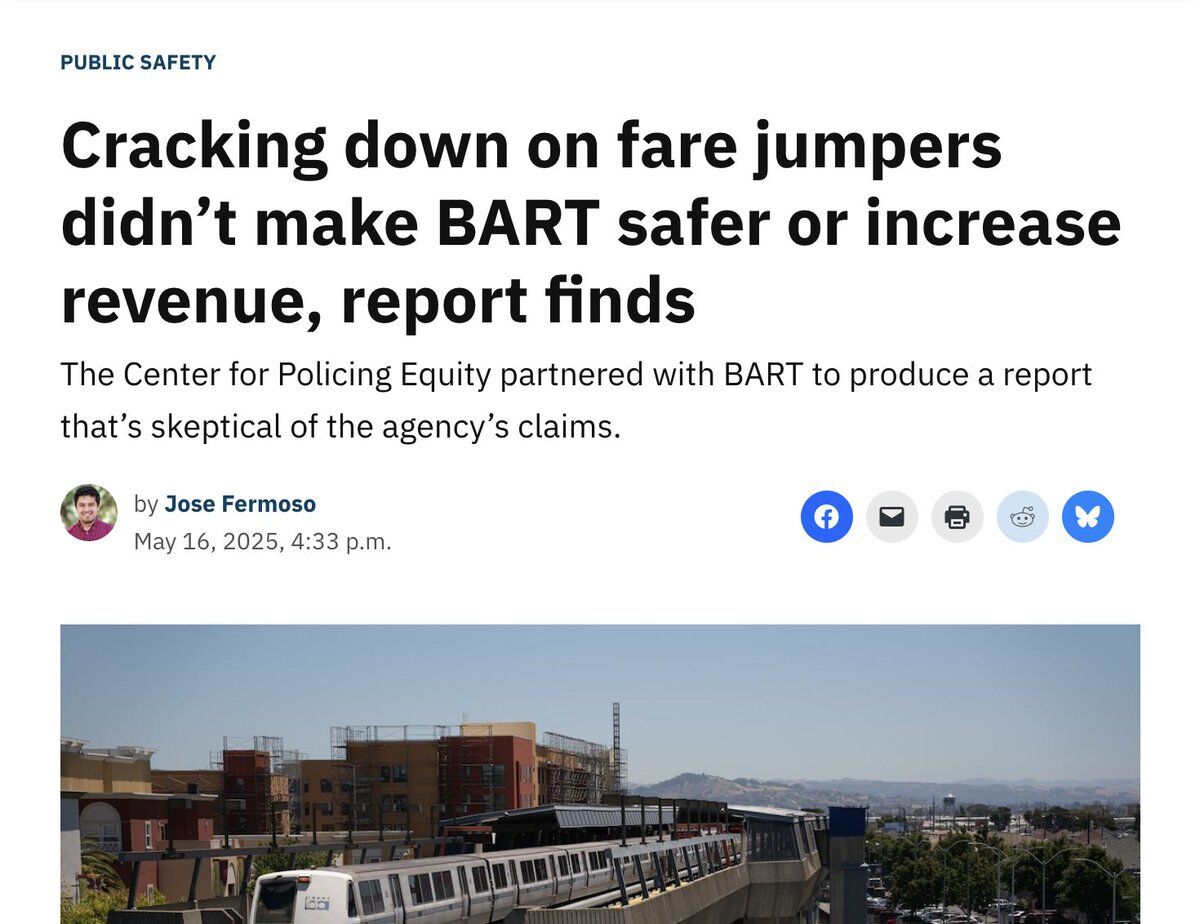
Source: x.com
Source: x.com
TL;DR
BART voted 9-0 to fight fare evasion, then hired consultants to argue enforcement doesn’t work. Crime dropped 41% after new gates went in. Now they can’t find the invoice — and they want your tax dollars anyway.
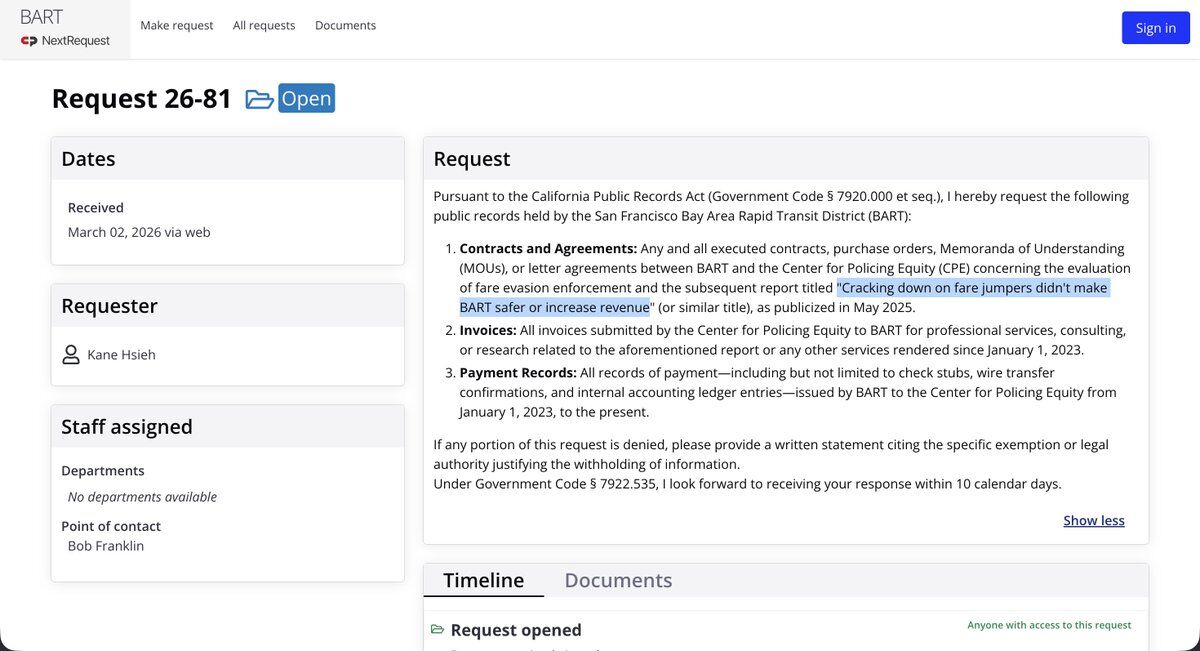
In March 2026, SF resident Kane Hsieh filed a public records request asking a simple question: how much did BART pay the Center for Policing Equity to produce a report arguing that cracking down on fare jumpers didn’t work?
Three weeks later, BART still can’t find the invoice.

With @SFBART pushing another tax while claiming they always took fare evasion seriously (lol), as recently as 2025 they were paying "equity" consultants to argue it didn't matter. I filed a records request 3 weeks ago for the report cost. They still can't locate the invoice:

Since some are doubling down saying there was never a vote by the BART Board opposing fare evasion. Here are the receipts: In 2017 all nine board members voted to oppose fare evasion and create a new proof of payment ordinance. …
BART Voted Against Fare Evasion. Why Did They Pay Someone to Say It Didn’t Matter?
The board’s public record on this is unambiguous. In 2017, all nine BART board members voted unanimously to oppose fare evasion and create a new proof of payment ordinance. Nine ayes. Zero noes. Directors Allen, Blalock, Dufty, Josefowitz, Keller, McPartland, Raburn, Simon, and Saltzman. Every single one.
Then, in 2023, the board majority voted to oppose a bill that would have decriminalized fare evasion. The Governor vetoed the bill. BART’s own account says its opposition played a role.
So twice, on the record, the BART board said: fare evasion is a problem we oppose.
Then, in 2022, BART quietly hired the Center for Policing Equity to study fare enforcement. CPE published its report in May 2025, concluding that cracking down on fare jumpers “didn’t make BART safer or increase revenue.” CPE Vice President Hans Menos framed fare enforcement as giving “armed agents of the state with the power to take away life and liberty” too much discretion.
BART voted against fare evasion. Then paid ideology-driven consultants to argue that fighting fare evasion was pointless — with your tax dollars.
The Numbers the Consultants Didn’t Want You to See
BART’s new Plexiglass fare gates, a $90M investment, now generate $10M annually in recovered fare revenue. Fare evasion dropped 21%. Senator Scott Wiener, who helped secure state funding for the gates, noted that “when we make smart investments in our transit systems, good things happen.”
The safety data is even more direct. Crime on BART dropped 41% in 2025. Violent crime fell 31%. Robberies decreased 60%. Property crime dropped 43%. During the same period, BART delivered nearly 5 million more trips than the year before.
And here’s the data point that connects enforcement to safety directly, the one you won’t see in the CPE report: 80% of those arrested for crimes on the BART system had not paid a fare. Fare evasion isn’t a victimless infraction. It’s the front door to worse behavior. Let it slide and you’re signaling the rules don’t apply. Enforce it and riders come back.
CPE’s central claim, that enforcement didn’t improve safety or revenue, was refuted by BART’s own results in the same year the report was published. The fare gates that went in across all 50 stations in 2025 generated $10 million more per year and coincided with the biggest crime drop in the agency’s recent history.
Paying consultants to argue your problems don’t exist isn’t a budgeting mistake. It’s a management philosophy.
The Invoice Nobody Can Find
Kane Hsieh filed CPRA Request 26-81 in March 2026, asking for all contracts, invoices, and payment records between BART and the Center for Policing Equity. The request cites the California Public Records Act and asks specifically about the fare enforcement report that became public in May 2025. Under state law, BART had 10 calendar days to respond.
Three weeks in, the agency couldn’t locate the invoice.
This is the same agency that spent $96 million on overtime in 2023. The same agency whose Inspector General, Harriet Richardson, resigned in 2023 accusing top BART leadership of repeatedly impeding her oversight work. The Alameda County grand jury later confirmed the pattern. When Richardson’s successor tried to audit overtime, she was told the timekeeping data was inaccessible, until the CFO contradicted that claim in the same board meeting.
The CPE invoice may turn up. But the fact that it took more than three weeks to locate a contract for a report that was publicly released in May 2025, while BART is actively pushing a new tax, is a data point about institutional culture. Not misplaced paperwork. Culture.
Now They Want More Money
BART faces a $400 million annual deficit and is threatening to close 10 to 15 stations, including Orinda, South San Francisco, Castro Valley, and Warm Springs, unless voters approve a new regional sales tax in November across five counties. We covered the full doomsday scenario in detail here.
The financial trajectory tells you everything. Over the past decade, BART ridership fell more than 50% while employee headcount rose approximately 30% and total employee spending nearly doubled. In FY2024, fare revenue was roughly $219 million against operating expenses of about $1.02 billion. Before the pandemic, fares covered about two-thirds of operating costs. Today, they cover less than a quarter.
BART spent $96 million on overtime in 2023 alone, 14% of the entire agency’s salary spend. One janitor earned $271,000 on a $57,945 base salary by claiming 114-hour work weeks. When KTVU pulled the security footage, he was disappearing into a storage closet for hours at a time. BART officials defended him.
The CPE relationship isn’t a one-off hire. It’s a window into how an institution under financial pressure chooses to spend scarce money. Not on the Inspector General’s office, which was “significantly underfunded” according to the Alameda County grand jury. Not on overtime accountability systems. On a consultant to argue that the agency’s own documented problem isn’t really a problem.
Bay Area voters are being asked to fund a transit system that, as recently as 2025, was paying for ideological research that contradicted both its public voting record and its own operational data. Before November, the one question worth demanding an answer to is simple: how much did BART pay CPE, who authorized it, and what did they think they were buying?
Kane Hsieh’s records request is still open. BART still can’t find the invoice.
If you want to know whether BART has fixed the management culture that produced this, that’s your answer right there.
Related Links
-
BART's Doomsday Gambit: Pay Up or Lose Your Station (Garry's List)
-
BART's 'Leave Them Be' Order Burned the Transbay Tube (Garry's List)
-
BART: Fund Fraud or Lose Your Stations (Pirate Wires)
-
BART's long fight against fare evasion is finally paying off (SF Chronicle)
Comments (0)
Sign in to join the conversation.