BART’s ‘Leave Them Be’ Order Burned the Transbay Tube
BART knew about the encampment, had legal authority to clear it, and asked Oakland nicely. Then it burned.
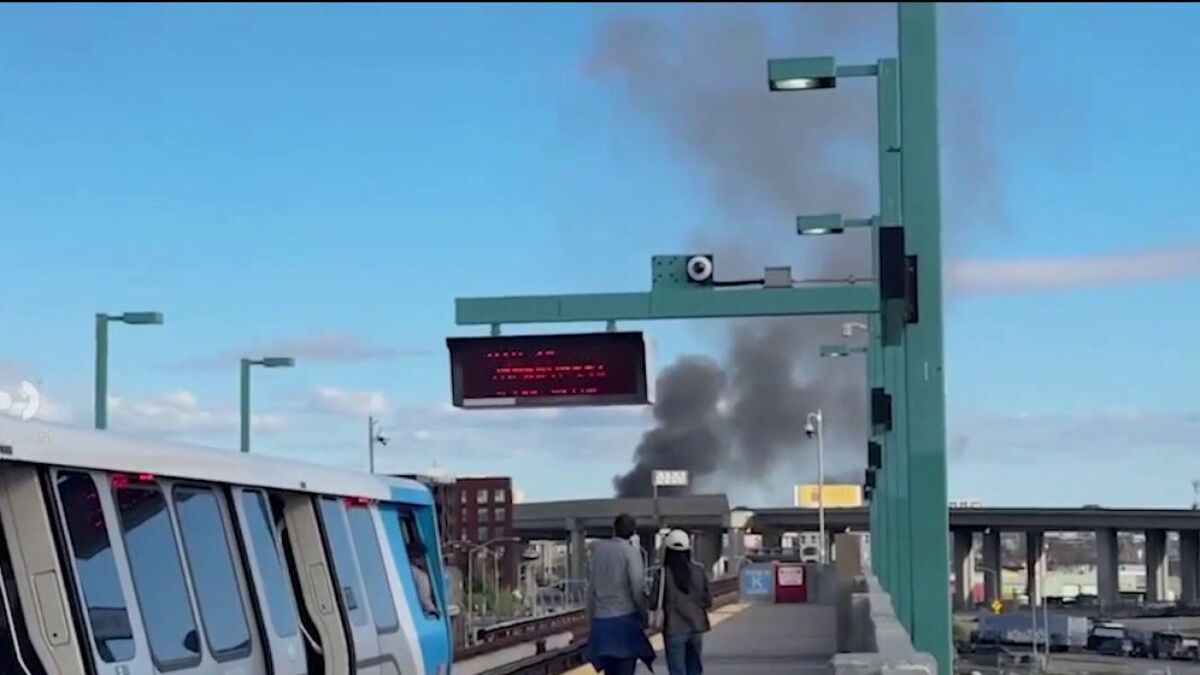
Source: ktvu.com
Source: ktvu.com
TL;DR
Two encampment fires shut down BART in seven days. BART knew about the West Oakland RV site, had legal authority to clear it, but the board’s “leave them be” culture meant waiting for permission it didn’t need.
Two encampment fires. Seven days. One is a tragedy. Two is a policy.
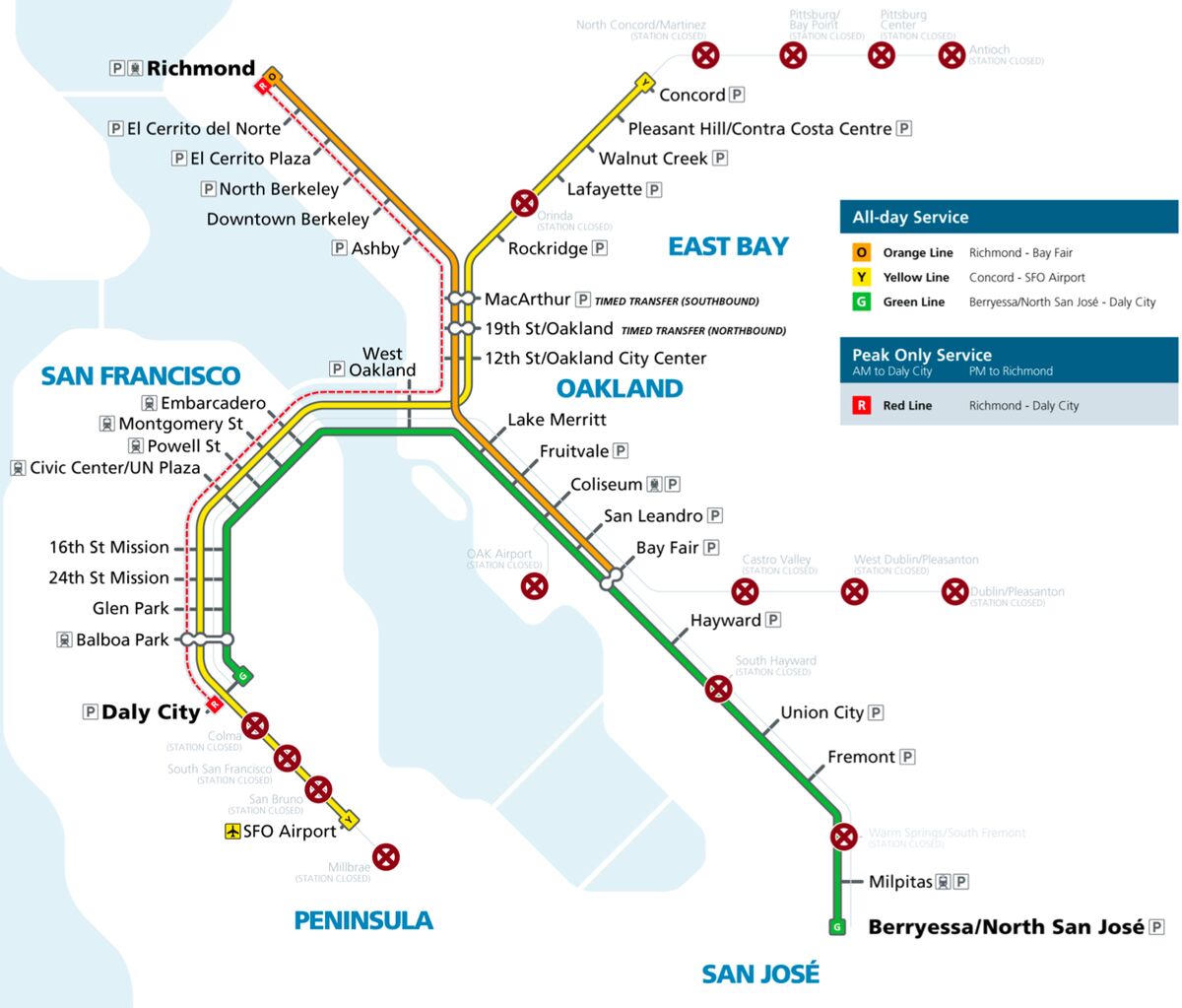
On February 16, a generator at a homeless encampment near South Hayward exploded, damaging BART’s fiber cables and forcing a station closure. Seven days later, an RV fire at Fifth and Filbert Streets in West Oakland sent flames to elevated tracks and destroyed radio communications cables. Within 20 minutes of operators spotting smoke, the Operations Control Center lost all communication with trains. The Transbay Tube, the sole rail link between Oakland and San Francisco, went dead for over 12 hours.
Hundreds of families returning from Oakland’s Black Joy Parade were stranded. Riders waited 45 minutes for shuttle buses, then endured two-hour cross-bay trips. No injuries were reported in either fire. Next time, someone living in an RV beside an electrified third rail might not be so lucky. The “leave them be” approach isn’t just dangerous for infrastructure. It’s dangerous for the people living in these camps.
BART spokesperson Alicia Trost admitted what makes this unforgivable:
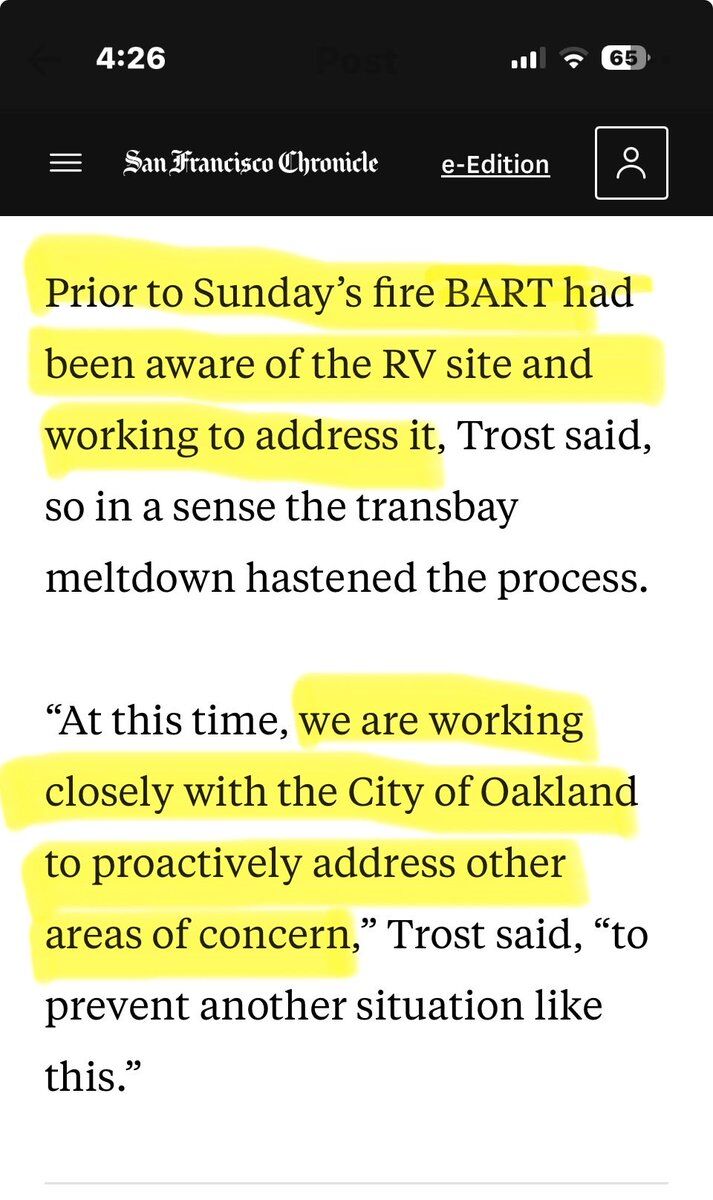
They knew. They asked nicely. It didn’t happen in time.
EDIT: Since publishing this, BART reached out to clarify: “BART Police clears encampments off our property, and we monitor the encampments that are located near our infrastructure but are not on our property. We then ask the property owners (typically the city) to prioritize clearing the encampments because they pose a risk to BART, and we offer our help in doing it. BART does not allow homeless camps on our property, including our parking lots.”
The Authority Nobody Used
Former BART Board Director Debora Allen went public about the failure:

As an elected @SFBART board member, I intervened a few times when homeless encampments appeared close to our tracks. If an encampment poses an immediate threat to the BART transit system it can be removed immediately by BART, without asking for the city’s permission. I forced it once in Concord. Where were the #BART directors on this? Where is the board chair? Do they even spend time in their BART district communities?@VM_MelHernandez
Allen says BART can remove encampments on its own property without city permission. Federal case law backs her up. In the “Here There” encampment case, Judge William Alsup ruled BART can enforce California trespass law on its own right-of-way and is “not responsible for providing housing or services for the homeless.” Caltrans maintenance policy goes further: encampments posing “an imminent threat to life, health, safety, or infrastructure” can be cleared immediately with no advance notice.
BART has its own police force. It has established legal authority. Allen proved it works when she forced removal of a trackside encampment in Concord. Instead of exercising this authority on the West Oakland RV site they knew about, BART staff politely asked Oakland for help. Oakland didn’t come in time.
Allen directly tagged Board Chair Melissa Hernandez: “Where were the BART directors on this? Where is the board chair?” Hernandez has been fighting station closures in her Tri-Valley district while running for Congress. She’s campaigning for a promotion while her transit agency can’t keep an RV from burning down the Transbay Tube. The February 26 board meeting? Scheduled for the station closure vote, not encampment fire response.
The ‘Leave Them Be’ Board
Allen’s thread explains how the board created the conditions for this disaster. BART police received a “leave them be” order so that “certain directors could usher in the Crisis Intervention Team program and move work from police officers to unsworn crisis intervention specialists.” Board members told her: “We just need to leave those poor people alone. Things are hard enough for them.” After COVID, directors discussed allowing sanctioned homeless camps in BART parking lots. The transit agency that can’t protect its own cables from a known fire risk wanted to invite encampments onto its property.
Allen was one of two board members who voted against forming the Progressive Policing Bureau that replaced police response with outreach-first crisis intervention. For that, Board President Lateefah Simon called her stance “unconscionable” and evidence of “structural racism.” Directors Janice Li, Rebecca Saltzman, and John McPartland all publicly distanced themselves. A union leader wrote an op-ed opposing Allen’s re-election specifically because of “her support for more police.”
They called her a racist for wanting enforcement. Now the “leave them be” policy is literally burning the system down.
The outreach-first results speak for themselves. BART’s Crisis Intervention Specialists reported 4,500+ contacts in Q4 2023, but only 210, under 5%, resulted in verified service connections. Inspector General Harriet Richardson found BART spent $350,000 on a homeless outreach contract that put exactly one person into treatment. Three hundred fifty thousand dollars. One person helped. Two fires in one week.
BART adopted a Homeless Action Plan full of strategies for “regional collaboration” and “person-centered” engagement. Plans on paper didn’t prevent cables from burning.
The board’s shock after the Transbay Tube went dark is performative. They know this happens. They chose the ideology that lets it keep happening. Allen says it plainly: “Homeless camp fires have been shutting down BART for at least a decade, probably more. Don’t be fooled by their shock.”
The Bill Comes Due
BART is asking voters for nearly $1 billion a year through the Connect Bay Area sales tax, currently polling at 56% support across five counties this November. The agency just took a $590 million state bailout loan from funds earmarked for the San Jose BART extension. Senator Dave Cortese: “They’re essentially mortgaging our capital projects to make payroll.”
As we covered in detail, BART spent $96 million on overtime in 2023. One janitor earned $271,000 on a base salary of $57,945 by claiming 114 hours per week. That’s 16 hours a day, seven days a week, 52 weeks a year. For a Bay Area worker making $80,000, that overtime tab is more than three years of their salary, paid to one person to allegedly mop floors around the clock. Over the past decade, ridership fell more than 50% while employee headcount rose nearly 30% and total spending nearly doubled. Even if the ballot measure passes, BART still faces annual deficits of at least $45 million.
When the Inspector General tried to investigate, BART drove her out. Richardson resigned in 2023 accusing the board of “a pattern of obstruction.” The Alameda County Grand Jury confirmed her office was “significantly underfunded.” Senator Glazer: the board was “determined to undermine her investigations.”
But the proof that reform works is already in BART’s data. When the agency finally invested in visible safety in 2025, crime dropped 41%. Violent crime fell 31%. Robberies dropped 60%. BART delivered nearly 5 million more trips than in 2024. The fix was available. The board chose not to apply it to encampments.
The same week the Transbay Tube burned, LA City Council voted 11-3 to empower encampment removal from fire-risk zones. Between 2018 and 2024, 33% of all LA fires involved homeless Angelenos. LA is acting. BART is asking nicely.
56% of voters support giving BART nearly $1 billion a year. Those voters should ask why BART can’t protect its own cables.
Before November, demand the BART board commit publicly to clearing encampments near critical infrastructure using the legal authority it already has. Judge Alsup’s ruling is clear. Caltrans policy is clear. Allen proved it works in Concord. The mechanism exists. What’s missing is a board willing to use it.
A blank check to an agency that watched a known fire risk destroy its most critical corridor isn’t an investment in transit. We want a vibrant and ever-growing ever-well-served transportation system. But if we don’t solve these problems before we write a new check, it’s a reward for institutional failure.
Corrected Feb 26, 2026, 6:44AM: The fires were not on BART property so BART was not able to exercise its right to clear the dangerous encampments and had to rely on city authorities to do so. A shared failure, but also still a preventable failure.
Related Links
-
BART's Doomsday Gambit: Pay Up or Lose Your Station (Garry's List)
-
Borenstein: Gov. Newsom just enabled BART's reckless spending (East Bay Times)
-
BART directors, community react to potential station closures (Pleasanton Weekly)
-
Debora Allen's thread on BART encampment failures (@debora_allen1)
Comments (0)
Sign in to join the conversation.