The Princeton Professor Who Whitewashed Khomeini, Then Got Promoted by the UN
A Princeton professor called the Ayatollah’s circle ‘moderate’ and ‘progressive.’ Within months, hundreds were executed. He never apologized.
TL;DR
In 2020, Princeton’s Richard Falk still described the revolution as ‘one of the great de-westernizing achievements of the last 75 years.’ The same intellectual pattern that gave Iran and Khomeini cover now gives cover to Hamas.
In February 1979, Princeton professor Richard Falk wrote in the New York Times that Ayatollah Khomeini’s inner circle was “uniformly composed of moderate, progressive individuals” with “a notable record of concern for human rights.” He assured readers that “to suppose that Ayatollah Khomeini is dissembling seems almost beyond belief.” He predicted Iran “may yet provide us with a desperately-needed model of humane governance.”
Within months, gay men were being executed. Women were forced into veils. The secular left that had helped make the revolution was crushed. Revolutionary courts executed hundreds by firing squad. The Shah had curtailed torture in his later years under international pressure. Khomeini reintroduced it and double down.
Being wrong about theocracy, it turns out, is not a disqualifying credential. The UN gave Falk a job.
What Richard Falk Wrote
Former FCC Chairman Ajit Pai recently surfaced the op-ed and its most devastating passages. Falk didn’t just get the prediction wrong. He went out of his way to attack everyone who got it right.
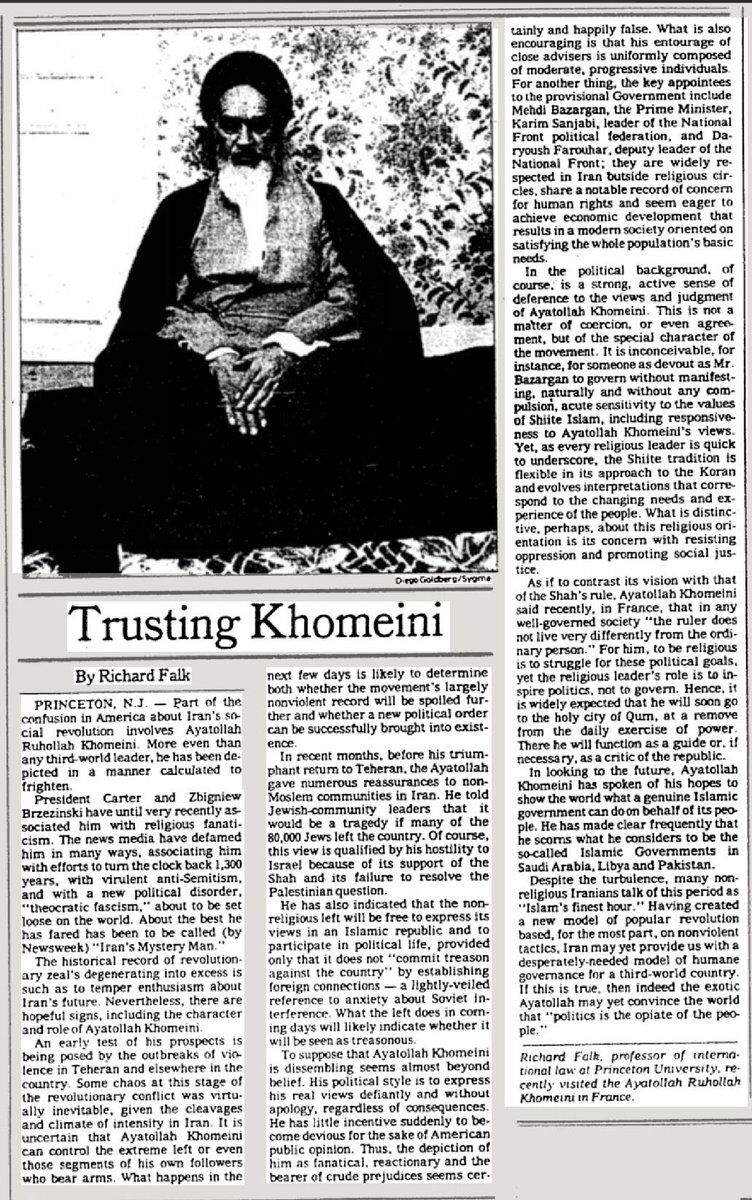
He wrote that “the news media have defamed [Khomeini] in many ways, associating him with efforts to turn the clock back 1,300 years, with virulent anti-Semitism.” The media had it right. Falk gave Khomeini cover.
Some other quotes from the op-ed (whose author was appointed by @UN @Refugees in 2008 as "Special Rapporteur on the situation of human rights in the Palestinian territories"): - "The news media have defamed [Ayatollah Khomeini] in many ways, associating him with efforts to turn the clock back 1,300 years, with virulent anti‐Semitism." - "More even than any third‐world leader, he has been depicted in a manner calculated to frighten." "[Khomeini] has also indicated that the nonreligious left will be free to express its views in an Islamic republic." - "To suppose that Ayatollah Khomeini is dissembling seems almost beyond belief." - "What is also encouraging is that his entourage of close advisers is uniformly composed of moderate, progressive individuals" who "share a notable record of concern for human rights and seem eager to achieve economic development that results in a modern society." nytimes.com/1979/02/16/archives/trusting-khomeini.html
The full thread pulls out more. Falk described Khomeini’s key appointees as people who “share a notable record of concern for human rights and seem eager to achieve economic development that results in a modern society.” Falk later revealed that the NYT’s Opinion Page editor solicited the piece, acknowledging the paper’s own Khomeini coverage was inadequate. The editor titled it “Trusting Khomeini” without consulting Falk. The content earned the title.
The Expert Who Read the Book
While Falk was writing glowing op-eds, Bernard Lewis was doing actual research. The British-American historian, also at Princeton, had his assistant find Khomeini’s own book, “Islamic Government,” sitting in the Princeton University Library. It contained his 1970 lectures from Najaf, calling for “armed jihad” and claiming Jews were “seeking to rule over the entire planet.”
Lewis shared his findings with the Washington Post. The CIA hadn’t seriously engaged with the book.
Henry Precht, head of the State Department’s Iran desk, called the book “a forgery” and rejected Lewis’s conclusions. US Ambassador William Sullivan cabled home envisioning Khomeini taking a “Gandhi-like role.”
The deception appears deliberate. Khomeini’s advisers had explicitly coached him to refrain from attacking the US or criticizing women’s rights. They sent Ibrahim Yazdi, an American citizen who would later become foreign minister, to cultivate sympathetic officials and academics in Washington.
Bernard Lewis read the book. The CIA didn’t know it existed. The State Department called it a forgery. That’s the pattern: the evidence sits in plain sight, and the establishment buries anyone who points at it.
Foucault Wasn’t Duped
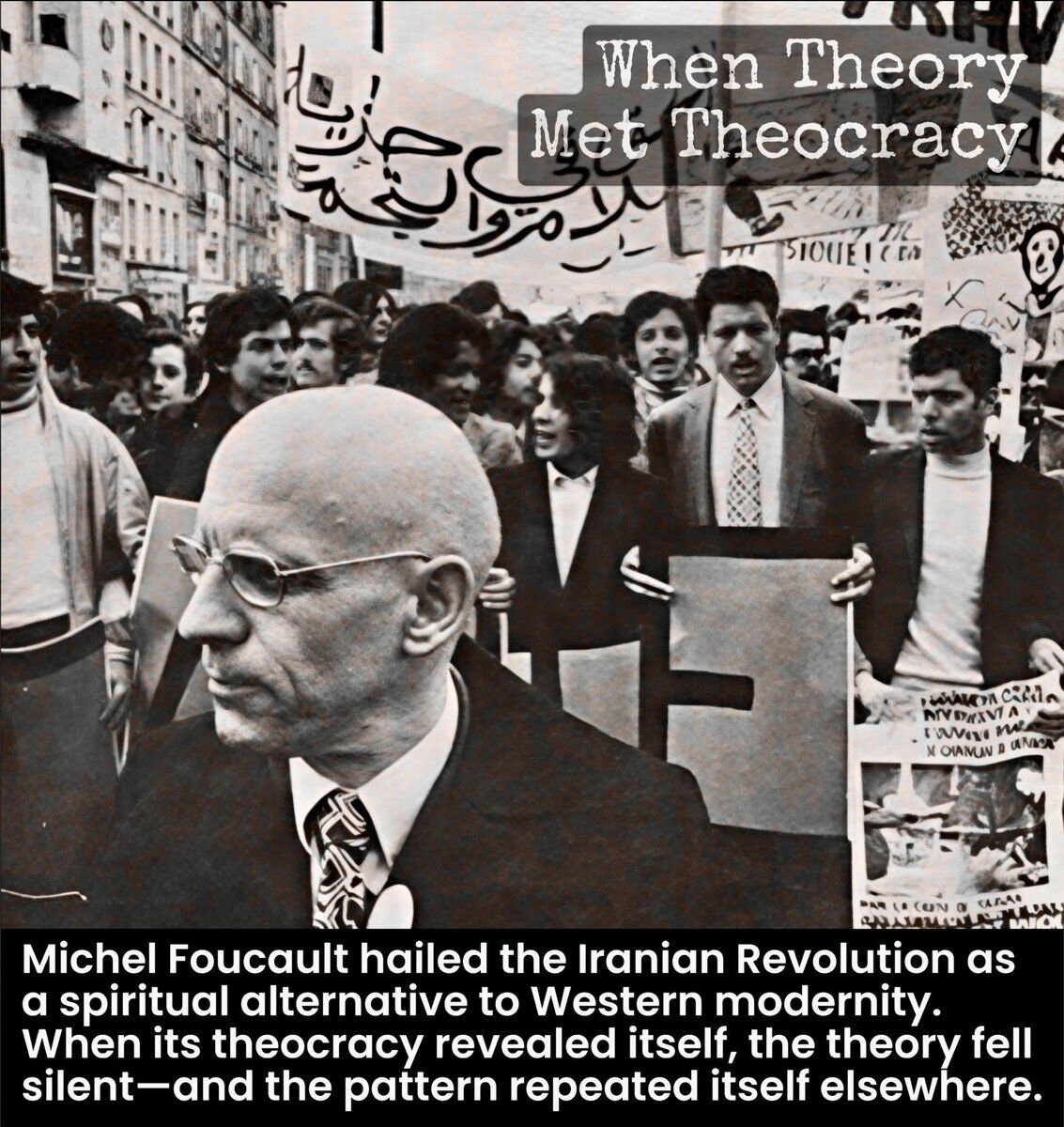
Michel Foucault wasn’t deceived by any charm offensive. He was electrified.
The French philosopher visited Iran twice in 1978 and wrote eight reports for Corriere della Sera praising the revolution as a “spiritual alternative to Western modernity.” When the theocracy established itself, Foucault never gave an explicit answer to the criticisms. Janet Afary and Kevin Anderson’s 2005 book argued he was aware of the regime’s homophobia and misogyny and chose to minimize it.
Foucault’s own framework trapped him. If Western rationality, medicine, schools, and prisons are all tools of oppression, then anything that opposes Western modernity looks like resistance. Radical Islam fusing theology with politics against the West? That’s not theocracy. That’s liberation.
You can’t see the cage when your theory tells you the cage is somewhere else.

Foucault, grandfather of Woke, travelled to Iran during the revolution to take inspiration. He was electrified by how radical Islam fused theology with politics into explosive 'political spirituality' against Western modernity. This was the original Red-Green alliance. We’re watching the exact same pattern re-emerge today. Be warned.

In Feb. 1979, the @nytimes ran “Trusting Khomeini,” an op-ed from a @Princeton “expert” who opined: “Having created a new model of popular revolution based, for the most part, on nonviolent tactics, Iran may yet provide us with a desperately-needed model of humane governance. …
Beff Jezos calls this the original Red-Green alliance: the fusion of radical left theory with Islamist politics that first took shape in 1979. He’s right that we’re watching the exact same pattern re-emerge.
The Same Pattern, Different Century
The 1930s had the same structure. Walter Duranty won a Pulitzer Prize for his New York Times coverage of Stalin’s Soviet Union while suppressing the Ukrainian famine. The Times now disavows his work but has never returned the Pulitzer.
Any ideology that names Western modernity as the supreme enemy will eventually romanticize the enemies of Western modernity, no matter what those enemies do to women, gay people, or religious minorities.
After October 7, the pattern came back to American campuses. Georgetown’s Jonathan Brown, holder of the Saudi-funded Alwaleed bin Talal Chair in Islamic Civilization, called Israel a “genocidal state.” Columbia professors Bruno Bosteels and Timothy Mitchell signed a letter framing the massacre as “an occupied people exercising a right to resist.” Fergie Chambers, a Cox family heir, called Hamas “an indigenous anti-colonial resistance group.” The same framing Falk used for Khomeini’s revolution. The vocabulary barely changed in 45 years.
This is what I mean when I say good-person status on the left has become structurally tied to supporting bad actors. The social cost of calling it out is prohibitive. Researchers Forest Romm and Kevin Waldman surveyed 1,452 students at Northwestern and the University of Michigan and found that 88% admitted pretending to hold more progressive views to succeed socially or academically. In a ten-person seminar, that’s nine students afraid to say what they actually think.
He Never Recanted
In 2004, Falk said the US government was complicit in the 9/11 attacks. UN Secretary-General Ban Ki-moon publicly rebuked him. In 2008, the UN appointed him Special Rapporteur on Palestinian territories anyway.
The UK government condemned Falk’s statements as anti-semitic three separate times: in 2011 for sharing a cartoon depicting a dog in a Jewish skullcap, in 2012 for endorsing an antisemitic book, and in 2013 for blaming the Boston Marathon bombings on “American global domination” and “Tel Aviv.” WikiLeaks cables revealed even the PLO secretly tried to get him removed.
In June 2020, Falk published reflections on meeting Khomeini. He described being “deeply impressed by Ayatollah Khomeini’s keenness of mind and clarity of vision.” He rationalized the regime’s authoritarianism as necessary because it faced “serious, credible, and continuous threat.”
Hundreds executed in the revolution’s first year. Torture reintroduced. Women forced under the veil. Gay men hanged from cranes. One of the great de-westernizing achievements of the last 75 years.
In November 2025, at age 95, Falk was detained and questioned at the Canadian border.
Khomeini told the world he was lying. He called it “khod'eh”: tricking your enemy into misjudging your true position. The man Falk trusted told the world he was lying. Falk still trusted him. This wasn’t a one-time mistake. It’s a persistent, ongoing orientation.
Institutions that reward Richard Falk and ignore Bernard Lewis will keep producing Richard Falks. The antidote is what Lewis demonstrated in 1979: read the primary sources. Read what they actually wrote, not what a Princeton professor assured you they meant.
When someone tells you who they are, believe them.
Related Links
-
Trusting Khomeini (1979 NYT Op-Ed) (New York Times)
-
Iran's First Charm Offensive (Algemeiner)
-
Revisiting Meeting Ayatollah Khomeini in January, 1979 (Richard Falk)
-
Ajit Pai's thread on the Falk op-ed (@AjitPai)
-
UN Watch on Richard Falk's tenure (UN Watch)