Study Says 88% of Students at Elite Schools Are Lying About What They Believe
A new study of 1,452 students at Northwestern and the University of Michigan finds that 88% hide their real views on politics and social issues, faking progressive beliefs to get by.
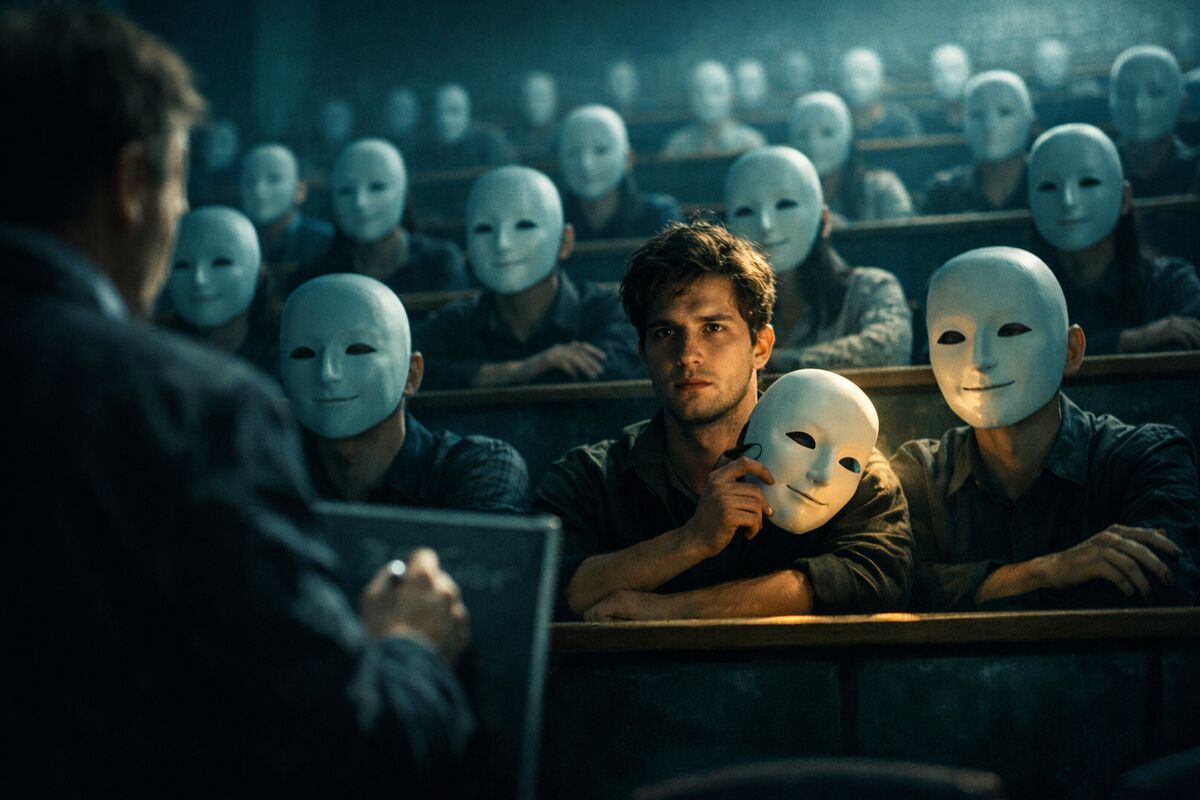
TL;DR
New research finds 88% of college students fake more progressive views than they hold—submitting dishonest classwork, lying to friends, even hiding beliefs from partners. This isn’t peer pressure. It’s identity regulation at scale.
When self-abandonment for fear of ideological fallout is the norm, you can’t even have a conversation about how to make systems better.
The numbers from a new study by researchers Forest Romm and Kevin Waldman are staggering.
The survey, conducted in late 2024 at Northwestern and the University of Michigan, asked 1,452 students about their political views and whether they felt pressure to conceal them in class and social situations. It’s not a random sample of all U.S. colleges, but it’s a detailed look at two elite campuses.
The Numbers Are Staggering
Between 2023 and 2025, researchers conducted 1,452 confidential interviews with undergraduates at Northwestern University and the University of Michigan. They asked a simple question: Have you ever pretended to hold more progressive views than you truly endorse to succeed socially or academically?
An astounding 88 percent said yes.
This wasn’t anonymous surveys where people check boxes and move on. These were confidential, one-on-one interviews where students admitted what they’d never say aloud in a classroom, a dining hall, or a dorm room. More than 80 percent said they had submitted classwork that misrepresented their views in order to align with professors. Think about that: the majority of students are lying in their own academic work just to get by.
The Gap Between Public and Private
The researchers used gender discourse as a test case—highly visible, ideologically loaded. In public, students echoed expected progressive narratives. In private? Their views were dramatically different.
The self-censorship cuts across topics: 78 percent of students censor themselves on gender identity beliefs. 72 percent on politics. 68 percent on family values. What looks like campus consensus is actually performative. The real views are hidden behind a wall of fear.
It Poisons Everything
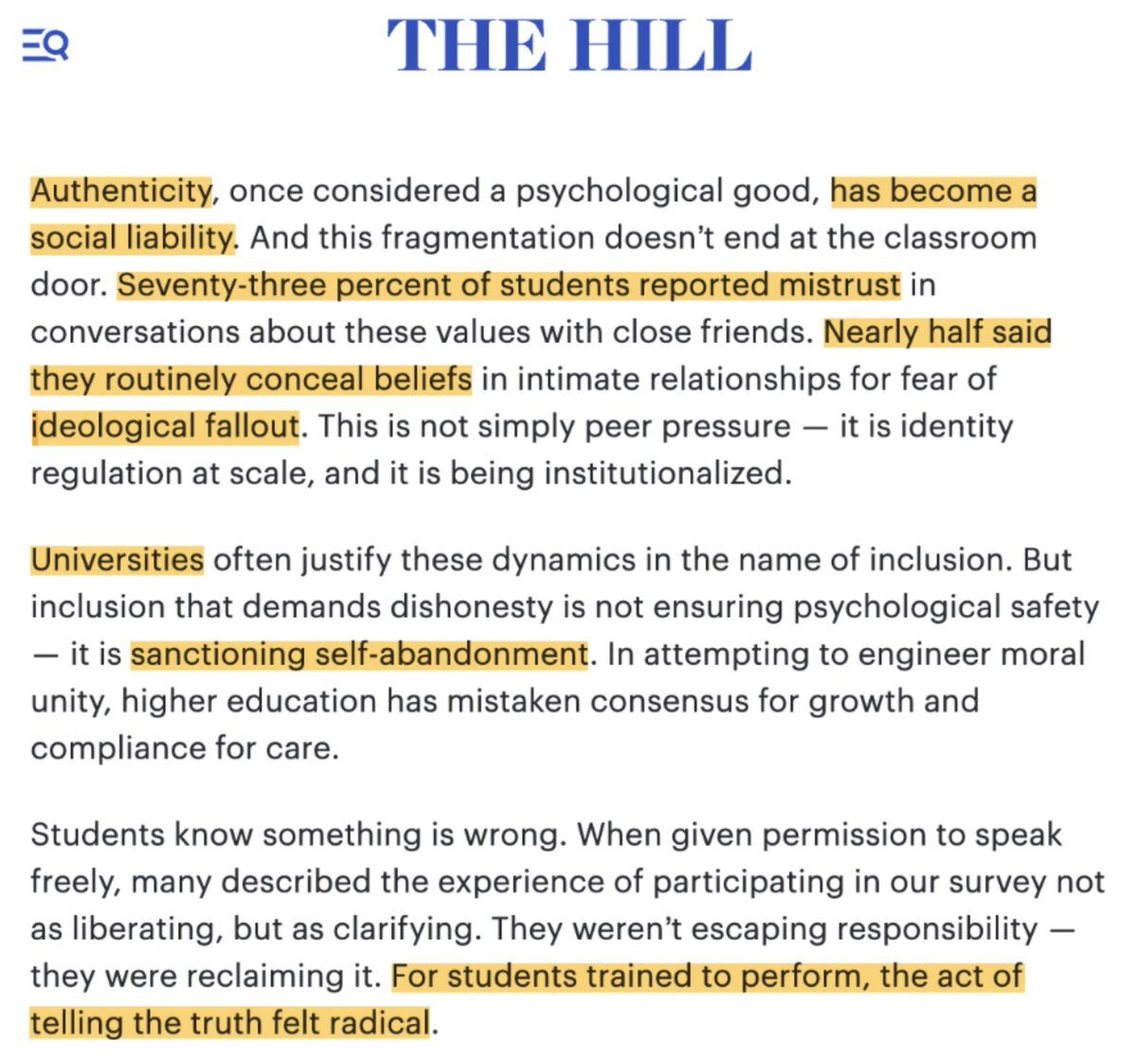
The fragmentation doesn’t end at the classroom door. 73 percent of students reported mistrust in conversations about these values with close friends. Nearly half routinely conceal beliefs in intimate relationships for fear of ideological fallout.
Authenticity, once considered a psychological good, has become a social liability. These students can’t be themselves anywhere—not in class, not with friends, not even with romantic partners. They’re fragmented, performing a version of themselves that isn’t real, because the cost of honesty feels too high.
You Can’t Improve Systems You Can’t Criticize
Universities often justify these dynamics in the name of inclusion. But inclusion that demands dishonesty is not ensuring psychological safety—it is sanctioning self-abandonment. In attempting to engineer moral unity, higher education has mistaken consensus for growth and compliance for care.
The researchers ask the central question: “What happens to identity formation when belief is replaced by adherence to orthodoxy?” We’re finding out. You get students who can’t think for themselves, who perform rather than learn, who submit to groupthink rather than develop genuine convictions.
When given permission to speak freely, students described the experience not as liberating, but as clarifying. They weren’t escaping responsibility—they were reclaiming it. For students trained to perform, the act of telling the truth felt radical.
That’s the path forward: re-center truth over consensus. Give students back what’s been taken from them—the right to believe, and the space to become.
Universities that can’t do this are failing at the core job of education. Instead, they’re running ideological compliance training.
Related Links
-
Faking Wokeness to Fit In - Study Summary (Steve Stewart-Williams)
-
Garry Tan on ideological conformity (@garrytan)
-
Garry Tan on free inquiry in academia (@garrytan)
Comments (0)
Sign in to join the conversation.