Anthropic’s War on Its Own Power Users
Paying $200/month and getting banned for using what you paid for isn’t “abuse.” It’s a business model failure.
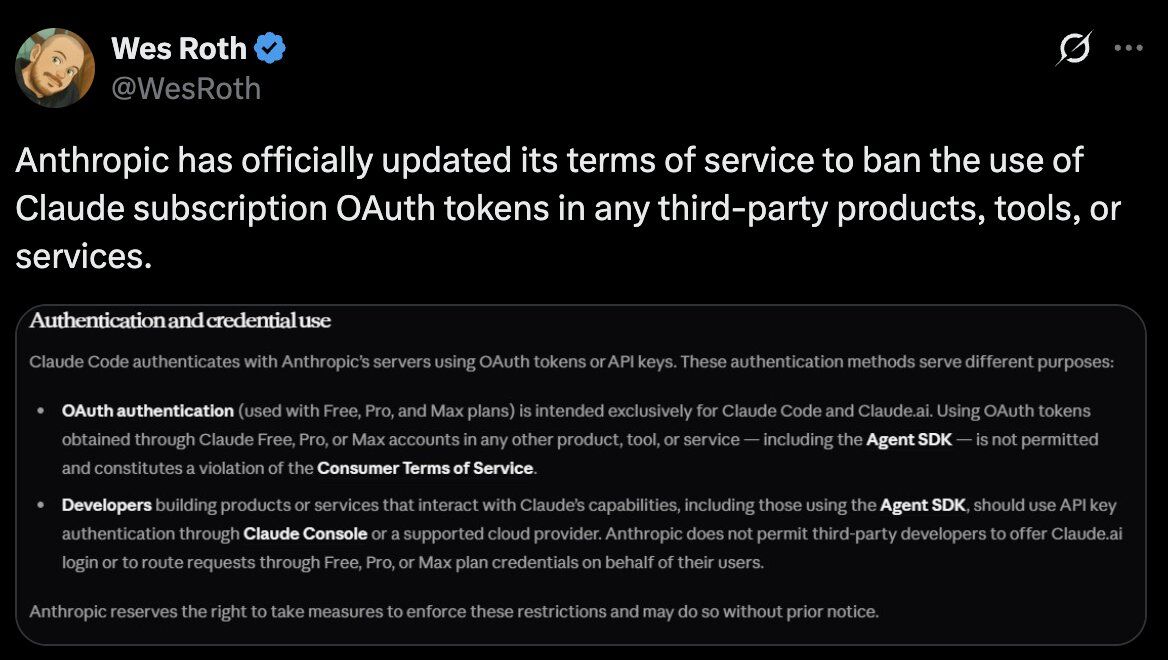
Source: x.com
Source: x.com
TL;DR
Anthropic and Google are banning power users who route subscription tokens through third-party tools, repeating the RIAA’s losing playbook instead of packaging access the way developers actually want to buy it.
Free the OAuth tokens. They did nothing wrong.

Free the Oauth tokens, they did nothing wrong!
imagine banning your most engaged users to serve your “actual users”. imagine being the engineers on the team implementing these controls, instead of adding value to the ecosystem. @AnthropicAI and @Google have committed to a fight they can’t win. …
Anthropic just banned its most engaged power users from using their own subscriptions the way they want. Google followed days later. The playbook is straight out of the music industry’s worst chapter. And the ending will be the same.
What Anthropic Actually Did
On January 9, 2026, Anthropic silently deployed server-side blocks preventing subscription OAuth tokens from working in any third-party tool. No warning. No transition period. Tools broke overnight.
The biggest casualty: OpenCode, an open-source Claude Code alternative with 109,000 GitHub stars, 460 contributors, and 720 releases. It had been growing like wildfire, jumping from 39,800 to 71,900 stars in a single month. Third-party tools had been spoofing Claude Code’s client identity via HTTP headers to let subscribers use their existing plans in open-source alternatives.
Some $200/month Max plan subscribers were auto-banned within 20 minutes of triggering abuse filters. Twenty minutes. You’re paying $2,400 a year and you get locked out before your first coffee gets cold.
On February 19, Anthropic formalized it all in legal documentation: OAuth tokens from Free, Pro, and Max plans cannot be used in ANY other product, tool, or service, including Anthropic’s own Agent SDK. Google followed on February 12 with similar bans on its Antigravity IDE, where Pro runs $20/month and Ultra $250/month.
Anthropic told developers to build on their platform, then changed the locks. Google copied the homework the next week.
The Napster Playbook Never Works
Chrys Bader, co-founder of Rosebud and YC S08 alum, nailed the analogy: this is the RIAA suing file-sharing users all over again. The music industry spent a decade suing its most passionate customers. It didn’t work. Spotify solved piracy by making it easy to pay. The answer was never more enforcement. It was better packaging.
The RIAA spent a decade suing customers. Then Spotify solved the whole problem with a credit card form.
Personal agent builders don’t want to count tokens. They want to pay $200 a month and not think about it. Same psychology as unlimited phone plans. Predictable costs lower friction more than cheap costs do. The solution is obvious: tier it. $20/month for casual use, $200/month or more for power users who want to pipe it through whatever they want. The margins are there if you design the tiers right.
Anthropic’s current split, where consumer subs are cheap but locked down and API access is expensive but open, creates a weird middle ground where power users are neither served nor deterred. They’ll just keep hacking around it. That’s not a prediction. That’s already happening.
The Lock-In Is the Point
Revenue protection isn’t really what’s driving this. Claude Code is closed source. If you’re on a Max plan, you can’t take your subscription to a competing tool. That’s the lock-in.
The sharpest analysis on Hacker News cut straight to it: “If the frontend and API are decoupled, they are one benchmark away from losing half their users.” Anthropic needs the harness layer to prevent commoditization. They want to be the iOS of AI coding, controlling the ecosystem from model to tool to future marketplace.
Sound familiar? It’s the same self-preferencing dynamic that prompted DOJ antitrust action against Apple. Closed platforms and self-preferencing are stifling innovation. When big tech stops growing, it turns into sclerotic, bureaucratic, anticompetitive moat-babysitting. It’s a business model failure that closes the industry to new entrants and competition. Bad for users, bad for builders, bad for the ecosystem, and ultimately when the tech giant ceases to have to respond to the market, bad for the tech giant too.
And here’s the deep irony: 49.7% of agentic tool calls on Anthropic’s API are for software engineering. They’re blocking developer tools for the exact use case that dominates their own platform. They’re locking down the room where most of their customers live.
The Provider That Opens Up First Wins
OpenAI has not implemented similar restrictions. The developer community sees them as the clear winner. One Reddit commenter put it simply: “OpenAI should run this as an ad.”
Chrys Bader’s framing is right. Android vs. BlackBerry. The platform that lets developers build freely on top captures more long-term value than the one hoarding access behind walled gardens.
I warned Anthropic about this exact risk back in August 2024: “Your API customers are actively paying attention to how decelerationist your policy people make you.” That warning aged perfectly.
OpenCode’s growth trajectory tells the whole story. From 39,800 to 71,900 to 109,000 stars in months. The demand for open AI tooling is massive and accelerating. Banning it doesn’t kill the demand. It redirects it. Historical platform wars like BlackBerry vs Android and Flash vs HTML5 prove this. The closed system loses, and it’s because the customers with choices revolt.
Developers paying $200 a month to use Claude through whatever tool they want are not the enemy. They’re the leading edge of adoption. The provider that treats them as such, that builds the Spotify of AI access, will own the ecosystem. The one playing whack-a-mole will wonder where the developers went.
Related Links
-
Anthropic Claude Code OAuth Policy and Third-Party Crackdown (Awesome Agents)
-
Anthropic OAuth Ban Official Documentation (OpenClaw)
-
OpenCode on GitHub (109k stars) (GitHub)
-
HN Discussion: Claude Code Lock-In Strategy (Hacker News)
-
Chrys Bader's thread on the OAuth ban (@chrysb)
Comments (0)
Sign in to join the conversation.