Your Favorite Neighborhood? It’s Illegal Now.
We didn’t stumble into the housing crisis—we legislated it. The cities we love would be banned under today’s rules.
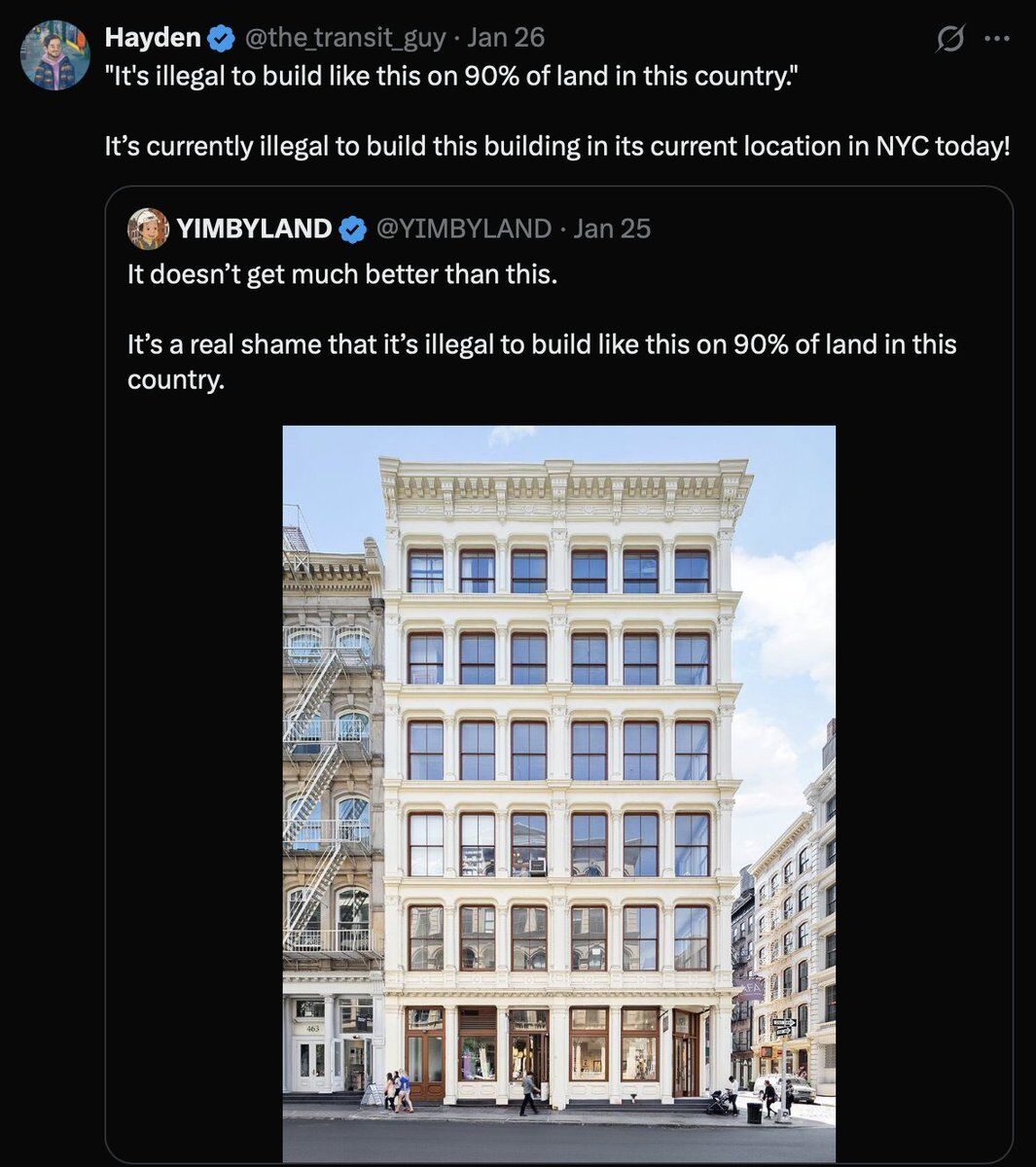
Source: x.com
Source: x.com
TL;DR
Every charming neighborhood you love—the brownstones, corner shops, mixed-use buildings—would be illegal to build today. And 99% of voters have no idea we did this to ourselves.
Every charming neighborhood you love? Illegal. Those classic brownstones, corner shops, mixed-use buildings that make cities livable? We banned them. And 99% of voters have no idea.
Archived tweetWe have vandalized the future of our cities by strangling development through zoning rules and building codes. Cities we love today, and the ways we live in them, would be illegal to rebuild as-is. 99% of voters don’t understand this.
Gianmatteo Costanza @emissionite January 27, 2026
We Made Our Best Cities Illegal
Here’s the paradox that should infuriate you: the buildings that make neighborhoods worth living in are the same buildings we’ve made impossible to build. That classic NYC building in the image? It would be illegal to construct in its current location today. Not in some far-flung suburb—in New York City itself.
Zoning rules and building codes have “vandalized the future of our cities.” 90% of land in this country now bans the kind of walkable, mixed-use construction that created every beloved urban neighborhood. The corner café, the apartment above the shop, the townhouse that grew organically with the city—all outlawed. We turned our best ideas into contraband.
The 50-Year Kneecapping
This wasn’t an accident. We started kneecapping our cities 50 years ago when we massively downzoned vast areas and embarked on what @emissionite calls a “mindless obsession to preserve, protect, prevent change.”
Here’s the damning part: they knew what they were doing. The 1977 SF downzoning environmental review projected it would lead to a loss of 180,000 housing units, higher rents and prices, and adverse environmental impacts from greater commutes. They did it anyway.
The result? “Growth control” in the 1980s worked exactly as designed, and now 2BR apartments average $4,700/mo in San Francisco. No, tech didn’t do this. The NIMBY “growth control” wackos did this to us—and they’re still in charge.
The Perfection Trap
Building codes now mandate “fantastical standards without cost-benefit analysis,” increasing the base cost of construction and leaving little room for quality materials.
Here’s the hypocrisy baked into the system: 99.9% of existing homes would fail a long list of standards we now demand of new housing. And yet, they remain fully occupied by people who seem perfectly unconcerned about these “deficiencies.” Only NEW housing must be flawless, future-proof, and “morally pure.” Existing homeowners get to relax comfortably in buildings that would never be approved today while blocking everything else.
It’s like rookie programmers who never test their code until the very end—our regulations are “perfect” only in theory, not in practice. See Palisades in LA for how that works out.
Democracy’s Broken for Housing
Our democracy is fundamentally broken when it comes to housing because local control does not give political power to the victims of housing mismanagement. Think about who gets to vote on housing decisions: current homeowners who benefit from scarcity.
Who doesn’t get a voice? Displaced former residents forced out by high rents. Newcomers unfamiliar with Byzantine permitting rules. Prospective residents deterred from even trying to move here. The people paying the price for housing mismanagement have no seat at the table.
Markets Build, Government Bureaucracy Burns Money
As a fervent YIMBY, I want free-market housing to be built. Government can supplement, but it will always be a drop in the bucket and is consistently inefficient at building homes.
When money is “granted” rather than earned, incentives shift toward process compliance over cost control, speed, and material quality. Private builders are forced to optimize because their survival depends on it. Grant-funded construction lacks that same financial discipline.
Actual developers confirm it: “I cannot emphasize just how much regulation and a web of arbitrary and overly complicated bureaucracy increase the cost of housing.”
We didn’t stumble into this housing crisis—we legislated it. For 50 years we’ve treated cities like museums instead of living systems. The result? Your kids can’t afford to live where they grew up. Your employees spend hours commuting. Your favorite neighborhoods are frozen in amber while demand skyrockets. The fix isn’t complicated: legalize the cities that worked. Let builders build what people actually want. Stop demanding that new homes meet standards your own home would fail. 99% of voters don’t understand this—be the 1% who does.
Follow @garrytan for more.
Take Action
Share this with someone who thinks the housing crisis is inevitable
Related Links
-
Original thread on zoning vandalism (@emissionite)
-
1977 SF downzoning environmental review predictions (@arpitrage)
-
Growth control and $4,700 rents (@garrytan)
-
Developer on regulation costs (@DPOURBABA)
Comments (0)
Sign in to join the conversation.