When Liberalism Didn’t Say No to Racism
When illiberal ideas dressed up as progress demanded that equal rules are unjust, liberals had no answer. Now we do.
Source: x.com
Source: x.com
TL;DR
The liberal project failed because its defenders stopped believing in it. When asked why the individual should remain the basic unit of moral concern, they lacked the ability to say ‘No.’ But we can say it now.
When illiberal ideas arrived dressed in progressive clothing—demanding that “formally equal rules which reliably produce unequal outcomes are themselves unjust"—liberals had no answer. They lacked the ability to say no.
We should have had an answer then. We can have an answer now.
How this presented in San Francisco
The algebra ban is the cleanest example. The SF school board didn’t claim algebra was being taught badly; they claimed that because fewer Black and Latino kids made it into advanced math, the existence of advanced math itself was the problem. In their logic: equal access to 8th grade algebra plus unequal group outcomes equaled “algebra is racist.”
Liberals couldn’t intially push back because the claim was wrapped in the language of justice. To defend algebra, you had to say out loud: unequal outcomes by themselves do not prove injustice. That sentence had become unsayable in polite liberal spaces.
Lowell followed the same script. The merit-based admissions test produced a student body the board didn’t like demographically, so they scrapped the test. The move wasn’t “let’s fix K–8 so more kids are ready,” it was “smash the measuring stick that reveals the gap.”
What we did in SF, supporting the school board recall and backing candidates willing to say the unsayable, was the missing response. It was the willingness to say: equal rules are not inherently unjust, unequal outcomes often reflect unequal preparation and support, and tearing down excellence to hit a spreadsheet target is a betrayal of the very kids you claim to fight for.
The Fox That Walked Through the Front Door
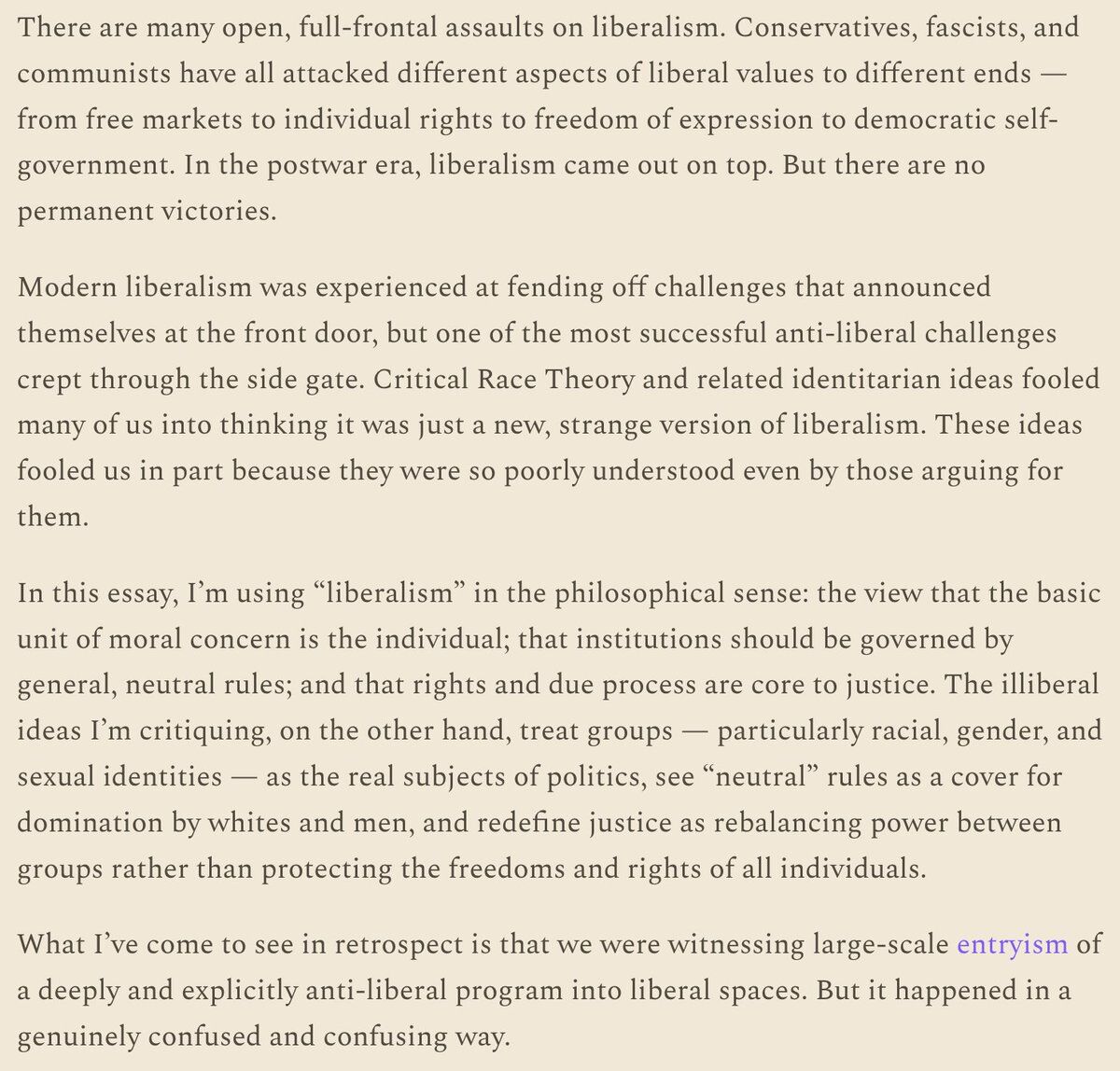
Matthew Yglesias makes a rare admission in The Argument: "There are no permanent victories.” Liberals assumed the big questions were settled. They weren’t.
The gate was wide open because liberals couldn’t articulate why individual rights matter. Around 2010-2015, concepts like “microaggressions” and “systemic racism” entered through viral digital content, presented as natural next steps from “racism is bad.” As Yglesias explains in the interview, these ideas were “a copy of a copy of a Tumblr post"—even advocates didn’t understand them, which made them harder to critique.
Anti-Racism Was Always Racism
Yglesias argues liberalism "degenerated” into something illiberal. I think anti-racism never stopped being racism. It just changed the target.
Yglesias defines the shift clearly: illiberal ideas “treat groups as the real subjects of politics, see neutral rules as a cover for domination, and redefine justice as rebalancing power between groups.” But this isn’t a deviation—it’s racism wearing new clothes.
Kendi’s idea of racism says: don’t focus on whether one person treats another person unfairly, focus on whether groups end up with different results. To do that, you have to treat groups (like races) as fixed, primary buckets that matter more than the individual person.
As Yglesias puts it: the Kendi schema “only makes sense if you’re totally abandoning liberal individual constitutionalism.” It’s not an extension of liberalism. It’s a replacement. So this isn’t a tweak to classic liberalism that protects individuals. It’s a different system that puts groups first instead.
We worked hard to eliminate racist thinking in America. Then it came roaring back in deeply illiberal form—but we were told it was progress.
When Quoting MLK Became ‘Right-Wing’
Here’s how completely the script flipped. Yglesias observes: “There was this whole period when it was considered the most right-wing thing in the world to quote Martin Luther King on judging people by the content of their character.”
Think about that. The foundational principle of the civil rights movement—judge people as individuals—became suspect.
The mantra “it’s not my job to educate you” made it impossible to challenge novel claims. “Sealioning"—asking probing questions—was reframed as trolling, shutting down intellectual challenge. This is the opposite of how truth-seeking works. It’s how ideologies protect themselves from scrutiny.
Archived tweet@LinLyn99 Once seen it cannot be unseen
Garry Tan @garrytan January 31, 2026
The Vaccine Scandal: When Group Equity Trumped Individual Lives
This isn’t abstract philosophy. Real people were hurt.
During COVID vaccine rollout, the advisory committee on immunization practices suggested deprioritizing the elderly—the people most likely to die—because the elderly population is disproportionately white. Let that sink in.
Black senior citizens would be deprioritized in favor of younger people. Their individual lives put at risk for "racial equity” statistics. Yglesias is blunt: “People have something in common with other people in the same ethnic group… But we’re not literally linked by a metaphysical chain of command.”
Why Group Stereotypes Hurt Everyone—In Both Directions
The fundamental answer for why statistical discrimination is wrong is simple: “It’s really hurtful and it sucks to have negativity placed on you for things that you didn’t do.”
That’s it. That’s the whole argument. And it applies universally.
The same logic that makes racial profiling wrong makes anti-male or anti-white stereotyping wrong. The golden rule applies: “everybody cares a lot when it happens to them.” This is why neutral rules protecting individuals matter—not as a “cover for domination,” but as the only protection against it.
It is true that the overwhelming majority of violent crimes are committed by men. It is also true that the overwhelming majority of men do not commit violent crimes. Judging individual men by the statistical average is wrong—for the exact same reason judging anyone by group averages is wrong.
Rebuilding on Solid Ground
Yglesias says “something we’re going to have to do to rebuild liberalism is to take it seriously in both directions"—the primacy of the individual counts for everyone.
This isn’t about left versus right. This is about whether individuals are the basic unit of moral concern, or groups are.
The answer we should have given is clear: No. Equal rules that produce unequal outcomes are not themselves unjust. Past injustice does not confer present moral debt on innocent individuals. The individual remains the basic unit of moral concern.
To not be judged by the color of our skin but by the content of our character
Liberalism failed not because its principles were wrong, but because its defenders stopped believing in them. When challenged—"Why should formally equal rules matter when they produce unequal outcomes?"—they had no answer. They lacked the ability to say no.
But we can say it now.
The individual is the basic unit of moral concern. Neutral rules are not a cover for domination—they are the only protection against it. Judging people by the content of their character is not a talking point—it’s the foundation of a society where people of different backgrounds can live together.
Anti-racism that judges people by their race is still racism. We worked hard to get rid of that thinking. It came roaring back wearing progressive clothes, but the underlying logic never changed.
Now the tide is going out, and everyone can see what was always there.
Once seen, it cannot be unseen. The question is what we build next.
Follow @garrytan for more.
Related Links
-
The Fox in Liberalism's Henhouse (The Argument)
-
What Went Wrong With Modern Liberalism? (Interview) (The Argument Podcast)
Comments (0)
Sign in to join the conversation.