We Didn’t Leave the Party. It Left Us.
From a re-education camp in China to a citizenship ceremony in San Francisco, my family’s politics have never been about ideology, but about which party keeps its word.
TL;DR
My family fled communist China, then found a home in the Democratic Party. I still believe what they taught me — safety, schools, a fair shot. But the party is growing increasingly unrecognizable.
Last week The Information recently published a profile of me. I had given the reporter another story too, one that explains what I believe about work, prosperity, and why stopping anti-Asian hate is central to who I am. He didn’t find it interesting enough to run. So I’m publishing it here.
My father’s earliest memory is of a tree in a village square in China. He was small, barely old enough to stand. His mother had just seen the home the family had been assigned by the People’s Liberation Army: a shack in the countryside with beds of packed clay, far away from the house they were forced to leave in the city. She set her son, my father, down in the shade of the tree and walked out of the village. No one ever saw her again.
His next memory is his father, my grandfather, crossing that same square, going woman to woman—all of them strangers—asking whether any of them would nurse his son.
My grandfather was a member of China’s intelligentsia, the thin top layer of a civilization that had honored scholars for two thousand years and had recently decided to stop. He had a nice townhouse in the provincial capital, a wife, two sons, a daughter, and another child coming. Then the Cultural Revolution turned the world upside down, and the men at the top of the old order were sent to the bottom of the new one. My grandfather was ordered to leave the capital and farm goats. He complied. He was an orderly and reasonable man, which in that country, in those years, was its own kind of sentence.
His two elder sons grew into simple, brutish men and joined the People’s Liberation Army as soon as they came of age. My father was a bookish child, and my grandfather saw it. So he taught him in secret, by candlelight, from texts he had smuggled out of his old life. In those years neighbors informed on neighbors and children denounced their parents, and the state called it virtue. My father’s brothers, jealous of the attention, reported their own father.
The regime imprisoned my grandfather in a re-education camp. Starved and kept from sleep, he was ordered to memorize Mao’s Little Red Book, page by page. For every page he could not recite, a guard put a brick to his face. A man who had spent his life on books, tortured by the act of memorization. One day a guard swung too hard and killed him. My grandfather was beaten to death over a page of the Little Red Book.
When the news reached the family, my father’s sister took her own life.
My father buried his sister in the same season he buried his father. He had been motherless since the tree. Every woman he loved was taken from him, and he came out of it believing that women are the most precious thing on this earth. And somewhere in that grief he understood that there was no life for him in that country, and he began looking for the way out.
He was the first in his entire prefecture to reach university, but under the regime you weren’t allowed to choose what you studied. The state assigned him chemistry. The university sat beside a smaller college and they shared one library. My mother was a student at the smaller school. She was in that library late one night near closing, and my father was there in his lab coat. She thought the coat was interesting. He thought she was worth staying for. The librarians turned them out at the same hour, the last two to leave, and when they stepped outside it had begun to rain. My father took off the lab coat, put it over her shoulders, and walked her to her dormitory. Every woman he had loved had been taken from him. She would be the first who stayed.
After he graduated, the state put him in a laboratory and handed him American toys and machines and told him to take them apart and learn how they were built. He was sent to another province to study material science, which involved learning English. At the end of the English course the teacher told him something my father never let go of. In America, he said, when a textbook reaches its tenth edition, they throw the ninth away. The idea of a whole edition of knowledge being discarded because a newer one exists, even as he was unable to read anything at all in China, struck him. “I am going back”, the teacher told his class, “and I am going to gather the books they throw out and send them to you.”
By the time he left, tens of millions had starved in the Great Leap Forward, more still in the Cultural Revolution, with parallel numbers in Russia and in every other country that insisted that you could draw a perfect and equal society on paper and then force living people to fit the drawing. My father didn’t wait to be asked to help build the new China. He walked to the teacher’s dormitory, knocked, and said, “you will need a secretary”. That was his whole application. What they built was called Bridge to Asia, and it did exactly what the teacher had promised. It took the books America was finished with and carried them by the million to schools that had none, first in China, then Vietnam, then Cambodia. A country that couldn’t print its own textbooks was suddenly helping supply them across Asia. When I was twelve, I asked my father whether I’d be expected to run the organization one day. He told me “the mark of a good grassroots organization is that it’s built to end, it solves the problem it was made for, and then it closes the door.” I’ve thought about that sentence often since, living in a city full of organizations that forgot the problem and kept the payroll.
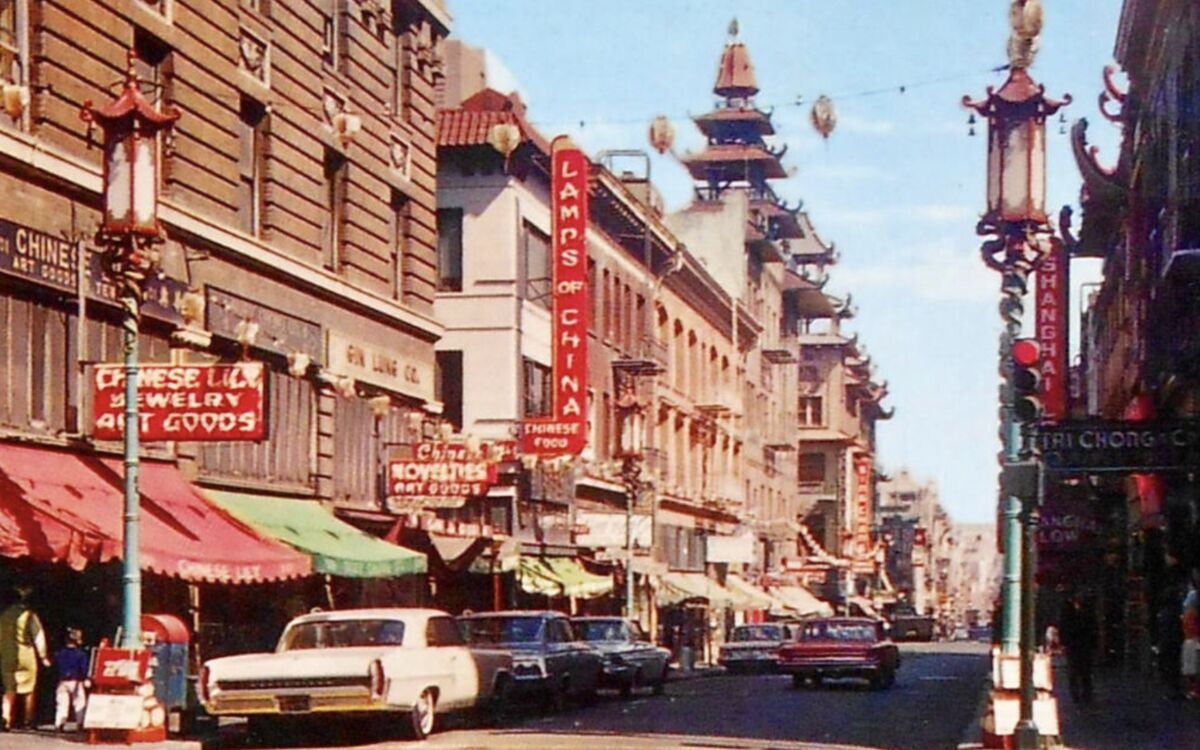
My parents became Americans in a small federal office in San Francisco. You raise your hand, you pledge, you answer the questions, and at the end they take your Chinese passport and hand back nothing but the fact of citizenship. My parents were overjoyed. They had crossed an ocean for this moment. Outside the door a young volunteer had set up a folding table, and to each new citizen coming out he made his pitch: join the Democratic Party, the party of people like you, immigrants, working families, people of color, the ones this country was supposed to be for. My parents signed that day. At our dinner table, growing up, the Democratic Party was the party of the striving newcomer and the Republican Party was the party of inherited money and the closed door.
That belief was first put to the test in 2008. My mother was for Hillary Clinton; she has always held that women make the better leaders, and she wanted to see one lead. My father disagreed. He liked the young Black senator from Illinois. When Obama won the nomination, my father said there was no way the country would elect him — that in all his years here, the office had gone only to wealthy white men — but at least, he said, Obama had gotten this far. That November, the country elected its first president of color. My father took it as proof of the promise made to him outside that federal building: that this party really was for people like our family. Obama was the first president I ever voted for.
We are living through the largest departure of Asian Americans from the Democratic Party in our nation’s history. But it isn’t because we’ve changed; it’s because the Party has moved away from our core beliefs. My father didn’t wake up one morning as a different man. He holds every belief he signed up for when joining this Party. He went on to earn a doctorate at Berkeley, and he believes in schools the way only someone once kept from them can. He believes in safety because he knows precisely what a state is capable of when it stops protecting its people. He believes a person should be able to come here, work, and leave his children more than he was given. Safety, schools, prosperity. None of that has changed for my family, we’re still Democrats. But what moved, for many people like him, was a sense that the party had drifted from those commitments.
Our belief in an economy that builds things, that rewards effort and risk, that lets a family climb, is not a slogan to me. It is the only thing that ever redeemed what my family lost, fleeing a system that had already tried the alternative. And anti-Asian hate is not a separate issue from it. It is the same wager under attack, the same message my father heard in that village, that people like us are disposable, that our striving is suspect, that we should sit down and accept the life we were assigned.
In San Francisco, the people most nostalgic for Communism are always the ones whose families never had to live inside it, and for some reason the people who fled it are the ones forever being told they have misunderstood their own history. California has decided that the doctrine matters more than the family it was written to serve. That is how a city spends fortunes on its own righteousness while the people it governs grow poorer, less safe, and less able to build a life.
My father’s earliest memory is a tree in a village square. He crossed an ocean so that mine could be unremarkable, and chose a country that would keep its word. Whether it keeps that word for the next family remains completely in our hands as Democrats. And the day the Democratic Party remembers that it was built for immigrants, working families, people of color, for safety and schools and the plain chance to build a life and hand it down, is the day we come home.
Comments (0)
Sign in to join the conversation.