This November, Follow the Union Money
California’s biggest political spenders are public-sector unions. Here’s where the money goes.
TL;DR
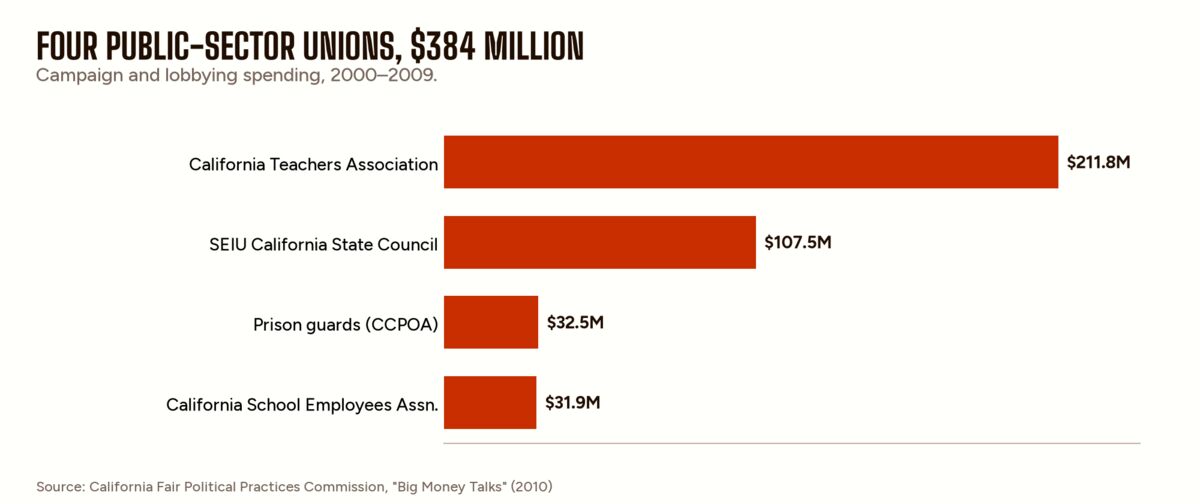
When the state’s ethics watchdog last totaled who spends the most to shape California politics, unions took the top two spots. The California Teachers Association spent $211.8 million in a single decade, and SEIU spent $107.5 million. This November, unions have put more than $80 million into three ballot measures, and two of them decide how much tax money goes to public employees.
The record: unions at the top
The biggest spenders on California campaigns and lobbying are unions.
- CTA and SEIU. The Fair Political Practices Commission’s report “Big Money Talks” tallied spending on campaigns and lobbying from 2000 to 2009. No. 1 was the California Teachers Association, at $211.8 million: $173.3 million to influence voters and $38.5 million to lobby officials. No. 2 was SEIU’s California State Council, at $107.5 million.
- Four unions, $384 million. The prison guards’ union (CCPOA, $32.5 million) and the California School Employees Association ($31.9 million) bring the total to $384 million. All four represent public employees.
- Candidates. SEIU spent $18.8 million on candidates and CTA $16.7 million. CTA also gave $6.5 million to the California Democratic Party.
- What the money protected. CTA’s biggest single expense, $26.4 million, defeated a school voucher measure in 2000. In 2005, CTA spent $12.1 million and SEIU $10 million to defeat Prop. 75, which would have required public employees’ consent before their union dues were spent on politics.
- Public-sector unions represent government workers: teachers (CTA, the California Federation of Teachers), school staff (CSEA), prison guards (CCPOA), firefighters (California Professional Firefighters), and state and county workers (SEIU Locals 1000, 1021 and 721, and AFSCME). Their members are paid with tax dollars, and they negotiate with officials they help elect.
- Private-sector unions bargain with private employers. SEIU-UHW, which wrote Prop. 40, mostly represents workers at hospitals, clinics and dialysis centers. The building trades and Carpenters represent construction workers.
- The critique. Critics argue that public-sector unions sit “on both sides of the table”: they help elect the officials who approve their contracts. A City Journal analysis published by the New York Post found that 10 of the largest California unions with public-sector members collected more than $1 billion in dues and fees in 2024.
- Prop. 3. It would make permanent a tax on the top 2% of earners that voters approved in 2012 as temporary. It brings in up to $15 billion a year, mostly for schools. Its top supporters have given $48.2 million, all of it from public-sector unions: CTA ($33.3 million), the National Education Association ($7.5 million), CSEA ($2.6 million), the California Federation of Teachers ($1.75 million), plus SEIU and AFSCME.
- Prop. 43. It would require two-thirds voter approval for certain local taxes, up from a simple majority. The opposition committee, “sponsored by labor organizations,” is funded by the SEIU State Council ($1.5 million), SEIU Locals 1021 and 721 ($500,000 each), and the firefighters, the Federation of Teachers and AFSCME, among others. Local taxes pay local government workers.
- Prop. 40. The wealth tax is a private-sector union’s project. SEIU-UHW and its committees gave $31.6 million of the $32.1 million from top supporters. The CTA opposes it. The split isn’t over the tax itself. Prop. 40’s money would go to healthcare, and CTA leaders worry it will undercut support for Prop. 3, the teachers’ own tax measure. The fight is over whose members get the money.
Public vs. private unions: why the difference matters
Not all unions are the same, and this November they aren’t on the same side.
This November
Public-sector unions are spending most heavily on measures that decide how much tax money is available to pay their members.
![UNION MONEY ON THE NOVEMBER BALLOT
Contributions from unions among each campaign's top 10 donors, as of Oct. 1, 2026.
Prop. 3 (support) — CTA $33.3M | NEA [additional segments] — $48.2M
Prop. 40 (support) — SEIU-UHW $31.6M — $31.6M
Prop. 43 (opposition) — $3.9M
Source: California Fair Political Practices Commission, top-10 contributor lists](https://dm2nowkhw0ff4.cloudfront.net/uploads/nsz04h6d93ehl87w4byou5ixgzsp)
How they play
The money is only part of it. Ballot measures themselves can be leverage.
- Prop. 40. Two sources told the Los Angeles Times that during June negotiations to pull the measure, SEIU-UHW president Dave Regan asked for union contracts at hospitals in San Diego and Fresno and a clinic in Imperial County. Regan called the claim “categorically false.”
- Prop. 44. Community clinics have sued SEIU-UHW and Regan under federal racketeering law, alleging he offered to drop the union’s clinic spending measure if the clinics helped it organize 25,000 workers. Regan denies the allegations, which have not been proven in court.
- Pensions. This year, police and firefighter unions backed Assembly Bill 1383, which would have lowered their retirement age from 57 to 55. CalPERS estimated it would add hundreds of millions of dollars a year in costs for cities and counties. The Legislature passed it almost unanimously; Newsom vetoed it.
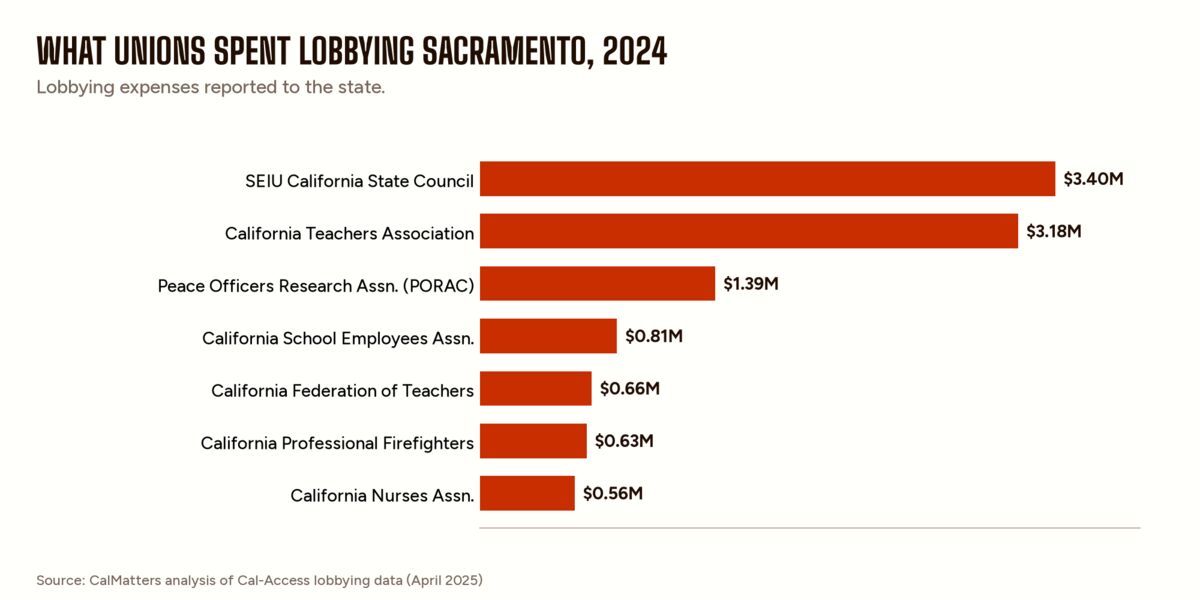
- Lobbying. In 2024, SEIU spent nearly $3.4 million lobbying Sacramento and CTA more than $3.1 million. Both got their way on bills nearly 70% of the time.
Where it stands
Public-sector unions are the biggest players in California politics, and they use that power to protect their members’ share of the budget. This fall, teachers’ unions are spending $42.5 million to make a “temporary” tax permanent. Government-worker unions are fighting a measure that would make local tax hikes harder to pass. Police and firefighter unions got the Legislature to pass, almost unanimously, a pension bill that would have cost cities and counties hundreds of millions of dollars a year, and only a veto stopped it.
That’s the problem with this much union money. When the people across the bargaining table also help elect the officials on the other side, taxpayers don’t get a seat. Before voters hand over more of their money this November, they should know who’s paying to ask for it.