The Fight for the Heart of Palo Alto’s Schools
Advanced classes, ethnic studies, two superintendent exits and a $33 million budget gap: a look at the record ahead of the Nov. 3 school board election.
TL;DR
In two years, Palo Alto Unified has scrapped Honors Biology, made a contested ethnic studies class mandatory over the objections of more than 1,400 parents who petitioned for a pause, and paid $758,289 to see two superintendents out the door. Then, two weeks after voters rejected a parcel tax, the board approved $35.4 million in raises — after its own business chief, according to two former trustees, said the deal would put it in a difficult financial position. Now it faces $33 million in cuts that critics say students will absorb.
What happened to advanced classes?
In a district known for its academic intensity, the menu of advanced classes has been shrinking. Parent Melissa Anderson listed the losses in public comment, from “delaning English, to cutting middle school math pathways and high school multivariable calculus, to most recently, voting to eliminate honors biology.”
- Honors Biology. “Please don’t hold students such as myself back from these wonderful opportunities to challenge ourselves,” an eighth grader told the board. Both student board representatives opposed the change in advisory votes. In January 2025, the board voted 3-2 to merge Honors Biology into regular Biology anyway.
- The advanced diploma. It lasted four months. The district announced one in June 2025, “in response to the board and community interest in more rigorous academic access.” By October it was gone. “There’s no support from the students,” then-Superintendent Don Austin said.
- Multivariable Calculus. Paly math teacher Daniel Nguyen spent $12,000 on a master’s degree so he could teach the class. The board approved it unanimously in December 2025. Weeks later, Paly’s Education Council of administrators and teacher leaders killed it in a private meeting. In an Oct. 3 letter, the council had warned that the course “risks amplifying the already significant pressures on students to do more, faster, at the expense of balance and wellness.” “Just as we do not create an advanced ballet course for the small number of students pursuing dance at a professional level, we should not create MVC simply because a handful of students would like it,” the council wrote. Gunn’s council did the same. “To claim that this will harm students strains credulity,” Nguyen said, noting that neighboring Mountain View-Los Altos already offers it. A March motion by trustees Rowena Chiu and Alison Kamhi to require the course failed 3-2. In April, after more pressure from parents and students, the schools agreed to offer it on campus during the school day. This fall, Nguyen himself is teaching it. Students earn Foothill College credit, so the class isn’t in the district’s own catalog.
The ethnic studies fight
- The vote. The state never required this. The 2021 law requiring ethnic studies only takes effect if the legislature funds it, and it never has. In January 2025, Austin recommended pausing the course. Days later, board leaders Shana Segal and Dharap put it back on the agenda, and on Jan. 23 the board voted 3-2 to make it a required freshman class. Chiu, who voted to pause, said she supported ethnic studies but called the district’s framework “ideological” and “over simplistic,” objecting to its “oppressor/oppressed” framing.
- What’s in it. One unit is titled “Power, Privilege and Systems of Oppression.” The full syllabus was released three weeks after the vote.
- The “brain dump.” The only material posted before the vote, about two days ahead, was a document titled “Curriculum and Sample Lessons.” According to parents who reviewed it, it included a video with the line “oh, white people do have souls. And my friends are like, ‘no, no they don’t.’” Staff later called the document a “brain dump” that wasn’t used to build the course, and Austin said that material was not taught.
- The training materials. More than 1,400 parents signed a petition asking for a pause. Their request to see materials from the UC Berkeley program that trained the district’s teachers was denied under a copyright clause. The program’s director asked parents to “trust the teachers.”
- The lawsuit. In July 2025, a parent and the Louis D. Brandeis Center sued under the state’s open-meetings law, alleging the requirement was adopted without proper notice. Austin called the suit “baseless” and said the vote “occurred in public.”
San Francisco did it first
Palo Alto’s debates are a replay of San Francisco’s, where most of the same changes were tried, and most were reversed.
- Algebra. In 2014, SFUSD moved Algebra 1 out of eighth grade for every student to keep students together longer. A Stanford study later found racial gaps in the most advanced math courses largely unchanged, and families who could afford it paid for algebra outside school. In 2024, more than 80% of San Francisco voters backed a nonbinding ballot measure urging the district to bring it back. This school year, eighth graders can take it again.
- Lowell. The board replaced merit admissions at Lowell High School with a lottery. A judge ruled the change violated state law because the board hadn’t given proper public notice, and in 2022 voters recalled three board members by margins of more than 70%.
- Ethnic studies. SF made ethnic studies a graduation requirement in 2021. Its original curriculum described Mao’s Red Guards as a social justice movement and asked ninth graders what white men should “give up” to achieve equity. Mayor Daniel Lurie criticized it, and the district replaced it. Unlike algebra and Lowell, the requirement itself stayed.
Statewide, the numbers point the same way. In 2025, only 37% of California students met the state math standard, still below 2019. At UC San Diego, the share of freshmen placed in remedial math rose from 0.5% to 8.5% in five years.
Where the money went
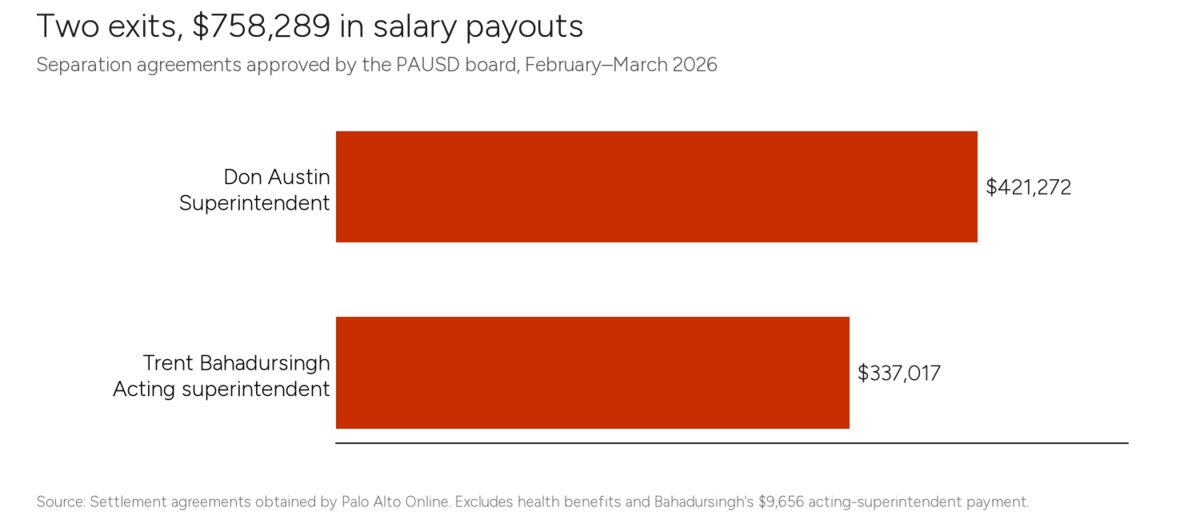
- Two exits, $758,289. It began with a public scolding. In February, Austin rebuked a student board representative at a public meeting. Ten days later — and about a week after the district agreed to a $3.25 million settlement with teacher Peter Colombo — he and the board agreed to part ways, months after extending his contract to 2029. His settlement pays $421,272, a year’s salary, plus health insurance through June 2027. His deputy, Trent Bahadursingh, lasted about three weeks as acting superintendent and left with $337,017. Neither settlement said why. Chiu and Segal voted no on the second.
- The tax and the raises. In June, the Measure B parcel tax got about 62% of the vote and failed; it needed two-thirds. Two weeks later, the board approved teacher and staff contracts worth about $35.4 million including benefits. Teachers got a 5% raise retroactive to last school year, another 5.4% starting July 1 and two $5,000 bonuses.
Pay first, students later
Talks with the Palo Alto Educators Association, the teachers union, had reached impasse. Then, according to former trustees Todd Collins and Ken Dauber, the contracts went through on the consent agenda — “a device meant for routine items like photocopier contracts” — with no discussion. Before the vote, they wrote, Dharap asked the chief business officer whether the deal would put the district in a difficult financial position. The answer: “That is correct. That’s where we are heading to.” Dharap later said he wanted to head off a strike. “There had never been any mention of a strike, ever,” Collins and Dauber wrote.
- Who pays. With raises locked in, the money has to come from somewhere. Based on past layoffs, Collins and Dauber expect that “the most likely to suffer will be students who need special education aides and services, counselors and mental health support, and other enrichment, including advanced courses with lower demand.”
- The board’s line. “Where we are now in the budget is not a mistake by the board. We own that decision,” Dharap said in September. Board members also asked the public not to blame the employee unions.
- The union in the classroom fights. The teachers union and the classified staff union backed the ethnic studies mandate in January 2025. Both are now backing only one board candidate, Linda Henigin, who sided with the majority on Honors Biology and middle school math.
- The union’s response. “Rushing into alarmist rhetoric or declaring immediate crises is simply premature,” union president Tom Culbertson said. In a guest opinion, he and chief negotiator Daniel Nguyen, the same Paly teacher who fought for Multivariable Calculus, argued that the district would still face a deficit of about $34 million even with no raises, that its forecasts have underestimated revenue by about $20 million a year, and that Palo Alto teachers often got smaller raises than neighboring districts while Collins and Dauber were on the board. “Blaming educator compensation may be politically convenient,” they wrote, “but it does not explain the district’s alleged underlying financial problems.” Cuts, they said, should come “far from classrooms.”
What gets cut
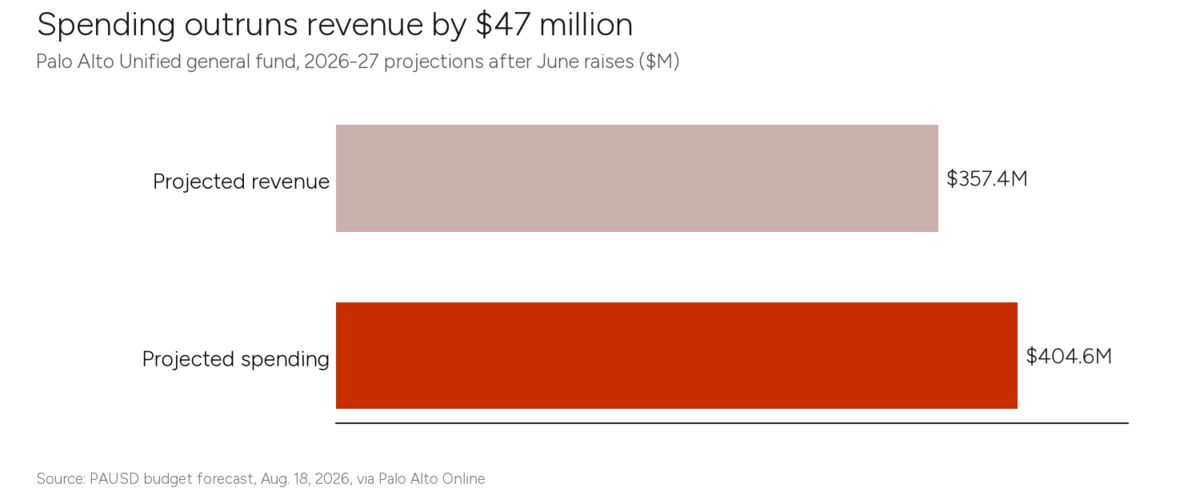
No cuts are final, and the first interim budget comes in December, after the election. The district projects $33 million in cuts next year and $10 million the year after.
- The district’s plan. “Central office and administrative costs come first,” Superintendent Jason Glass said. “We will reduce anywhere we can before we reduce programs and services that impact students.” Layoffs are a last resort, he said. But in August he said the district will look at “specific programs and services… and if we are going to live without it.” Dharap said he expects staffing cuts.
- The critics’ plan. Collins and Dauber warn of layoffs of “over 10% of current staff” or a county takeover. Their alternative: scale back the raises by 3 points and drop this year’s bonus, which they say “would nearly resolve the budget crisis in a single stroke.” (Guest opinion)
Who’s running
Dharap and Segal, who put ethnic studies back on the agenda, aren’t running again. That leaves two of five seats open, enough to change the outcome of a 3-2 vote. Voters pick two. Candidate profiles:
- Avery Wang, a tech executive with a Stanford Ph.D. who built the song-matching technology behind Shazam, has spent years challenging the district’s math placement practices. He first sued in 2020, when the district placed his son in a geometry course he had already completed. The district eventually backed down and moved him up. He then backed a second suit by four parents; in 2023, a judge ruled that the district’s high school math placement violated state law, including by making students retake courses they had already passed, and ordered the district to pay $38,311 in legal fees. He wants more advanced courses, early math and reading help, a bell-to-bell phone ban and an audit of vendor contracts, including $500,000 on a no-bid math placement test. Endorsed by Chiu.
- John Craig, an engineer and tech executive, is running on transparency and governance and has questioned Austin’s payout. Endorsed by Chiu.
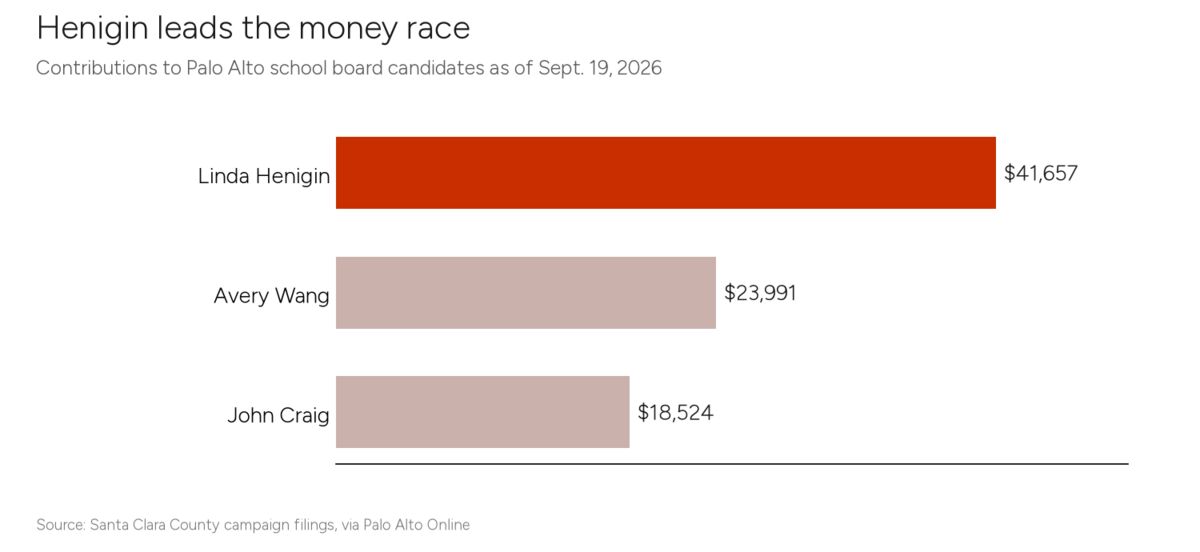
- Linda Henigin, a classroom aide in the district and longtime PTA volunteer, is endorsed by both employee unions, the South Bay Labor Council and the county Democratic Party. She sided with the board majority on Honors Biology and middle school math and is the most reluctant of the three to scale back raises. A lawsuit challenging her “math teacher/mother” ballot title stalled after a judge ruled it was filed too late; the title stays.
Where it stands now
None of these fights is over. Multivariable Calculus came back after months of pressure, and Nguyen is now teaching it on campus; Honors Biology has not. Ethnic studies remains a graduation requirement, even after a lawsuit challenged how it was adopted. On the budget, the board says it owns the raises and the union says they aren’t the problem, but the cuts that follow will be decided by whoever holds the two open seats.
The outside audit is due in mid-October. Election Day is Nov. 3. The interim budget, with the first concrete list of cuts, comes in December.