Power Spoke to Truth. Truth Didn’t Flinch.
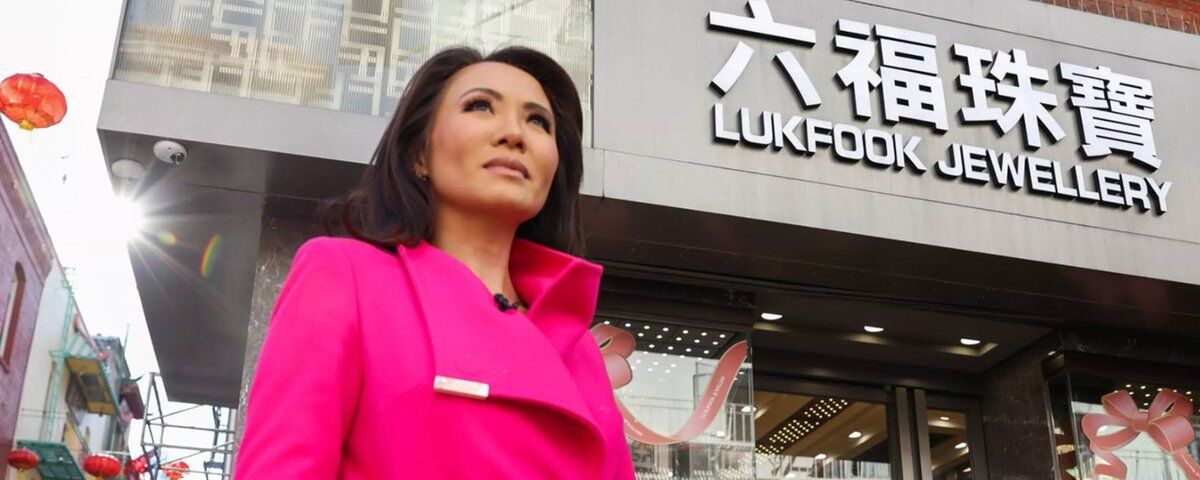
We all know the phrase “speaking truth to power.”
Amplified by Dion Lim is the defining book about the reverse: what happens when power speaks to truth and tells it to shut up. What happens when a progressive District Attorney’s office orchestrates a media hit on the reporter covering violence against your community and tries to kill your news stories. Buy this book. I’m going to tell you why.
The Video That Started Everything
On a Monday morning in February 2020, reporter Dion Lim was sitting at her desk at ABC7 San Francisco, bleary from anchoring the 11 p.m. news, scrolling her phone for a story idea. She was going to pitch something about the Niners in the Super Bowl. Fan Zone. Red and gold gear. Easy.
Then a DM came through from an anonymous account. No caption. Just a 17-second video.
She almost dismissed it. Female news anchors get unsolicited messages constantly. But she opened it.
The video showed an elderly Asian man in a rumpled blue bomber jacket and tan hat being beaten by multiple men in the Bayview neighborhood of San Francisco. They threw objects at him. They yelled slurs. They hit him with a stick. He had been collecting empty cans.
Dion writes: “He looked uncannily like my dad — the same round face and wide nose.”
She played the video at the editorial meeting. Didn’t pitch it. Didn’t argue for it. Just turned her phone volume up, pointed it at the room, and let the screams play. Someone said “Go!” before the meeting ended and she was out the door to cover the story.
A GoFundMe started by a community member to crowdsource money for the victim raised $70,000. The attackers were arrested and convicted. And something broke open. Dion’s inbox flooded with messages from “Hollywood A-listers to second-generation noodle shop owners” sharing stories of being spit on, grandmothers pistol-whipped, incidents they had never told anyone. “Pandora’s box,” she writes, “was about to be cracked wide open.”
What Pandora’s Box Looked Like
During the pandemic, a wave of anti-Asian hate crimes swept through San Francisco and the rest of America. Donald Trump used “China virus,” “China plague,” and “kung flu” 319 times in public between March and September 2020.
NYU researchers found his tweets coincided with spikes in hashtags like #ChinaVirus and #KungFlu. Stop AAPI Hate, founded by Cynthia Choi, Manjusha Kulkarni, and Russell Jeung, documented nearly 11,000 hate incidents between March 2020 and December 2021.
Dion covered them all. Not from a desk. She was in the field, often the only reporter there.
Vicha Ratanapakdee, 84, a Thai grandfather, was killed on a morning walk in the Anza Vista neighborhood of San Francisco on January 28, 2021. After tirelessly going door-to-door to locate surveillance video, a confidential source provided her the video that would later be seen around the globe. Later, more sources provided documents showing his killer, Antoine Watson, took photos of his lifeless body on the pavement. According to the Ratanapakdee family, this was a detail DA Chesa Boudin’s office had never told the family.
When Dion connected with Monthanus, Vicha’s daughter, the DA’s office had denied her a Thai interpreter. “I was refused. I had to push back for it. They said they didn’t have anyone.” Then Dion told her what the DA never did: that her father’s killer had photographed his body. Monthanus told Dion: “I’m feeling like my District Attorney is doing the job for the suspect… I wish the Asian community would speak up.”
The progressive District Attorney Chesa Boudin called the murder a “temper tantrum” in the New York Times.
March 16, 2021. Atlanta. Robert Aaron Long walked into Young’s Asian Massage, then Gold Spa, then Aromatherapy Spa. Eight people dead, six of them Asian American women: Xiaojie “Emily” Tan, Daoyou Feng, Hyun Jung Grant, Suncha Kim, Soon Chung Park, Yong Ae Yue. Cherokee County Captain Jay Baker told reporters Long had a “really bad day.” The Daily Beast later surfaced Baker’s Facebook posts promoting T-shirts that read “COVID-19 imported virus from CHY-NA.”
That same day in San Francisco, Danilo Yuchang was shoved on Market Street. Dion writes: “I slumped back against the wall and looked at my kitchen, feeling sick and hollow. This is happening everywhere. Everywhere.”
Jasper Wu, not yet two years old, wearing a Superman costume, shot in his car seat during a freeway gang shootout on the 880 in Oakland in November 2021. Not longer after, Dion raced to the scene. CHP officers escorted her news van so Jasper’s mother and grandmother could safely place incense and joss-paper offerings on the highway. She filmed on her phone and wept as the news chopper flew overhead.
Kelvin Chew, murdered in the Portola District. An Hang, attacked at Costco. Lathan Johnson, who had 170 victims, targeting Indian women specifically. CWell, an Oakland gas station owner, pepper-sprayed. A 78-year-old man attacked on Natoma Street, a story Dion’s station rejected three times before Lisa Ling and Daniel Dae Kim helped amplify it. Mei Ran Hu, 64, stabbed to death by a schizophrenic neighbor in her low-income apartment. Dion pitched the story four times. The newsroom said they “generally don’t cover stabbings.” It got a 30-second anchor read.
Half a million books are published in America every year. For six years during and after the pandemic, thousands of victims, cities terrorized, communities organizing their own safety patrols because nobody was coming to help. Not one major publisher produced a book about it. Zero.
That’s what this book is. The first full record.
When Power Decided Truth Was a Problem
Dion’s confrontational interview with DA Chesa Boudin on January 3, 2021, went viral.
She had asked her news director, “Can I go hard on this?” The answer: “Yes.” She put on heels instead of sneakers, channeled her East Coast directness, and when Boudin claimed she “misunderstood” his office’s statement, she responded: “Chesa, with all due respect, it feels as though you’re deflecting.”
Then the DA’s office went on offense. Against Dion.
In the summer of 2021, journalist Radley Balko emailed Dion asking who her sources were. A cardinal sin. On June 14, the Washington Post ran “The Bogus Backlash Against Progressive Prosecutors,” which accused Dion of pressuring victims’ families.
Through FOIA requests, the public later obtained 81 pages of texts between Kasie Lee, Boudin’s victim services head, and Balko. The files included a document titled “Dion Lim Misrepresentations.” The DA’s office, which should have been prosecuting the people attacking Asian Americans, was orchestrating a media hit on the journalist covering those attacks.
Dion’s two Signal sources went silent after the Post piece. “I woke up every morning with a feeling of dread,” she writes. “Oh God, what am I going to be accused of today?” Her management declined to issue a public statement of support. They took her off Boudin stories temporarily. One manager asked her to confirm a source’s account in front of them.
Veteran journalist Vic Lee told her the attack was “a badge of honor: how many journalists made elected leaders so scared they went on the offensive?”
The message from the DA’s office was clear. Stop covering these anti-Asian hate crimes, or your career is in jeopardy.
Oakland DA Pamela Price went further. After Dion’s reporting on the Jasper Wu case, Price’s office issued an email to AAPI community leaders naming Dion by name, claiming she “misled the public,” and telling an elected official: “Your constituent seems uninformed about the basic principles of constitutional law.”
Dion Didn’t Stop.
She walked away from nearly 20 years in broadcast journalism because progressive District Attorneys made it nearly impossible to tell the truth, and she refused to lie.
Here’s what it actually cost:
On May 16, 2021, at 4:56 PM, Dion was reading her AAPI Heritage Month closing thoughts on live television. Her hands started tingling. Her voice cracked. She broke down on air: “I want to break down in tears, like right now, or give up entirely.”
Earlier that year, alone in the wing of the station that used to house ESPN, her hands had curled and gone numb. She hyperventilated. She called a manager from the desk phone using her left knuckle because her fingers wouldn’t grip. She was having a panic attack.
During a virtual headdress-making class for viewers, two hours of smiling and small talk while “people were out there getting pistol-whipped and assaulted and killed,” she called her husband Evan sobbing: “I didn’t want to kill myself but giving up sounded easier.”
It took five months to find a therapist. Out-of-network, $300 an hour. Her insurance offered 10 sessions through EAP, which she described as “a great excuse not to go.”
Dion was raised to believe that crying was a sign of weakness. Her mother’s rule: “The only time I was allowed to cry was at her funeral.”
Dr. Jenny Wang on Asian American mental health: “In Asian culture, there is an emphasis on usefulness to society. If you show weakness, you may be ostracized or pushed to the corner. There’s an element of shame.”
An ABC reporter in New York who had been covering anti-Asian hate in parallel, broke down “bawling like a baby” in a CVS with his daughter after interviewing 50 victims in six months. His method was to “allow myself to cry, to give myself the license to feel the pain. After a good cry, I’d get back at it.”
The book documents all of this without flinching. The panic attacks, the dread, the isolation, the IVF through five years of trying, the marriage strain, the anonymous letters, the racist hate mail. It documents what it actually costs to be the person who shows up when every institution is telling you to sit down.
Third State Books
My wife Stephanie Lim founded Third State Books because she saw a gap that was really a wall.
Asian American stories weren’t being rejected by publishers for lack of quality or audience. They were being rejected because the publishing industry had no infrastructure for them. No champion. No press that understood these were American stories, not niche ethnic interest.
Third State was the first independent publisher built specifically for Asian American voices. And Amplified was their first book.
Other publishers had approached Dion during the pandemic. They wanted the book to be “more positive.” Dion’s answer, which I think about constantly: “How do you make anti-Asian hate a little bit more positive?”
So she went with Stephanie. The book was supposed to publish in August 2024. It took 21 additional months. Legal review. Institutional resistance. The kind of friction that kills most small publishers. As Dion writes: “Any other publisher would have dropped you, but Stephanie and Charles stayed with me for those 21 months.”
Stephanie held. Not because the business math worked. Because the book mattered.
At the launch last week, Stephanie put it simply: Asian American history is American history. It should be taught alongside Japanese incarceration and the Chinese Exclusion Act, not as a subcategory, but as part of the main text. She pointed out that for six years and half a million books published annually, zero major publishers produced a book about anti-Asian hate. “That silence,” she said, “is itself the story.”
Stephanie built the press. Dion wrote the book. Every delay, every institutional roadblock, every quiet rejection proved the thesis of the book itself: power doesn’t just suppress the story. It suppresses the story about the suppression.
Why This Book Is Different
Amplified is not an op-ed about anti-Asian hate. It is not a policy paper. It is not a memoir that sanitizes the hard parts.
It is 230 pages of names, dates, cases, institutional mechanics, and personal cost. The can collector in the Bayview. Vicha Ratanapakdee photographed dead on the pavement by his own killer. Jasper Wu in his Superman costume. The Atlanta spa victims named individually. Pamela Price’s internal memo telling prosecutors not to pursue sentencing enhancements. The 81 pages of texts between the DA’s office and the Washington Post columnist.
Every player named. Every mechanism documented.
It is also a story about what happens inside the person who carries it. The panic attacks. The on-air breakdown. The husband who held everything together. The therapist who cost $300 an hour. The mother who told her daughter the only acceptable time to cry was at her funeral. The IVF. The baby born into a world the book documents as hostile.
Olivia Munn wrote in the foreword: “Visibility for Asian Americans is not a gift bestowed. It is a right claimed.”
Dion claimed it at enormous personal cost. She lost her career for it. Stephanie bet her company on it. The book is what happens when two women decide that if nobody else is going to tell the truth, they will.
What You Can Do
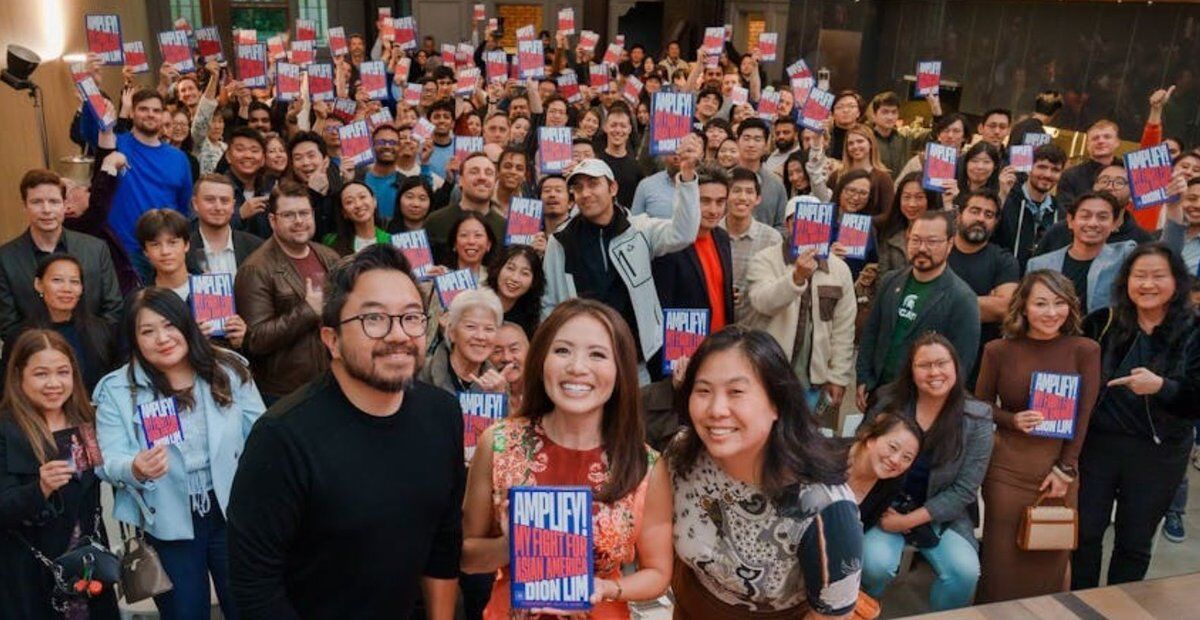
We hosted the launch last week at our home in San Francisco. The room was packed. Some of the people holding copies were victims of anti-Asian hate crimes. Angela, who was attacked while out for a run. Families who had been watching Dion fight for them on television for years. They held up copies of the book and it felt like the truth had finally won a round.
Buy Amplified. Buy it for yourself. Buy it for someone who thinks anti-Asian hate was a 2021 news cycle that ended. It didn’t end. It was made to disappear from the news, and this book is the permanent record of exactly how that happened and who did it.
Request it at your library. Library requests tell the publishing industry that a book matters. Share the excerpts that hit you. Post the parts that make you angry. Get it into schools. Dion’s goal is to put this book in every Asian American studies class in the country. I’ll go further: this is American history. Teach it as American history.
The old playbook says speak truth to power and hope someone listens. This book documents what actually happens: power speaks first, and it speaks louder, and it uses lawyers and political operatives and corporate settlement offers to make truth disappear.
But truth has the internet now. And a journalist who stands up for her community who would not be silenced.
Get the book Amplified now.