NIMBYs Stole $8,775 From Every American Worker
Berkeley economists calculated the exact cost of housing cartels. The receipts are in—and they’re devastating.
TL;DR
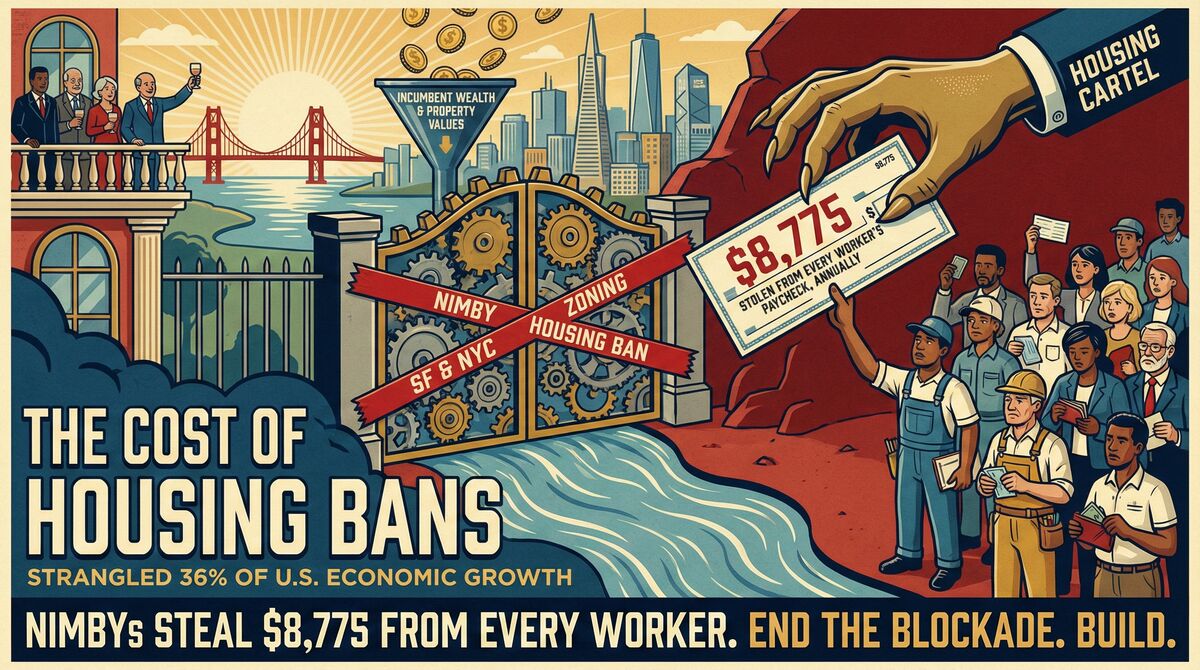
Housing restrictions in just three cities—NYC, SF, and San Jose—have strangled 36% of US economic growth and cost every American worker $8,775 per year in lost wages.
We now have the receipts on America’s biggest heist. Two economists calculated exactly how much NIMBYs have stolen from every single working American: $8,775 per year, every year, for decades.
This isn’t speculation. It’s peer-reviewed research from Chang-Tai Hsieh (University of Chicago) and Enrico Moretti (UC Berkeley), published in the American Economic Journal: Macroeconomics.

NIMBYism is economic suicide. Housing bans in SF and NYC didn’t just make rent expensive—they strangled 36% of all US economic growth for decades. That is $8,775 stolen from every American worker’s paycheck, every single year, just to protect the views and property values of a few incumbents. They aren't "preserving neighborhood character." They are running a cartel that loots the working class to subsidize the landed gentry. End the blockade. Yes, In My Backyard. eml.berkeley.edu/~moretti/growth.pdf
They aren’t “preserving neighborhood character.” They are running a cartel that loots the working class to subsidize the landed gentry.
The 36% Growth Tax Nobody Voted For
Hsieh and Moretti analyzed 220 metropolitan areas from 1964 to 2009 using a spatial equilibrium model. Their finding? Housing constraints in high-productivity cities like New York, San Francisco, and San Jose lowered aggregate US growth by 36 percent.
This isn’t just about expensive rent making life uncomfortable. It’s about the entire American economy being dramatically smaller than it should be. Every worker in every state has been made poorer because a handful of coastal homeowners decided they didn’t want new neighbors.
$8,775 Stolen From Your Paycheck (Here’s The Math)
The calculation comes directly from Footnote 28 on Page 26 of the paper. Here’s the brutal math:
Step 1: The counterfactual. What if just NYC, SF, and San Jose relaxed zoning to the level of the median US city? Not Houston. Not “unregulated.” Just average—like Richmond, Virginia or Indianapolis.
Step 2: The GDP boost. The model shows this would generate an additional $1.95 trillion in 2009 GDP.
Step 3: The worker’s share. Apply the standard 65% labor share: $1.95T × 0.65 = $1.27 trillion in lost wages.
Step 4: Per-worker cost. Divide by 144 million US workers: $1.27T ÷ 144M = $8,775 per worker per year.
That’s not a one-time fee. It represents the annual salary increase American workers would have received if labor hadn’t been trapped in low-productivity places by NIMBY zoning in just three cities.
The Factory Analogy: Best Players on the Bench
Imagine the US economy as a giant factory with two teams. Team A (San Francisco/NYC) produces $100 of value per worker per hour because of the network effects of tech, finance, and specialized industries. Team B (the average city) produces $30 per hour.
In a sane economy, you’d move workers to Team A to maximize output. Everyone gets richer.
But Team A built a wall. They refused to build housing around the productive factory.
A brilliant worker who could generate $100/hr in San Francisco can’t afford to live there. They’re stuck generating $30/hr elsewhere. That $70 gap doesn’t go anywhere—it’s productivity that simply never happens. The worker loses. The country loses.
Spatial misallocation is just putting your best players on the bench because you refuse to buy a bigger bus.
The Property Rights Revolution That Robbed America
How did we get here? As Harvard economist Edward Glaeser documented: “In the 1960s, developers found it easy to do business in much of the country. In the past 25 years, construction has come to face enormous challenges from any local opposition. In some areas it feels as if every neighbor has veto rights over every project.”
The contrast is damning. Southern cities with elastic housing supply saw employment growth without misallocation—productivity gains actually became jobs. But in SF and NYC, productivity growth just pushed up housing prices and nominal wages, locking everyone else out.
The standard deviation of wages across US cities in 2009 is twice what it was in 1964. That’s inequality built directly into geography by zoning laws.
A Cartel That Loots The Working Class
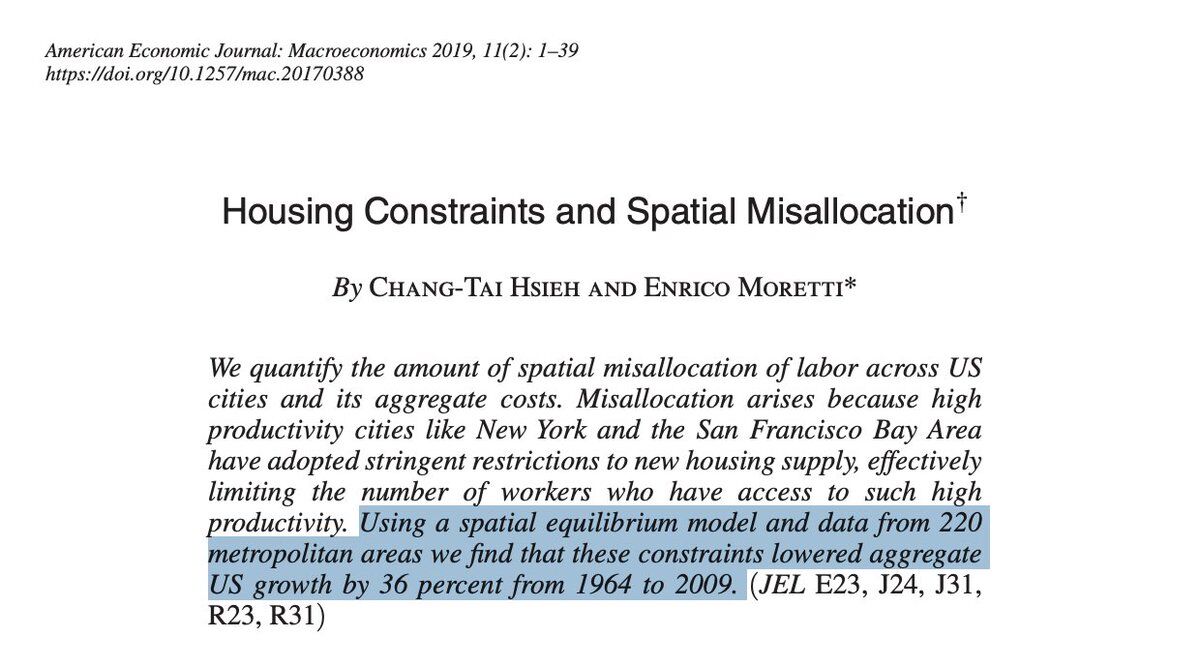
The Hsieh-Moretti paper puts it plainly: incumbent homeowners have a “private incentive to restrict housing supply.” When they do so, they “de facto limit the number of US workers who have access to the most productive American cities.”
This creates negative externalities for ALL US workers—not just those in restrictive cities. A software engineer stuck in Ohio because she can’t afford SF rent? That’s a national productivity loss. A nurse who could work at UCSF but lives in Texas instead? Lost output for everyone.
They call it “preserving neighborhood character.” Economists call it a cartel that extracts rents from everyone else. The landed gentry gets property values; the working class gets higher rents and lower wages.
The receipts are in. Every year NIMBYism continues, $8,775 disappears from every American worker’s potential paycheck. This isn’t about views or “character"—it’s about whether we let a small group of homeowners continue running the most expensive cartel in American history.
End the blockade. Yes, In My Backyard.
Follow @garrytan for more.
Related Links
-
Housing Constraints and Spatial Misallocation (American Economic Journal: Macroeconomics)
-
Garry Tan on NIMBYism as economic suicide (@garrytan)
Comments (0)
Sign in to join the conversation.