NIMBYs Stole 36% of America’s GDP
A landmark study proves what YIMBYs knew: zoning boards in SF and NYC cost the entire country trillions.
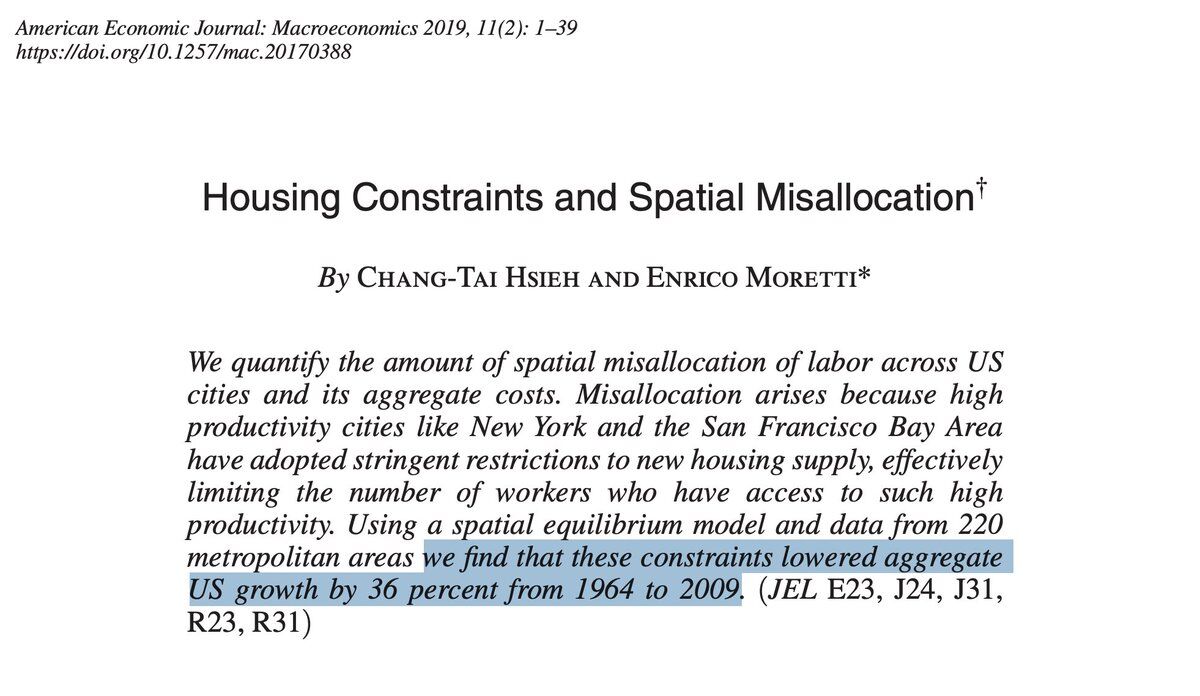
Source: x.com
Source: x.com
TL;DR
Housing constraints in productive cities like SF and NYC lowered US GDP by 36% from 1964-2009. That’s not a typo. That’s the cost of NIMBYism.
What if America’s economy is 36% smaller than it should be—not because of bad policy in Washington, but because of zoning boards in San Francisco and New York? A landmark study puts the staggering cost of NIMBYism in stark economic terms.
The $10 Trillion Question
Economists Chang-Tai Hsieh and Enrico Moretti published a study in the American Economic Journal: Macroeconomics that should make every local planning commissioner’s head spin. Using a spatial equilibrium model with data from 220 metropolitan areas, they found that housing constraints in high-productivity cities lowered aggregate US GDP by 36% from 1964 to 2009.
The mechanism is brutally simple: cities like NYC and the San Francisco Bay Area are incredibly productive. But they’ve adopted stringent restrictions on new housing, effectively capping how many workers can access these economic engines. This “spatial misallocation” of labor means millions of Americans can’t move to where they’d be most productive—not because they don’t want to, but because they literally can’t afford to.
Archived tweet> by 2009, aggregate U.S. output (GDP) was ~36% lower than it would have been without housing constraints... i think it's time we finally unlock the full potential of the united states of america https://t.co/hcIB6URmkR
Harris Rothaermel @DeveloperHarris January 29, 2026
Think about that. We’re not talking about 36% less growth in San Francisco. We’re talking about 36% less growth for the entire United States.
Why We Say YIMBY

This is why we say YIMBY
> by 2009, aggregate U.S. output (GDP) was ~36% lower than it would have been without housing constraints... i think it's time we finally unlock the full potential of the united states of america
This is exactly why the YIMBY movement matters. Every unaffordability issue passes through housing. YIMBY is “abundance made local"—more homes means lower rents, shorter commutes, higher birthrates, bigger talent pools. Everything a growth economy needs.
The choice is stark: build abundance or fall to zero sum NIMBY scarcity. SF rents jumped 12% year-over-year in 2025, with one-bedrooms hitting $3,100. With AI wealth flooding the Bay Area, the urgency is only increasing. If we don’t build, rents really will be 3x higher in 10 years—and everyone will be worse off.
The Hsieh-Moretti paper puts hard numbers on what YIMBYs have been saying for years: restricting housing doesn’t just hurt renters—it makes the entire country poorer. It’s time to unlock America’s full potential.
Follow @garrytan for more.
Take Action
Share this with anyone who thinks housing policy is a local issue
Related Links
-
Housing Constraints and Spatial Misallocation (Hsieh & Moretti 2019) (American Economic Journal)
-
SF Rent Surge in 2025 (SF Chronicle)
-
@DeveloperHarris tweet on GDP impact (@DeveloperHarris)
-
Garry Tan on YIMBY tweet (@garrytan)
Comments (0)
Sign in to join the conversation.