MacKenzie Scott’s $26 Billion Sugar Pile
Forbes celebrates her as history’s greatest giver. But without stewardship, the outcomes are spotty at best.
TL;DR
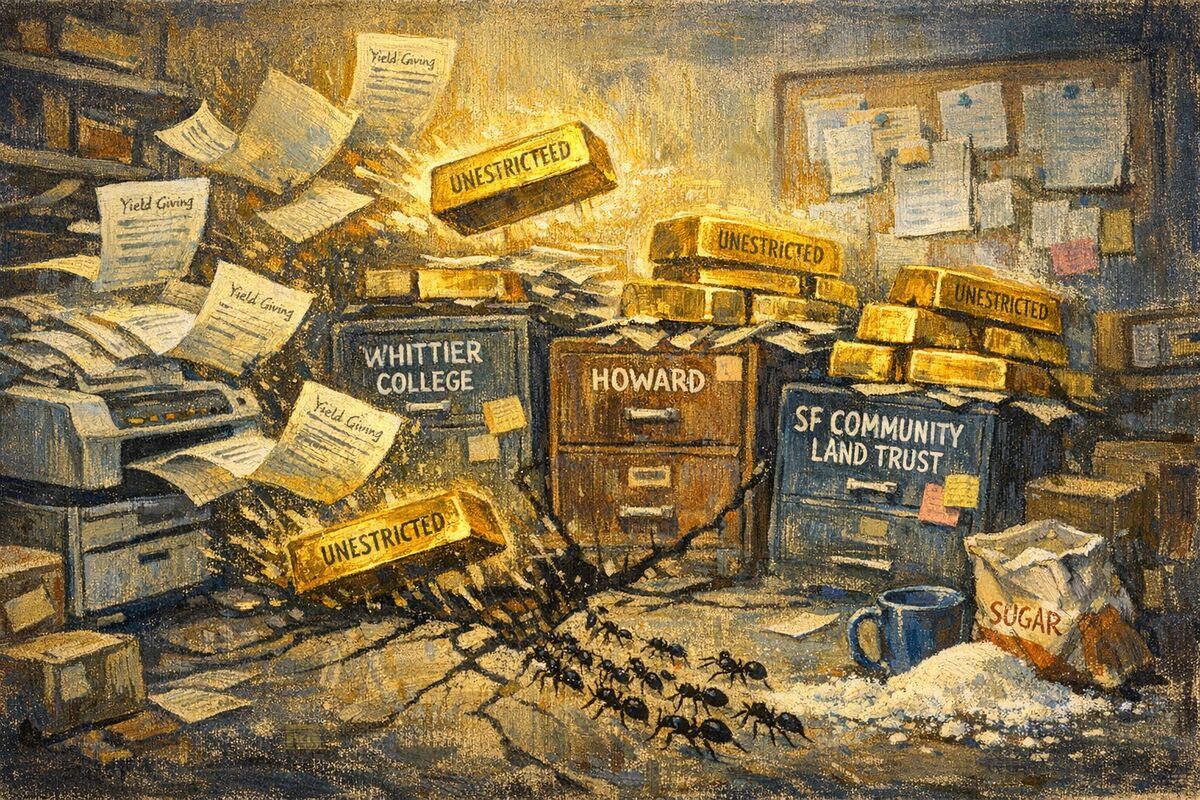
MacKenzie Scott has given away $26 billion faster than anyone in history — with no oversight, and no accountability for the chaos that follows. Philanthropy without stewardship is negligence.
Big money giving has big bad effects. Forbes wants you to believe otherwise.
This is the pedestal they created:

But for those who have been following the effects of some of that big money, it isn’t all roses.

Peter Savodnik isn’t wrong. The same week Forbes crowned Scott the third-biggest philanthropist of all time, the evidence of what her giving actually does keeps piling up. This isn’t generosity. It’s negligence at scale.
The Speed Record Nobody Should Want
Forbes frames velocity as virtue. Scott has disposed of 75% of her Amazon shares in less than seven years, pushing $26.4 billion to more than 2,500 groups. In 2025 alone, she gave away $7.2 billion — more than Musk, Page, Ellison, and her ex-husband Bezos have donated in their entire lifetimes combined.
How does this actually work? A spokesperson for Howard University told Forbes the school found out about its $80 million grant only when someone from Scott’s Yield Giving emailed them. No apparent vetting. From Howard’s perspective there was no prior relationship. No conversation about whether the institution could absorb that kind of windfall. Just an email saying the money’s coming.
That’s one way to put it. Another way: these are one-time windfalls that distort nonprofits. As I’ve argued before, you want donors who pay attention and donate regularly. Not this.
Compare that to Warren Buffett, who leads the lifetime giving list at $68.3 billion. He built decades-long relationships with the Gates Foundation and his family charities. He understands what they do. He watches outcomes. Scott’s approach is the opposite — spray and pray at a scale nobody has ever attempted.
When $12 Million Destroys a College
Want to see what happens when a windfall lands without oversight? Look at Whittier College.
Maxwell Meyer documented the disaster via The Free Press: Scott gave $12 million to this small Hispanic college. The gift tore the place apart. The president used the cash to hire her own son for a six-figure job in a position nobody could explain. She became authoritarian. Enrollment plummeted from 490 freshmen to under 300. The school ended up with a $10 million budget gap.
If you don’t pay attention or follow up, that’s creating chaos, not helping a cause.
Or look closer to home. The San Francisco Community Land Trust received $20 million from Scott. I’ve noted before that this organization’s board includes anti-police, anti-housing activists — including an aide to Dean Preston, the former SF Supervisor who blocked housing for 8,500 people. That’s who’s stewarding Scott’s millions.
The pattern is clear: massive windfalls without oversight corrupt institutions. The outcomes hurt the very people they claim to support.
Sugar on the Floor
Giving requires one thing people are utterly unprepared for: stewardship.
Love and care is needed. You can’t write a check and walk away. You will destroy organizations and see your money turn the thing you love into the thing you hate. Money without stewardship is pouring sugar on the floor. You are going to get ants.
Here’s a better model. For every $1 million you give away, pledge to spend one hour the next year auditing how every dollar is spent and what the outcome is. Call it the Stewardship Pledge.
Scott’s approach is the anti-Stewardship Pledge. At $7.2 billion a year, she’d need to audit for 7,200 hours annually — 3.5 full-time employees doing nothing but oversight. She clearly isn’t doing that. And if you don’t pay attention, graft and entropy become the default.
Virtue Signaling for Its Own Sake Is Not Virtue
Savodnik calls it “incalculable harm to the republic in the service of brand building.” Whether or not that’s Scott’s intent, the media incentives are undeniable.
Forbes frames Scott’s $760 million to HBCUs amid the DEI backlash as “stepping up for her principles.” The headline screams that she gave more than Musk and Bezos combined. The implication: she’s morally superior because she writes bigger checks faster. And every uncritical profile reinforces a cycle where speed gets celebrated and outcomes go unexamined.
But speed isn’t a virtue — it’s a risk factor. The Whittier president probably didn’t set out to run her college into the ground. She mismanaged because a sudden windfall created opportunity without accountability. That’s not a character flaw unique to one administrator. It’s a predictable consequence of Scott’s model, repeated at scale across 2,500 organizations.
The question isn’t whether Scott means well. It’s whether a philanthropy model designed to avoid scrutiny should be celebrated precisely for avoiding scrutiny.
What Real Generosity Looks Like
Contrast this with philanthropists who actually steward their giving.
Phil and Penny Knight pledged $2 billion to the Knight Cancer Institute — the largest single gift ever to an academic health center. They’ve been funding it since 2008, building a relationship, watching outcomes, expanding when results warranted.
That’s focused giving with personal connection and measurable outcomes. Same with Arnold Ventures, which employs 100+ subject-matter experts to identify evidence-based solutions before cutting checks.
The common thread: specificity, accountability, results.
Forbes wants you to measure generosity in dollars. But dollars without stewardship aren’t generous. They’re lazy. They’re destructive. They pour sugar on the floor and congratulate themselves when the ants arrive.
Philanthropy is good and more people should give. This is not an indictment of philanthropy. This is a cautionary tale of philanthropy without stewardship. The result? Those who you want to help are not helped. The causes you want to further go sideways.
Real philanthropy is harder than writing checks. It requires the thing Scott seems unwilling to provide: attention.
Related Links
-
Peter Savodnik on Scott's philanthropy (@petersavodnik)
-
Garry Tan on nonprofit distortion (@garrytan)
-
Whittier College disaster (@mualphaxi)
-
Garry Tan on stewardship (@garrytan)