Fraud, Waste, and Abuse Hits Working People the Hardest
A sourced look at fraud, corruption and unmeasured spending in California’s public programs, who bears the cost, and what’s on the ballot Nov. 3.
TL;DR
California’s biggest losses hit the programs working people depend on: about $20 billion in stolen pandemic jobless benefits, $361 million skimmed from EBT cards and at least $4 billion in questionable Medi-Cal payments. And that’s just what got caught. San Francisco tripled its homeless-nonprofit spending while the count held near 8,000. Los Angeles couldn’t say where its money went. High-speed rail managed to spend about $15 billion without laying a single mile of track.
Who pays the price?
The largest documented fraud hit unemployment and EBT aid, money meant for people who had lost work or live on low incomes. When those systems fail, the people they serve wait longer, get less or get cut off. Every dollar lost to fraud, overruns or penalties is a dollar not spent on services, or one taxpayers have to replace.
The fraud
Jobless benefits (EDD)
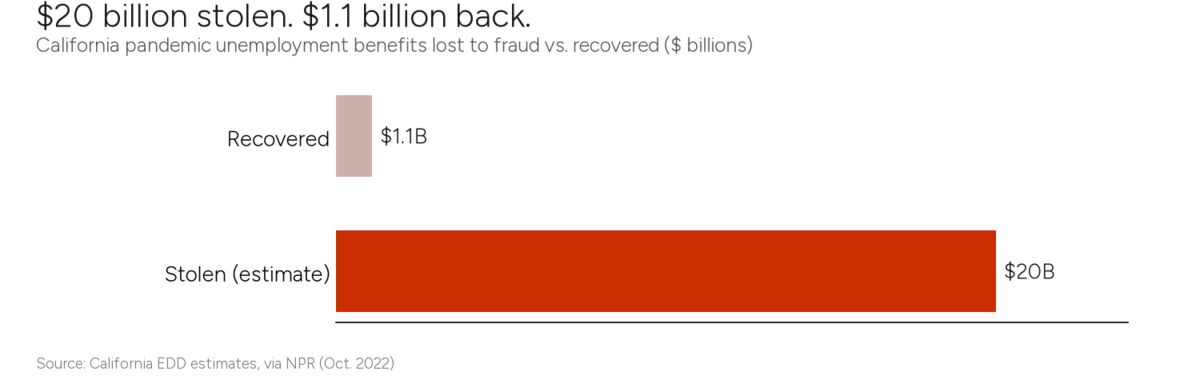
- Stolen: state officials conservatively estimate $20 billion, about 11% of the $177 billion paid in pandemic jobless benefits. About $1.1 billion was recovered as of 2022, mostly from frozen debit cards.
- What auditors found: EDD “did not take action to bolster its fraud detection efforts until months into the pandemic,” the state auditor found. Then it froze 344,000 accounts without a plan to unfreeze those “belonging to legitimate claimants.”
Food and cash aid (EBT)
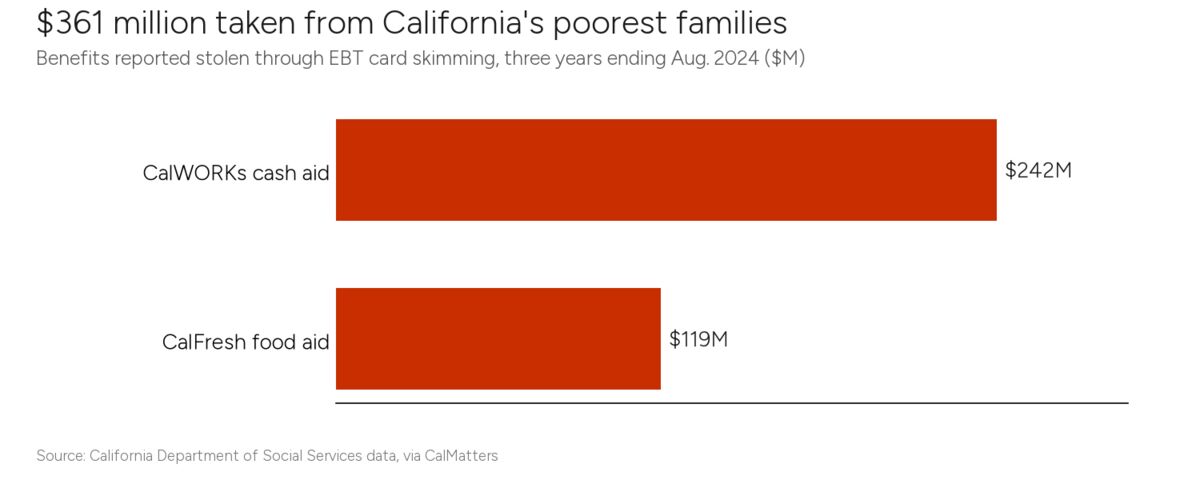
- Stolen: $361 million in three years, through card skimmers on ATMs, grocery terminals and gas pumps.
- Warning ignored: officials knew the risk two years earlier but didn’t fund fixes “until public benefits were already being stolen to the tune of millions per month,” CalMatters reported.
How much goes undetected?
There is no telling how much fraud, waste and abuse goes uncaught. The figures above are what investigators found. California’s own watchdogs estimate the rest runs into the billions:
- Unemployment, after the pandemic: the state auditor estimates EDD made about $1.5 billion in improper payments in 2023 and 2024, above the federal limit of 10% of payments, and that fraud topped $500 million in 2024 alone. The auditor says EDD’s anti-fraud measures haven’t consistently brought errors down.
- Medi-Cal: the auditor found at least $4 billion in questionable payments from 2014 to 2017 and said the real figure “could be much greater.” As of April 2025, the problem was only somewhat smaller than when it was estimated to cost $1.9 billion. The state health department has told auditors it is stepping up oversight of counties’ eligibility checks.
- Medi-Cal billing fraud: the attorney general’s own fraud unit says the amount stolen through fake or inflated bills “could reach billions of dollars annually.”
- Food aid: CalFresh’s payment error rate hit 10.93% in fiscal 2025, counting both overpayments and underpayments, well above the 6% federal threshold. Under new federal rules, the auditor estimates that error rate could cost the state nearly $2.5 billion a year starting in 2028.
No official or independent estimate exists for California’s budget as a whole.
The corruption
San Francisco Human Rights Commission. A controller’s audit flagged $4.6 million in questionable spending under former director Sheryl Davis, including gala tickets and a $9,000 Martha’s Vineyard rental. She faces 17 felony counts, accused of steering $4.5 million to a nonprofit she was tied to. Her attorney says she denies all allegations, and she has pleaded not guilty.
Oakland city contracts. Former Mayor Sheng Thao’s federal bribery trial began Oct. 13. Prosecutors say her city’s recycling contractor paid for attack mailers and promised her partner a $300,000 “no-show job,” at least $95,000 of it paid. All four defendants have pleaded not guilty. Attorney General Rob Bonta spent $468,228 in campaign funds on lawyers while answering investigators’ questions. He hasn’t been charged, and the state ethics watchdog found the spending legal.
San Francisco Public Works. Former director Mohammed Nuru got seven years in federal prison over a bribery scheme. Garbage hauler Recology agreed to repay ratepayers $94.5 million for rates Nuru helped set; the company called it a mistake, one its staff had flagged to the city in 2018.
The waste: homelessness
California allocated $24 billion for homelessness and housing over five years, according to the Legislative Analyst’s Office. The state auditor found the state “lacks current information on the ongoing costs and outcomes” of those programs.
San Francisco: spending tripled, with little impact
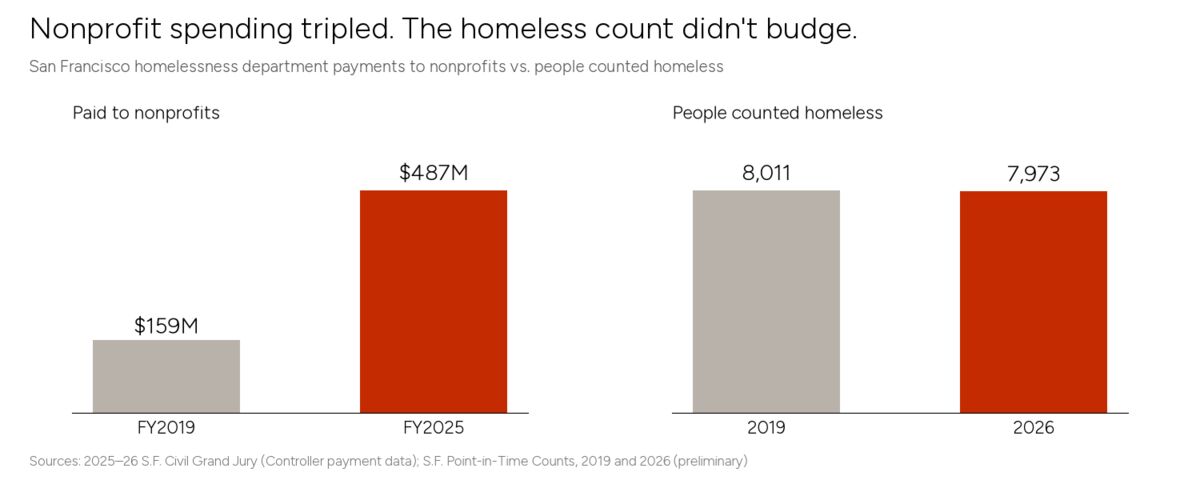
- Nonprofit contracts: $158.6 million in 2019, $487 million by 2025 across 291 contracts with 73 nonprofits, per a civil grand jury. Counting other costs, the city spends roughly $700 million a year on homelessness.
- Homeless count: 8,011 in 2019, 7,973 in 2026. Street homelessness did fall 22% since 2024.
- Outcomes: only 37.6% of people leaving the system in 2024 went to stable housing.
No metrics. The city promised performance measures for every contractor by 2019 and kept missing the deadline. Contracts still count activity, like how many people attend an intake orientation, not whether anyone ends up housed. To the grand jury’s knowledge, the department “has never declined to renew or award a contract” over a controller’s corrective-action finding. In August its new director, Mike Levine, said contract reviews had focused on providers’ expenses rather than results. Mayor Daniel Lurie is rebidding every contract with performance terms: “We are not going to continue spending $1 billion of taxpayer money on a failing system.”
Missing money. A 2022 audit of the United Council of Human Services found improperly placed tenants, including its own employees, and $108,861 in unauthorized rent. The city referred it to the FBI and cut it off. The Providence Foundation billed $105,000 for work that never happened and settled for $1 million.
Los Angeles: No tracking
Mayor Karen Bass took office in December 2022 with emergency powers and made homelessness her top priority.
- Unspent: about 40% of her record $1.3 billion homelessness budget, the controller found.
- Untracked: a court-ordered audit found the city didn’t check its homelessness spending against the services delivered. Bass called it “the broken system… I’ve been fighting against.” A federal judge later put the city under a court monitor.
- Inside Safe: her motel program has cost more than $300 million; about 40% of the 5,800 people it brought indoors are back on the street. In its first year it placed 255 people in permanent housing for $67 million, about $263,000 each; the city says that money also paid for outreach, shelter and encampment resolution. One contractor paid $110 per person per day was stocking instant ramen.
- Charged: the head of nonprofit Abundant Blessings agreed to plead guilty to pocketing at least $2 million in a scheme that included “ghost” clients. Home At Last’s founder is charged with diverting $7.5 million and hasn’t entered a plea.
- Result: city homelessness rose 3.4% in 2026. Bass blamed state cuts, the county and the Trump administration, and says homelessness is down 11% since 2023; city counts show 2.3%.
The efficiency gap
Some of the largest costs involve no crime. They come from delays and overruns.
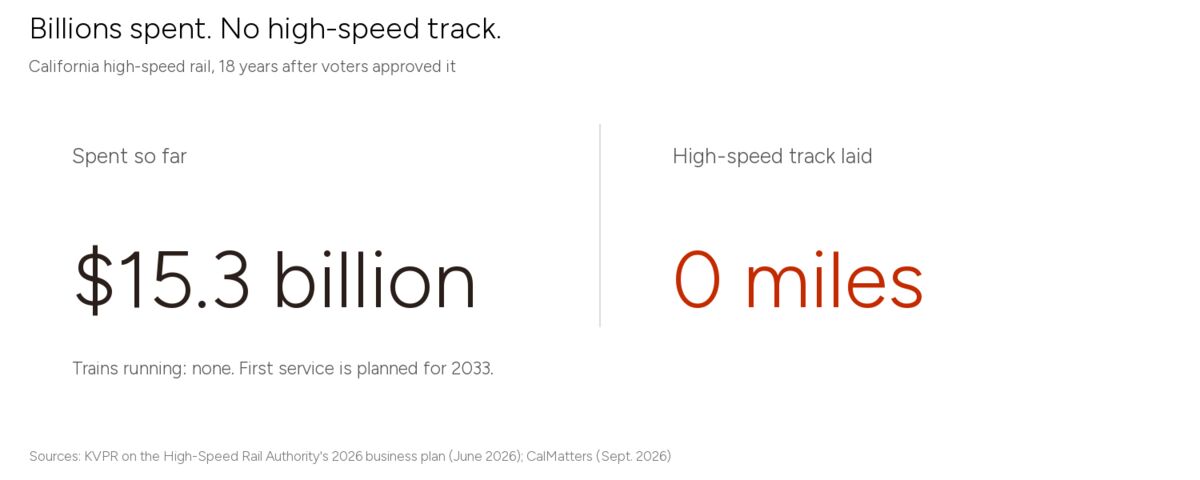
High-speed rail. About $15.3 billion has been spent, and 18 years after voters approved it, no high-speed track has been laid. No trains run; the first service, in the Central Valley, is planned for 2033.
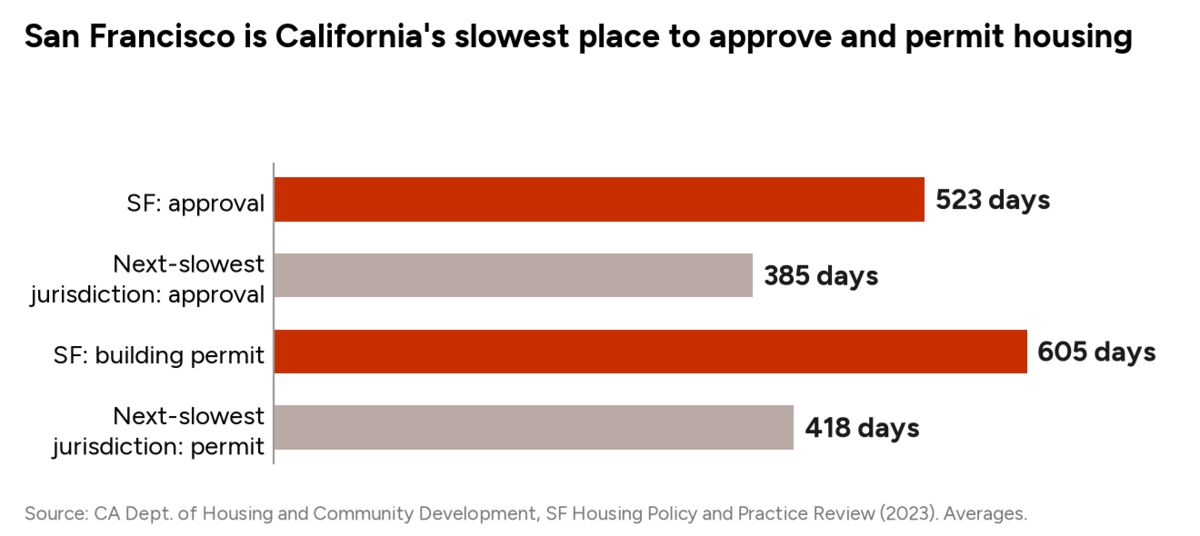
Housing. San Francisco takes 523 days to approve a housing project and 605 more to issue a building permit, the slowest in California. Its Planning Department reports costs near $1 million per affordable two-bedroom unit.
Who found these problems?
Much of this came to light through the system itself. Democratic Sen. Dave Cortese and Republican Assemblymember Josh Hoover jointly requested the 2024 homelessness audit. “The lack of transparency in our current approach to homelessness is pretty frightening,” Hoover said. San Francisco’s district attorney brought the Davis case, its controller audited the Human Rights Commission, and the state auditor produced the EDD, Medi-Cal and high-risk findings.
What’s on the ballot Nov. 3?
State controller (the state’s chief accountant)
- Malia Cohen (Democrat), incumbent. Promises “transparency, accountability, and fairness.” In 2022 she pledged to audit homelessness, the DMV and EDD; the LA Times reports she didn’t. She says other agencies were already auditing the DMV and EDD, and that she was denied audit funding.
- Herb Morgan (Republican). An investment executive running on exposing fraud. Promises every expenditure in a near real-time online database.
Governor
- Xavier Becerra (Democrat). “We have spent billions, and the results are not good enough,” he says, promising “No blank checks.”
- Steve Hilton (Republican). Asked the U.S. attorney general to investigate state program fraud; has derided the high-speed rail project.
Mayor of Los Angeles
Karen Bass faces Councilmember Nithya Raman, with homelessness a central issue.
Where it stands now
- Still high-risk: unemployment, Medi-Cal and CalFresh.
- In court: Thao in Oakland, Davis in San Francisco, nonprofit fraud cases in Los Angeles.
- Under a court monitor: LA’s homelessness programs; San Francisco’s contracts are being rebid.