Doing the Math on Prop B, San Francisco’s Public Bank Measure
Prop B creates a city-owned lender with no money to run it. If it ever gets funded, San Francisco taxpayers would be on the hook for loans private banks won’t make.
TL;DR
Prop B asks voters to write a city-owned bank into San Francisco’s charter without saying how it would be paid for. The tax that was supposed to fund it was withdrawn in March, so what’s left is a set of boards and oversight commissions with no capital. The City Controller estimates that if the city does build the bank, it would cost $310 million to $460 million over eight years. Most of that money would likely come from the public: city funds, lent at low rates to borrowers private banks have turned down, with taxpayers covering the losses. This is as the city faces a projected structural deficit of more than $1 billion , with a very recent record of public money going to insiders. Mayor Lurie, SPUR, the Chronicle editorial board and moderate and business groups oppose the measure; labor, progressive groups and a majority of supervisors support it.
What would Prop B do?
- Prop B would amend the city charter to create a Municipal Financial Corporation (MFC), a nonprofit lender that would later become a publicly owned bank. Both would be meant to invest in affordable housing, homeownership, small businesses, environmental justice and sustainability, according to SPUR’s analysis.
- Step one: the MFC could make loans but could not take deposits. It would lend mostly through community lenders (CFIs and CDFIs), and make the rest of its loans directly. The city’s business plan modeled about 70% of loans going through those lenders.
- Step two: after three to five years of profitable operation and accreditation, the MFC could become a state- and federally chartered bank. That bank could hold government money such as tax revenue and agency funds, but it would not accept personal deposits or run ATMs. State regulators (the Department of Financial Protection and Innovation) and the FDIC would oversee it.
- Each stage would have a board of directors and a separate oversight commission, written into the charter.
- Both would be barred from investing in fossil fuels, weapons makers, prisons and detention centers, or businesses with labor-law violations.
- Built-in brakes: the MFC can’t be created until the Treasurer-Tax Collector confirms it has adequate funding, and the Board of Supervisors could dissolve the MFC or the bank at any time by unanimous vote (Controller, SPUR).
Where does the money come from?
The measure doesn’t say.
- Prop B would not authorize or appropriate funding" for the bank. It builds a legal framework and leaves the funding to future decisions by the mayor and the Board of Supervisors. Possible sources include state and federal money, philanthropy and “other public financing.”
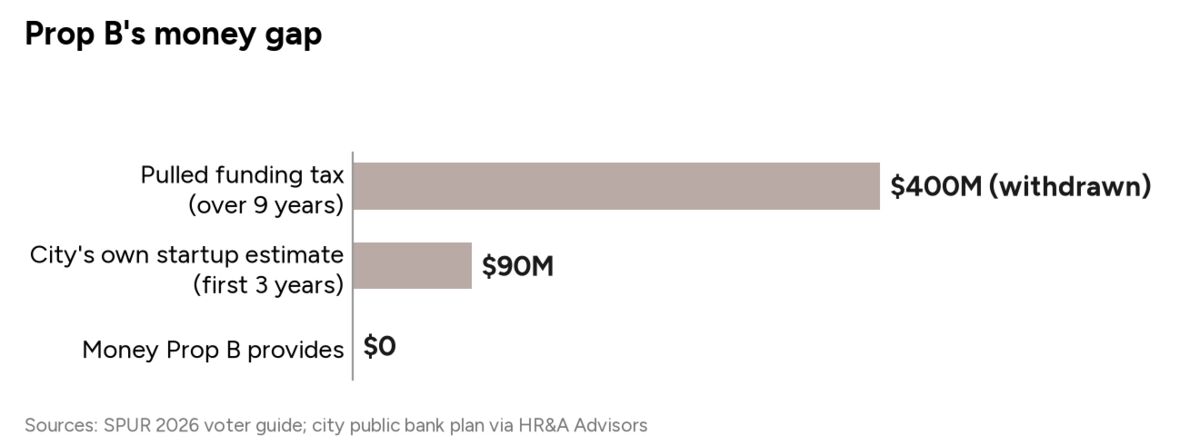
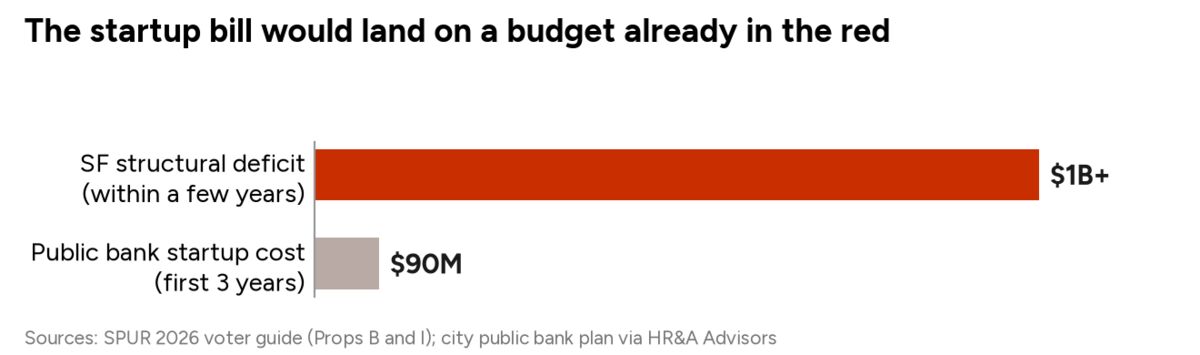
- The bill, if it comes due: the City Controller’s official statement estimates $310 million to $460 million over eight years, based on the city’s 2023 planning numbers. That includes about $90 million to capitalize the MFC in its first three years, about $220 million to run the bank in years four through eight, roughly $4 million a year to set up the MFC, and $550,000 to $600,000 a year for the oversight commission. The Controller says actual costs could be significantly higher or lower. Mission Local puts the startup capital needed before the bank could make loans at about $325 million.
- The funding tax was withdrawn. In February, Supervisor Jackie Fielder introduced a gross receipts tax increase on credit card companies, consumer lenders and mortgage brokers. It would have put $400 million over nine years into a Public Bank Fund. She withdrew it in March, before it reached the ballot.
- SPUR’s assessment: without capital, “the MFC would remain inactive and unfunded.” Any money would likely have to come from the general fund or new taxes, at a time when the Controller projects General Fund structural shortfalls of $1.1 billion by 2030.
Who carries the risk?
San Francisco would.
- Its job is to make loans banks won’t. The MFC’s stated purpose is to fill gaps in private lending: affordable housing, small businesses and borrowers the market underserves. Some of those gaps exist for good reasons. A borrower private banks have turned down is often one that lenders with their own money at stake judged too risky.
- It would lend cheap, too. The MFC could offer low-interest loans, credit enhancements, guarantees, and revolving loan funds". Lower rates mean less interest income to absorb the loans that go bad. A guarantee puts the city on the hook for someone else’s loan.
- The money would be public money. With the funding tax withdrawn, SPUR expects capital “may require General Fund or new revenues”. The Controller adds that some capital could take the form of city grants and forgivable loans “which are unlikely to be repaid,” and that the city would have limited control over the bank’s financial results. If loans go bad, losses come out of the same pot that pays for police, fire, Muni and public health.
- The investment rules are political ones. The charter would bar loans to whole industries and to businesses with labor-law violations. That’s a values screen, not a credit screen, and it’s written into a document that takes a citywide vote to change.
Who watches the money?
Prop B would put a new pool of public money under new city-created boards, in a city with a recent record of public money going to insiders.
- Public Works. Former director Mohammed Nuru admitted to a string of bribes and kickbacks tied to city contracts and was sentenced to seven years in federal prison.
- Public Utilities. Former SFPUC general manager Harlan Kelly, swept up in the same investigation, was convicted of fraud charges tied to bribes and false bank-loan applications and sentenced to four years. He is appealing to the Ninth Circuit.
- Human Rights Commission. In March 2026, District Attorney Brooke Jenkins charged former HRC director Sheryl Davis with 19 counts, including 13 felony conflict-of-interest counts, misappropriation of public funds and three counts of perjury. Prosecutors allege she steered more than $4.5 million in Dream Keeper funds to Collective Impact, a nonprofit she used to run. Davis has pleaded not guilty and hasn’t been convicted.
The Dream Keeper case is the closest parallel. It involved city money handed out through community organizations for equity goals. That’s close to how the MFC is designed to work: most of its loans would go out through community lenders, and the measure’s stated aim is to reach borrowers that private banks pass over. A loan that goes to a connected borrower and isn’t repaid can look like an ordinary bad loan, and that makes it harder to catch than a padded contract.
The charter creates oversight commissions for the MFC and the bank. It doesn’t say how they would catch that kind of problem, or who would be accountable if they didn’t.
How did we get here?
- 2017: The Board of Supervisors recommended studying a public bank, which led to a feasibility study.
- 2019: Then-Assemblymember David Chiu’s AB 857, the California Public Banking Act (co-authored with Assemblymember Miguel Santiago), gave local governments a legal path to charter public banks.
- 2021–2023: The Board created the SF Reinvestment Working Group in 2021. It produced a business plan for the MFC in 2023. The Board adopted its recommendations unanimously, and they are the basis for Prop B.
- 2026: Fielder introduced the funding tax in February and withdrew it in March. Supervisor Chen then sponsored Prop B, with Fielder, Melgar, Mahmood and Walton as co-sponsors. It passed the Board 9–2 on July 7, with Supervisors Sherrill and Wong voting no. It needs a simple majority of voters.
San Francisco isn’t the first to try. Los Angeles voters rejected a public-bank measure in 2018, and Berkeley is voting this November on a six-year parcel tax expected to raise about $9.2 million in its first year, or about $58 million over six years, to fund one.
The case against
- It’s an empty shell, until it isn’t. Prop B creates boards, commissions and a mission, but no capital. Either it stays a bank on paper, or City Hall eventually funds it with public money, on the Controller’s estimate $310 million to $460 million of it. Voters are approving the structure now and the bill later.
- It goes in the wrong document. SPUR’s main objection is that it locks detailed governance into the charter just as the city is trying to simplify it. “Establishing a public bank does not require these governance provisions to be in the charter.” The city could do it by ordinance. On the same ballot, Prop A would cut the number of boards and commissions in the charter from 55 to 38.
- Bad timing. With a structural deficit of more than $1 billion ahead, any capital would come from the same scarce dollars as police, fire, public health and Muni, and be lent out at below-market rates to riskier borrowers.
- Oversight track record. San Francisco has had three major corruption cases involving public money in recent years: Nuru, Kelly and the Dream Keeper charges. A new public lender would be another place public money could go to insiders.
- Hard to fix later. Anything written into the charter takes another citywide vote to change.
Who’s on which side?
- No: Mayor Daniel Lurie; Supervisors Stephen Sherrill and Alan Wong; SPUR; the San Francisco Chronicle editorial board; the San Francisco Chamber of Commerce; the Bay Area Council; GrowSF; ConnectedSF; the Edwin M. Lee Asian Pacific Democratic Club; the Howard Jarvis Taxpayers Association and the California Taxpayers Association (SF Public Press, No on Prop B).
- Yes: Supervisors Chen, Fielder, Mahmood, Melgar and Walton; Board President Rafael Mandelman and Supervisor Matt Dorsey; State Controller Malia Cohen; Assemblymember Matt Haney; the San Francisco Labor Council; Indivisible SF; the Democratic Socialists of America; the Green Party; and the SF Public Bank Coalition (SF Public Press).
Where it stands now
Prop B is on the November 3 ballot and needs 50% plus one to pass. If it passes, San Francisco gets a public lender with a charter-protected mission, its own boards and commissions, and no money. Where that money comes from, and who covers the loans that go bad, would be decided later, at City Hall.