California Spends $15 Billion a Year on Community Colleges. Only 1 in 5 Students Who Came to Transfer Has.
Most students come to community college planning to transfer to a four-year school. Four years later, about 1 in 5 has made it.
TL;DR
California spends $15.3 billion a year on its community colleges, $12,645 per student after inflation, up 26% since 2017-18. Transfers to UC and CSU haven’t moved in seven years. About six in ten new students enroll planning to transfer to a four-year school. Only about one in five of them get there within four years, and the state’s completion rate trails the national average. Meanwhile, a CalMatters investigation found one professor teaching 30 classes, and nobody in the state system tracks it. Californians pay a premium. What is it buying, and who answers for it?
Californians pay a premium for almost everything, including some of the highest taxes in the country. The fair question is always the same: what are we getting for it?
Start with community colleges.
This month, CalMatters reported on a community college professor teaching 30 classes to about 1,100 students this fall. In 2024, 11 colleges and universities paid her a combined $793,000-plus, more than any community college administrator in the state, including the system’s chancellor. CalMatters asked the obvious question: are her students learning?
Nobody in California’s community college system can answer it. That’s the real story.
What we pay
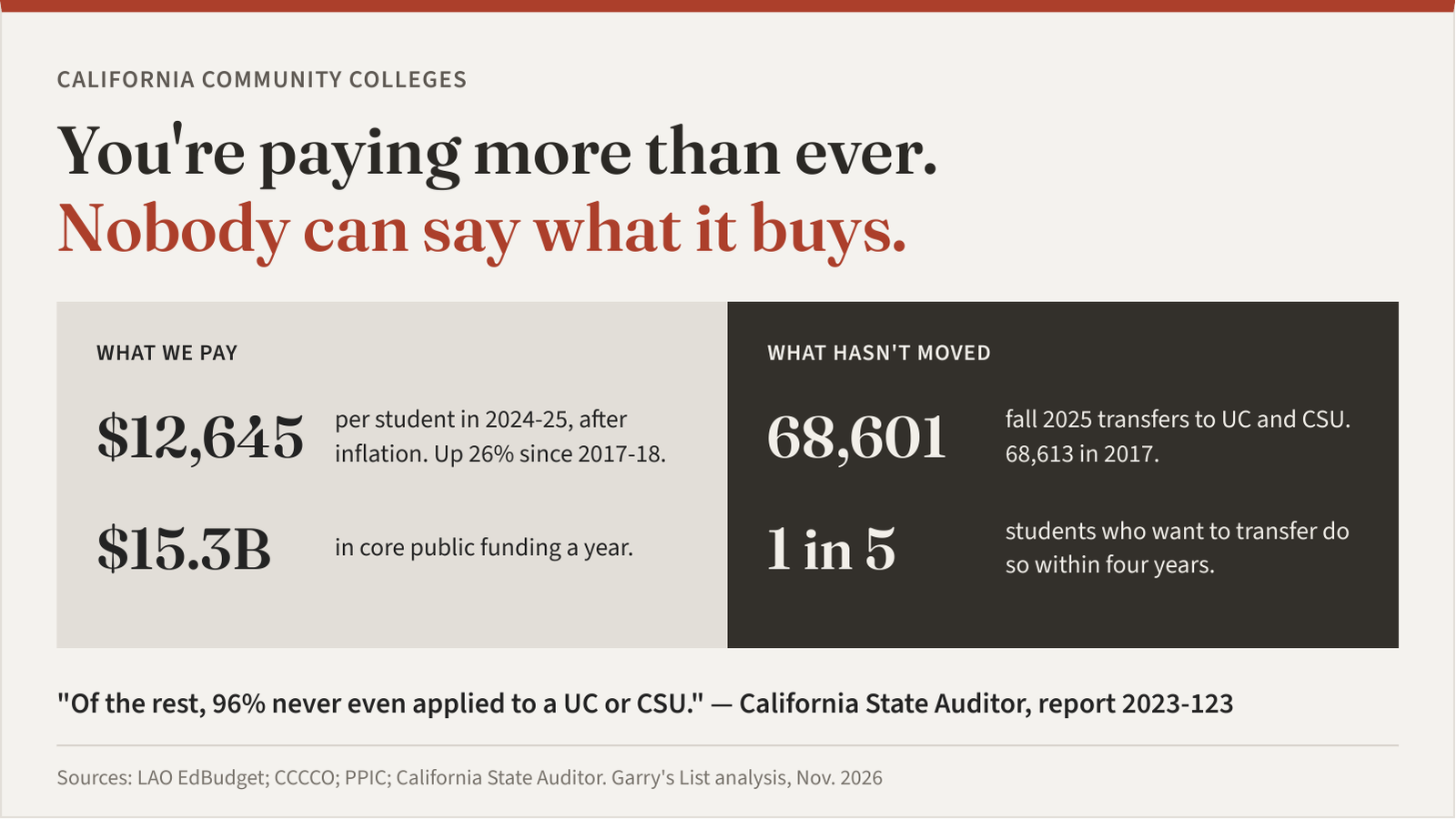
California spent $15.3 billion in core public funding on community colleges last year. After inflation, that’s $12,645 for every student, up from $10,071 in 2017-18, according to the Legislative Analyst’s Office. That’s a 26% raise in seven years, and more per student than at any point in at least a decade.
This isn’t fewer students splitting the same pot. The state’s main funding stream for the colleges rose 22% after inflation while funded enrollment slipped about 3%. The state is putting in a lot more money.
What we’re getting
Community colleges have three jobs: getting students to a four-year school, training them for work and teaching basic skills. Transfer is one of the system’s core promises, and it’s the one most students sign up for. About six in ten new community college students say they’re there to transfer and earn a bachelor’s degree, according to the Public Policy Institute of California. For most students, this is the promise. And it’s stuck.
- Transfers are flat. In fall 2017, 68,613 community college students enrolled at a UC or CSU as new transfers. In fall 2024, it was 66,985, down 2%. The newest count, fall 2025, is 68,601, still no higher than where it started (CCCCO; EdSource).
- Most who came to transfer don’t. Only about one in five do it within four years, and fewer than three in ten within six. PPIC says that share “has changed little over time.”
- Most never even apply. The State Auditor followed 940,000 students who started community college planning to transfer. Four years later, about 195,000 had made it. Of the rest, 96% never applied to a UC or CSU.
- Completion trails the nation. Of Californians who started at a community college in fall 2019, 39.7% had earned a degree or certificate six years later. Nationally it’s 44.1% (National Student Clearinghouse). The rate is rising, but no faster than before the new money arrived.
California spends more per student. Transfers haven’t moved.
How much each number has changed since 2017-18. 100 means no change; 126 means up 26%
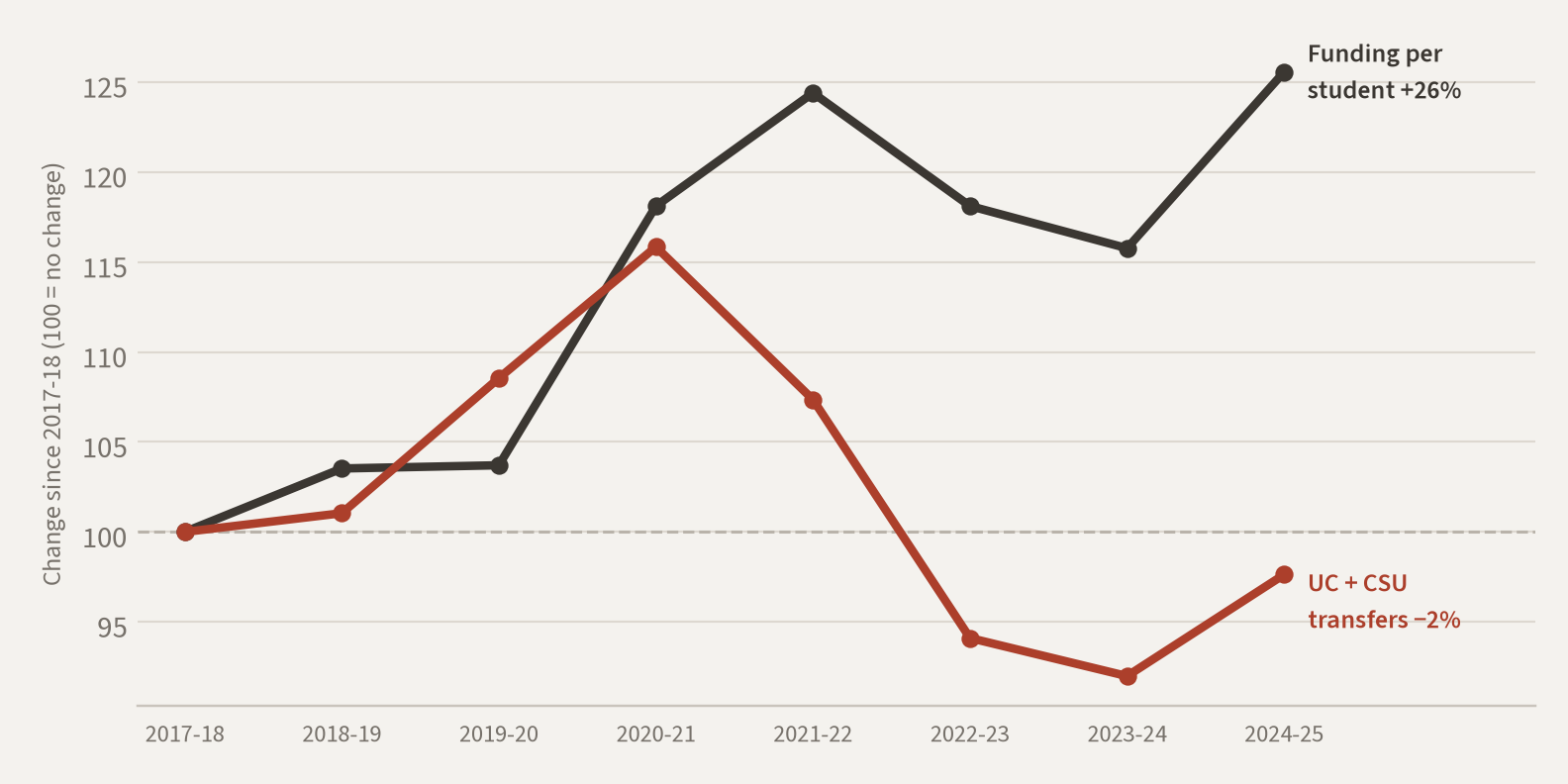
Source: LAO EdBudget tables (Prop 98 per funded FTES, 2025 dollars, CPI-U; 2024-25 net of $408M deferral repayment); CCCCO Vision 2030 deck (May 2026); CSU and UC transfer dashboards. Fall 2025 transfers: 68,601.
The students who do make it to a four-year school do well: they finish a bachelor’s within four years 76% of the time at CSU and 87% at UC (PPIC; UC). The students can do the work. The system isn’t getting them there.
Nobody is keeping score
Back to the 30-class professor. No rule stopped it. California has 73 community college districts. Each sets its own limits on part-time teaching and sees only its own payroll. Nobody adds up one instructor’s classes across districts. CalMatters had to piece it together from payroll records, course catalogs and faculty directories.
This isn’t an isolated case. CalMatters found at least 70 part-time instructors paid by five or more community college districts, CSU or UC campuses in the same year. One astronomy instructor said he teaches about 50 online classes and labs, for colleges in California and several other states, from an office above his garage in Michigan. “In its current form, I am not grading anything (by hand),” he told CalMatters.
State and federal rules require online instructors to interact with students regularly (Title 5 §55204; 34 CFR 600.2). Who checks? Chris Ferguson, an executive vice chancellor at the Chancellor’s Office, told CalMatters that the district, not the statewide system, should be accountable. But each district sees only its own slice. Ferguson also said the state doesn’t know how many part-time instructors it has, because its counts don’t account for people who teach in more than one district.
Every district keeps pass and withdrawal rates for every class it runs. None of it is public class by class, and nobody connects it to how many classes the instructor is teaching across the state.
We aren’t claiming these instructors are why transfers are stuck, or that results got worse. Nobody can make that claim either way, because nobody has checked. That’s the problem.
Who can fix it
Three bodies: the Chancellor’s Office, which runs the statewide system and already collects the data; the Board of Governors, which oversees it; and the Legislature, which writes the funding formula. None of this needs a new bureaucracy.
- Count teaching loads statewide. The Chancellor’s Office already collects payroll and course data from every district. Today one instructor can teach 30 classes and nobody in Sacramento knows.
- Publish results for every class. How many students passed, how many dropped and how many came back the next term, next to the instructor’s total statewide load. If you’re paying for a class, you should be able to see whether it works.
- Pay for results. Most of the state’s funding formula still follows enrollment. Only a small slice rewards outcomes like transfers. That slice should grow. When money follows results, results get attention.
Where it stands
California is paying more per student than ever. Where we can check the results against a benchmark, they’re flat, below the national average or short of the state’s own goals. That’s not the California standard we should accept.
It doesn’t have to be this way. California’s 1960 Master Plan promised that anyone could start at a community college and finish at a UC or CSU, and it became a model for the country. That promise is still worth keeping. Keeping score is how we keep it. We pay a premium. We should get a premium system, and proof that it’s working.