A Funding Deal Is Hollowing Out California’s Public Ivies
A 2022 state funding deal has quietly forced California’s elite research universities to chase graduation quotas at the expense of academic rigor, turning Nobel-minting institutions into remedial classrooms.
TL;DR
California built the world’s best public university system on a simple idea: the right institution for every student. A 2022 funding deal replaced that with a graduation quota. The UC system is paying for it in hollowed-out degrees and displaced research.
In 1960, the California Master Plan for Higher Education created an ambitious, yet pragmatic, statewide architecture to give every Californian an affordable pathway to a university degree.
But today, the pragmatic aims of the Master Plan have been scrambled. A recent mandate for equal outcomes has pulled research faculty hired to work at the frontier into teaching high-school material. The key driver of this little-known agreement between Sacramento and the University of California, the 2022-2027 Multi-Year Compact. Signed in the midst of the pandemic recovery, the Compact ties new state funding to a set of institutional requirements.
Although radical for its time, the 1960 Master Plan was realistic in seeing education as a limited, valuable resource: It committed to a tuition-free education but acknowledged that taxpayers picked up the tab, requiring that education dollars be allocated efficiently. It tasked different institutions—community colleges, state schools, and the UCs—with different kinds of educational responsibilities to ensure equity of access without sacrificing cutting edge research.
The Master Plan’s coherence requires that students be accurately matched to, and therefore prepared for, the institutions they attend. Yet the UCs, which are at the heart of the plan, have lost this focus. Largely as a consequence of the 2022 Compact, they have been tasked with the impossible: Teach students needing high school remediation while simultaneously attempting to provide cutting edge education to those operating at the frontier.
The Master Plan
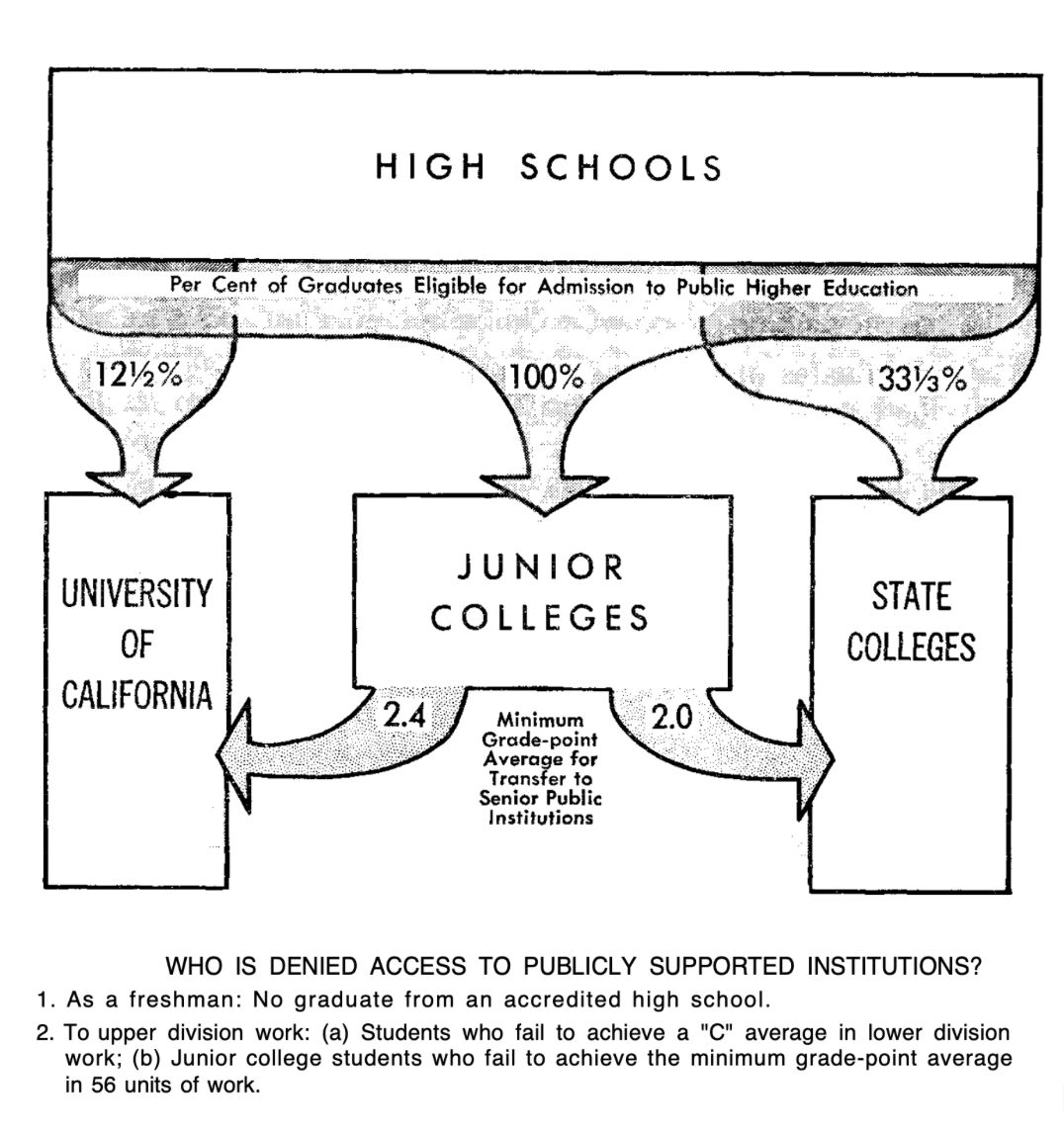
The concept of the Master Plan was straightforward: The community colleges (née junior colleges) would meet students where they are, the California State system would serve a broader competitive range, and the UCs would focus on research and PhD training at the frontier of knowledge. The plan called for the creation of many more community colleges focused on underserved areas, resulting in the largest public education system in the world. California leads our nation in social mobility because of the system the Master Plan produced.
The Master Plan also created a California version of the Ivy League—the UCs—with a public school sticker price, and with a public service mission.
This is in part because the Plan has multiple affordances for the late bloomer, or those behind in their educational preparation. Even the high school dropout has access to California community colleges. A student who does well in community college has generous transfer opportunities to a Cal State or a University of California (UC) campus. The transfer pathways also enable low-cost attainment of degrees from UCs—one can earn nearly free credits and then transfer to a UC where one earns their diploma.
The New Compact’s Requirements
The 2022-2027 Compact was celebrated when it first passed because it expanded Californians’ access to the UCs. It guaranteed more seats to Californians while offsetting the tuition loss of having fewer non-domestics with additional taxpayer funding. In addition to more Californians, UC agreed to admit more students overall, with growth concentrated (15%) at the already crowded, most popular campuses (Berkeley, UCLA, and San Diego). Yet it did not match this increase in students with a large increase in faculty: Today, UC Berkeley has 45,000 students and about the same number of faculty as in 1990, when 30,000 students were enrolled. Meanwhile, some teaching-focused Cal State campuses are laying off faculty.
The Compact committed UC to raising the 4-year graduation rate to 76%. At its own initiative, the University of California Office of the President (UCOP) went further, committing to a 6-year graduation rate of 90%. In 2024, UCOP seemed to promise more, announcing, “UC is committed to ensuring that every student who starts at the University leaves with a degree.” Berkeley’s most recent 4-year graduation rate is 81%.
The Compact had ambitious equity requirements. In particular, it included an “aspirational target to eliminate gaps between…graduation rates and those of low-income (Pell-eligible), and underrepresented groups by 2029-30.” This would require Berkeley to increase graduation rates of underrepresented students by 11%.
Several other priorities were set by the Compact. It requires a huge increase in STEM graduates: 25% more STEM degree holders by 2027. The Compact also requires UC to double the number of credits earned through online courses.
On their face, these requirements, known as “performance goals,” seem laudable and easily verifiable. The problem is that they are subject to something known as “Goodhart’s law,” the idea that institutions will become so focused on reaching the right number that they forget what those numbers are actually meant to measure.
The Compact’s Problems
While the Master Plan created opportunity for all, the new Compact demands outcomes for all. The shift is explicit in UCOP’s own language. A policy document declares, “Equity in access must be matched by equity in outcomes.” It further specifies, “Driving equity in STEM education means creating the conditions for all students to be able to learn—regardless of their background, preparation, or access to outside resources.” As such, the UCOP language speaks in the imperative, “ensuring” rather than “enabling;” invoking success of “every” student rather than those who strive to graduate. These are not mere marketing slogans. UCOP operationalized them, building public dashboards of metrics such as graduation rates and tying leaders’ performance to them.
A graduation rate is supposed to stand for something: that the student has performed UC-level work and earned a degree accordingly. Goodhart’s law warns that once a measure becomes a target, institutions optimize the number rather than the goal it represents. The trap here is set by the phrase, “regardless of preparation.” Such preparation is done before college, in the K-12 system that UC does not run, yet this system determines whether the student can work at the research frontier. An outcome that depends on inputs that UC does not control can be equalized in two ways: by pouring more resources into remediation until the underprepared meet the bar, or by lowering what the degree requires until everyone can jump over it.
Because the Compact sets no quality floor, it invites lowering the bar. The same report that calls for equal outcomes also celebrates a series of pedagogical innovations that are concerning or that do not fulfill the original goals of the frontier-focused UCs. For instance, lowering placement thresholds and redesigning math sequences to replace abstract reasoning with discipline-specific applications for life science and social science majors. Giving regular college credit for “foundational” workshops covering pre-college material is discussed approvingly because it ensures “that it contributes to degree progress.” These innovations may be borne of necessity—we dropped the SAT requirement and we do not accept letters of recommendation.
None of this is bad faith; it is simply a matter of incentives. The Compact failed to create a detection mechanism for grade inflation or hollowed-out courses. On a dashboard, there is no indication how the degree was earned: the right way, by raising up students, or the wrong way. This imperils a successful education system.
A Return to the Master Plan
California’s Master Plan was comprehensive, pragmatic, and progressive for its time. It boldly answered the question, who gets “access to publicly funded institutions?” with “100 percent of high school graduates.” To achieve that grand commitment, it divided labor amongst the community colleges, state colleges, and the UCs, which are meant to be devoted to frontier research.
The Compact may, with the best intentions, have harmed the frontier research institutions Californians rely on for leadership in the sciences. Taken to its logical endpoint, UCOP’s framework asks the research campuses to do a job the system already assigns elsewhere. To bring students into STEM regardless of preparation, the UCs would have to staff hundreds of sections of remedial courses and grant credit for high school material. With enough money from Sacramento, this could be done. But the resources are not free even when the dollars are: every faculty line and classroom devoted to remediation is one not devoted to teaching at the frontier. You cannot have both.
The UC’s trajectory illustrates a general principle: institutions with too many goals are bound to do none well. And this is why the Master Plan’s division of labor made sense. It addressed the challenge of allocating education resources while maintaining the value in selective institutions. The community colleges and Cal State system have faculty who are expert in teaching undergraduates. The Master Plan assigned them the mission of teaching to make a difference in every student’s life. The UCs cannot take on that mission without losing their defining one: frontier research and the opportunity to learn from such researchers. This is a recipe so rich that UC minted 4 Nobel prize winners last year. Yet, Berkeley’s leaders remain confused about it. They recently released a strategic plan proposing to deliver, “personalized education to students from vastly different starting points.” That is exactly the opposite of what UCs do.
The opportunity to learn directly from researchers is a central purpose of the Master Plan. Berkeley’s mission is to foster in students a “mature independence of mind,” to develop students who not only can transmit information, but discover new knowledge. That happens through close contact with researchers who can spot the seeds of a good idea in a student and cultivate them, work that cannot be scaled or scripted. A remediation mandate crowds out this mentoring.
A New Compact
The Compact injected a shock into a well-conceived system. It set out to advance equity and instead engineered a transfer of equities—one that fails on the balance sheet. In its vision, fairness demands that everyone receive a degree under a de facto open-admissions model at the UCs, propped up by remediation. But that vision hides the unfairness it imposes on others: California’s research-ready students watch institutional dollars flow to remediation instead of the frontier, and the taxpayers who funded a Nobel-making machine watch its faculty teach remedial math instead of advanced seminars.
The Compact does not contemplate these tradeoffs, nor anticipate the obvious pathologies, and the students and taxpayers who most need a true public Ivy bear the cost. In the end, it breaks faith with the most important compact of all: the promise that public education could be both inclusive and cutting-edge. The question, then, is what a compact honoring both halves of that promise would look like.
Beneath the Compact lies a tension of visions. Is the UC system an engine of social mobility, or an epistemic institution devoted to discovering and testing knowledge? It is both—but not symmetrically, because the knowledge discovery mission produces social mobility. The UCs widen opportunity because they are grounded in frontier inquiry: its graduates rise because a Berkeley degree certifies the mature independence of mind necessary to think about cutting-edge concepts. Tilt the system so that handing out degrees becomes the primary aim, and it imperils both knowledge discovery and social mobility.
A compact that genuinely wanted maximum mobility would therefore protect the knowledge discovery mission. Where the Compact set outcome targets and left quality to chance, a new one would pair every outcome target with a quality floor, and build the tripwires the present dashboards lack: tracking grade distributions, gateway-course standards, and course rigor as closely as UCOP now tracks graduation rates, so that a degree earned by lowering the bar is as visible as one that wasn’t.
Cost belongs in a new compact too. We should be wary of the easy promise of “free” tuition, because tuition is never free: the taxpayer pays, and is owed an accounting. Finite public dollars must be fit for purpose, which is the Master Plan built in from the start. A compact that keeps faith with the taxpayer does not promise a degree to everyone; it ensures the degree still means something. That is the only way to make public education both inclusive and cutting-edge.
Discussion
Discussion is for vetted members. Apply to join or log in.