$720 Million, 594 Deaths, Zero Accountability
SF nonprofits preside over overdose deaths while collecting billions. The city just renewed their contracts anyway.
Source: thevoicesf.org
Source: thevoicesf.org
TL;DR
SF’s top homeless nonprofits received $720 million over five years while 594 people died of overdoses in their buildings—and the Board of Supervisors just unanimously extended their contracts.
Newsom’s $236 million mental health program helping just 22 people in four years is a scandal. But that’s nothing compared to what’s happening right here in San Francisco, where $720 million flowed to nonprofits presiding over 594 overdose deaths in their buildings—and the city just renewed their contracts anyway.
Archived tweetGovernor Gavin Newsom’s $236M program for California’s mentally ill has helped just 22 people in four years: report https://t.co/6MNTcque85 https://t.co/dh0ySpEcAt
California Post @californiapost January 27, 2026
That state failure is just the tip of the iceberg. In San Francisco, the homeless industrial complex has turned death into a business model.
The Body Count Behind the Billions
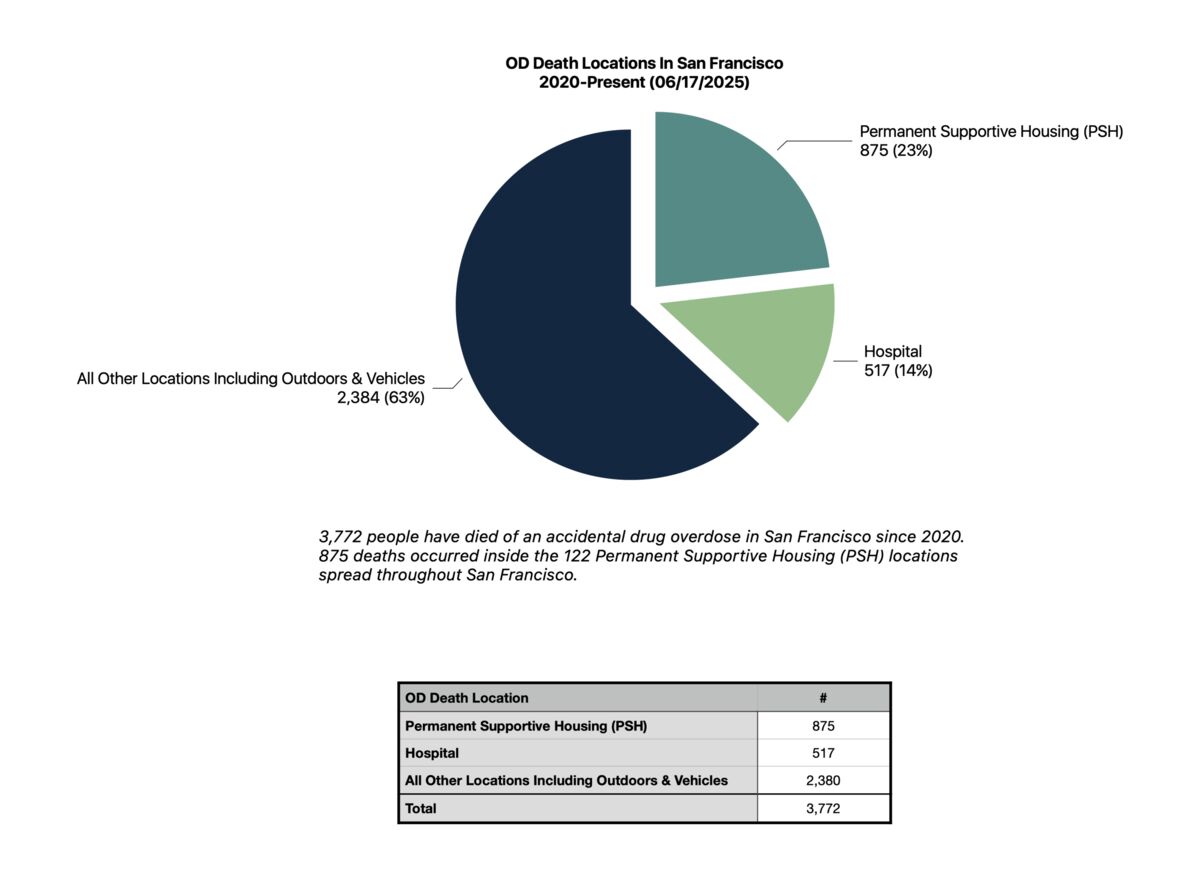
Since 2020, 3,772 people have died of drug overdoses in San Francisco. That’s nearly three times the 1,398 COVID deaths in the same period. But here’s what should enrage every taxpayer: 875 of those deaths—23%—occurred inside what the city calls “Permanent Supportive Housing.”
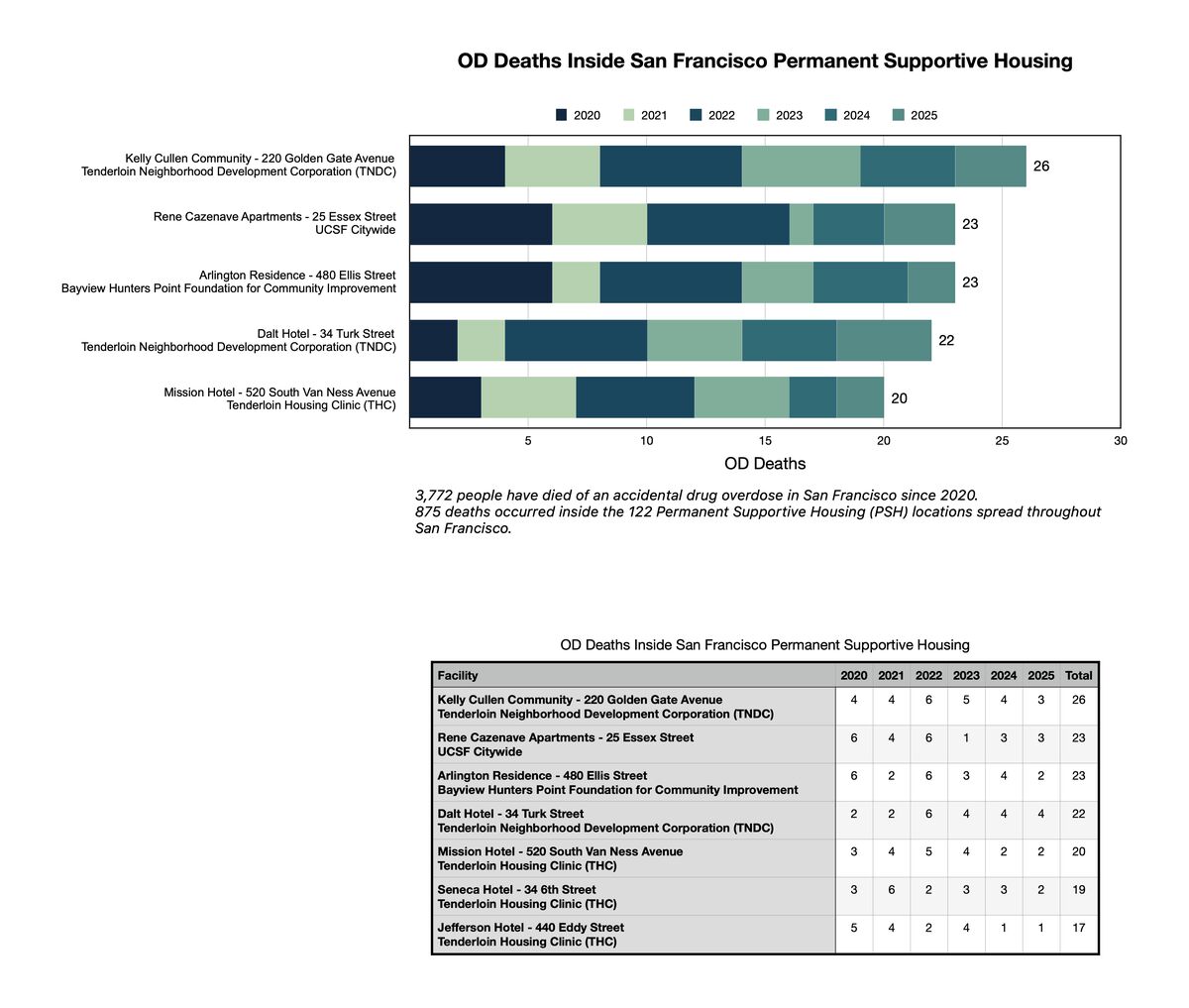
![OD Deaths Inside San Francisco Permanent Supportive Housing
2020 2021 2022 2023 2024 2025
Episcopal Community Services (ECS) [162]
Tenderloin Housing Clinic (THC) [156]
Tenderloin Neighborhood Development Corporation (TNDC) [93]
Conard House [67]
Department of Homelessness and Supportive Housing (SF HSH) [58]
OD Deaths
20 40 60 80 100 120 140 160 180 200
3,772 people have died of an accidental drug overdose in San Francisco since 2020.
675 deaths occurred inside the 122 Perm...](https://dm2nowkhw0ff4.cloudfront.net/uploads/hqm4uavzvxqg5juet2nulxf6mus1)
The top five providers account for nearly 70% of all PSH deaths. The Voice of San Francisco reports the grim leaderboard: Episcopal Community Services (162 deaths), Tenderloin Housing Clinic (156 deaths), Tenderloin Neighborhood Development Corporation (93 deaths), Conard House (67 deaths), and HomeRise (58 deaths).
How much did these providers receive while people died in their buildings? $720 million over five years. Episcopal Community Services alone took in $266 million. Tenderloin Housing Clinic: $278 million.
Not one responded. $720 million, 594 deaths, complete radio silence.
Failing Up: How Bad Performance Gets Rewarded
In any rational system, providers with the worst outcomes would lose their contracts. In San Francisco, they get raises.
On June 3, 2025, the Board of Supervisors unanimously approved extending ECS’s contract—the nonprofit that leads all others in overdose deaths—by over $25 million through 2027. The new total: up to $72.3 million.
Mayor Lurie signed off on it. This shouldn’t surprise anyone who’s tracked his connections to the nonprofit industrial complex. According to the Voice’s investigation, Lurie chose Chris Block—founding director of coordinated entry at ECS—to lead his Tipping Point $100 million Chronic Homelessness Initiative from 2017 to 2022. That initiative aimed to reduce chronic homelessness by half. It “failed spectacularly.”
Lurie’s “crowning achievement,” 833 Bryant, which he built with Tipping Point and a $65 million gift from the Schwabs? ECS still provides services there. The medical examiner says more than a dozen people have died from drug overdoses inside since 2021.
HSH’s own deputy director admitted the obvious during a deposition: they “don’t have total control” over the nonprofits they fund. They’re writing checks with no strings attached.
The State Policy Making It Worse
This isn’t just a San Francisco failure. California’s entire approach guarantees these outcomes.
State policy mandates that publicly funded homeless housing must allow unlimited drug use—"wet" housing. When the legislature passed AB255 to allow funding for sober recovery housing, Newsom vetoed it. The pattern statewide is identical: $24-37 billion spent on homelessness since 2019, homelessness grew 31%, and 40,000 people died of overdoses.
The California State Auditor found over $70 billion in lost taxpayer funds across state programs, labeling California the “fraud capital.” $24 billion of that went to homelessness with no meaningful outcomes.
Harm reduction has become harm acceleration. Until we fund treatment, recovery, and shelters—until we bring back accountability and tie funding to outcomes—this death machine will keep running on taxpayer dollars.
The pattern is clear: billions flow to nonprofits that preside over deaths, contracts get renewed, and state policy actively prevents recovery-focused alternatives. Watch whether the new administration changes anything—or continues business as usual.
Follow @garrytan for more.
Related Links
-
Housing first, morgue second - The Voice of San Francisco (The Voice of San Francisco)
-
California State Auditor: $70B+ in lost taxpayer funds (@Rightanglenews)
-
California homelessness spending failure analysis (@Twolfrecovery)
Comments (0)
Sign in to join the conversation.