The ‘CEO Tax’ Scam That Will Crush Your Grocery Bill
It doesn’t tax CEOs. It’s an 800% gross receipts hike that hits Safeway shoppers while executives pay nothing.
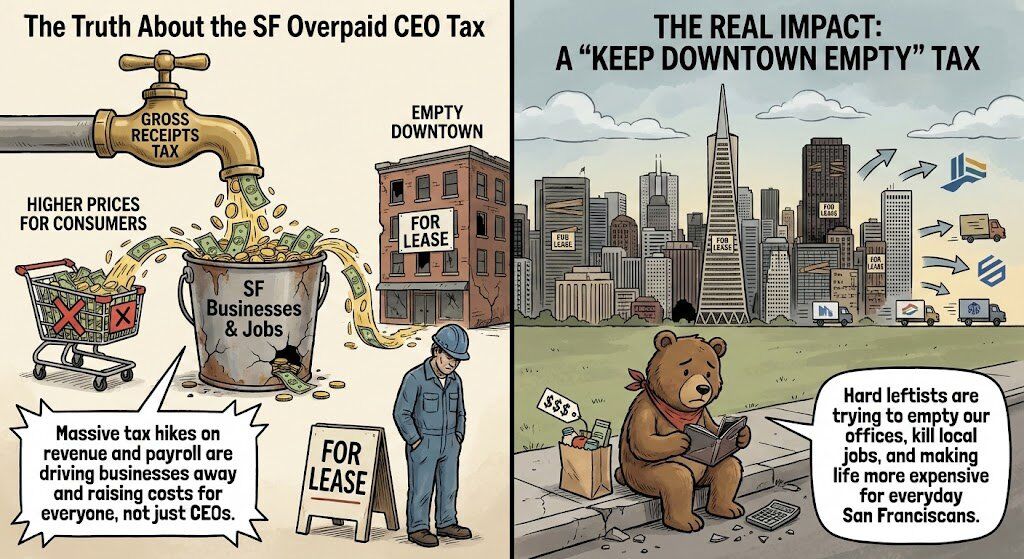
Source: x.com
Source: x.com
TL;DR
The so-called “CEO tax” doesn’t tax CEOs at all—it’s an 800% gross receipts tax increase that will be passed directly to consumers as higher prices while breaking the business-labor deal voters just approved.
San Francisco’s so-called “CEO tax” is back on the June 2026 ballot, and the hard left is betting you won’t read the fine print. Here’s what they don’t want you to know: the tax doesn’t touch a single CEO’s paycheck. Not one cent. It’s an 800% gross receipts tax increase that will hit grocery shoppers, pharmacy customers, and working families—while the actual overpaid executives living in Pacific Heights won’t feel a thing.
The ‘CEO Tax’ Lie: Who Actually Pays
Let’s cut through the populist branding. GrowSF reports that the “CEO tax” is actually a gross receipts tax—meaning it’s levied on total revenue, not profits. CEOs don’t write these checks. Businesses do. And economists widely agree that such taxes get passed directly to consumers through higher prices.
Here’s the detail supporters never mention: the Administrative Office Tax—based on employee payroll in San Francisco—also gets jacked up 800%. Low-margin businesses like grocery stores and discount retailers get hit hardest. That means your Safeway run is about to get a lot more expensive, while every CEO in your neighborhood sees zero personal impact.
$400 Billion Already Walked Out the Door
This isn’t theoretical. Schwab, Stripe, Square, and McKesson—companies worth a combined $400 billion—have already left San Francisco citing gross receipts tax burdens. Stripe specifically moved its headquarters out after 2018’s Proposition C, citing a flawed tax structure that wiped out their profit margin entirely.
Want to know why downtown is still 1/3 empty? Here’s the math: a startup with 250 employees and $750 million in gross receipts pays $10.4 million annually in San Francisco. The same company pays $4 million in Oakland, $17,000 in San Jose, and $3,600 in Sunnyvale. An 800% increase doesn’t reverse the exodus—it accelerates it.

Why is the hard left trying to KEEP DOWNTOWN EMPTY with their lie that it's an "Overpaid CEO tax"? Schwab, Stripe, Square, McKesson and more representing cos worth $400B left SF due to Gross Receipts Tax burdens. This increases it 800%. It will kill SF. growsf.org/news/2026-01-23-ceo-tax-doesnt-tax-ceos
The companies that built this city’s tax base are already gone. The ones hanging on will follow if this passes.
Breaking the Prop M Deal
Here’s where the bad faith becomes undeniable. In November 2024, San Francisco voters approved Proposition M—a hard-won compromise between business and labor groups to provide tax relief and simplify the business tax system. It lowered the overpaid-executive tax. It raised the small business exemption from $2.25 million to $5 million. It was a deal.
Now the same labor unions are pushing a June 2026 ballot measure that undoes everything voters just approved. The tax cut WAS the deal. If San Francisco can’t keep agreements for even 18 months, why would any business ever trust this city again?
Archived tweetHard left groups in SF are actually breaking a deal that was made between business and labor groups for Prop M in 2024 to provide relief to SF. SF has still not recovered. 1/3 of downtown is still empty, and it will stay that way if they win. https://t.co/pgcR3LFgpD
Garry Tan @garrytan January 24, 2026
Moderate Supervisors Under the Microscope
This is the moment of truth for every supervisor who ran as a “moderate” and took campaign donations from business-friendly donors. Garry Tan put it bluntly:
Archived tweetI can't tell you how deeply disappointed I am that a number of supervisors *WE WORKED HARD TO ELECT* are choosing to shut the door on business in San Francisco. You know who you are.
Garry Tan @garrytan January 24, 2026
GrowSF specifically called out Supervisor Bilal Mahmood for supporting a tax that will disproportionately hurt his own district. People using SNAP benefits to buy groceries will see their food costs rise. Meanwhile, every “overpaid CEO” living in his district faces no personal financial impact whatsoever.
If the supervisors we worked to elect won’t stand up against a misleadingly-named tax designed to punish businesses and consumers alike, what exactly did those elections change?
The June 2026 ballot will determine whether San Francisco continues its decade-long experiment in driving out business or finally commits to recovery. Email your supervisor now—especially if you helped elect them.
Follow @garrytan for more.
Related Links
-
CEO Tax Doesn't Tax CEOs (GrowSF)
-
Proposition M (2024) - Business Tax Reform (SF Treasurer)
-
Garry Tan on the $400B exodus (@garrytan)
-
SF tax comparison across Bay Area cities (@garrytan)
Comments (0)
Sign in to join the conversation.