Stanford’s Fake Disability Crisis Is America’s Future
When 38% of students at America’s most elite university claim disability status, the system isn’t broken—it’s working exactly as designed.

TL;DR
Nearly 40% of Stanford undergrads are registered as disabled—versus 3-4% at community colleges—because the school rewards gaming over honesty. And as one student wrote: “You’d be stupid not to game the system.”
When 38% of students at one of America’s most elite universities claim disability status, the system isn’t broken—it’s working exactly as designed. And that’s the problem.
"You'd be stupid not to game the system" is how the third-worldification of the US truly happens, as the third world itself develops. Draft Kings/crypto gambling, and other kinds of casino games as the only hope of making it big fast instead of regular, normalized work, etc.
This thesis nails it. The gaming has become normalized, and it’s not limited to DraftKings and crypto—it’s metastasizing through our most prestigious institutions.
The Stanford Scam: Gaming Disability for Better Dorms
The numbers are damning: 38% of Stanford undergraduates are registered as having a disability. Meanwhile, at community colleges? Three to four percent. The schools that boast the most academically successful students are the ones with the highest “disability” rates—disabilities that you’d think would deter academic success.
The accommodations are generous: single rooms (instead of cramped triples), extra test time (some students get double), excused absences, late assignments, and even exemptions from class participation for “social anxiety.” The process? A 30-minute Zoom call with minimal skepticism. According to one Stanford student who wrote about her experience, she “probably didn’t even need a doctor’s note.”
Even students with legitimate diagnoses feel the rot. One student with ADHD and Asperger’s admitted: “I probably didn’t deserve the accommodations, given the fact I got into Stanford and could compete at a high academic level.”
Fake Jains and Whole Foods: The Meal Plan Hustle
The gaming doesn’t stop at disability. Stanford requires undergrads to purchase an $7,944 annual meal plan—unless they claim a religious dietary restriction the cafeteria can’t accommodate.
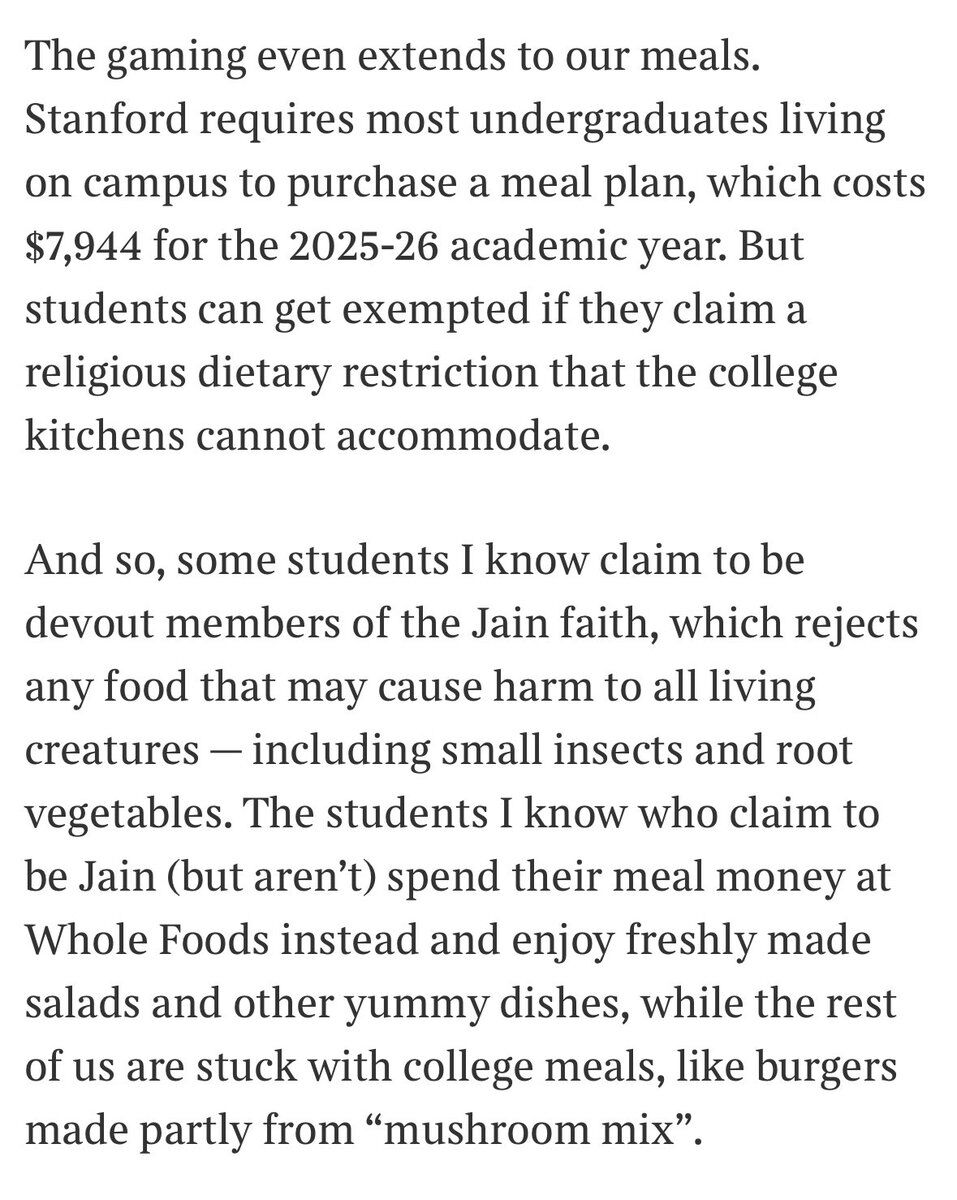
So some students claim to be devout members of the Jain faith, which rejects any food that may cause harm to living creatures—including insects and root vegetables. They spend their meal money at Whole Foods instead, enjoying freshly made salads while their honest classmates eat “burgers made partly from mushroom mix.”
Administrators are powerless. How do you challenge a religious dietary claim without risking a discrimination lawsuit? The university created a system with no verification and wonder why it gets gamed.
‘Accommodations Only Punish the Honest’
Archived tweet“At Stanford, almost no one talks about the system with shame. Rather, we openly discuss, strategise and even joke about it. At a university of savvy optimisers, the feeling is that if you aren’t getting accommodations, you haven’t tried hard enough.” https://t.co/1WeyZnEZ9c
Steve McGuire @sfmcguire79 February 02, 2026
That quote captures the perverse incentive structure perfectly. When the system rewards cheating, the rational choice is to cheat—or be disadvantaged.
This is the playbook: regulate something into a zero-sum game, and wealthy, sophisticated people win because they know how to game it. Stanford didn’t create brilliant students who happen to be disabled at 10x the community college rate. They created incentives, and students responded rationally. That’s what makes it so corrosive.
The Third-Worldification of American Institutions
Indian_Bronson’s insight cuts deeper than the Stanford story. “You’d be stupid not to game the system” is how institutional decay happens. DraftKings and crypto gambling become the only hope of making it big fast instead of regular, normalized work. And then that mindset spreads.
Here’s the twist: the actual third world is developing stronger institutions and less cynical young people. We’re inverting. This isn’t immigration-mediated—it’s the native population losing faith in institutions. When gaming becomes normalized at our most elite schools, trained by our brightest students, it metastasizes everywhere.
The Real Disability: Institutions That Reward Lying
Good institutions get captured by people who hurt those they claim to help. We’ve watched it happen with holistic admissions that hide discrimination, with disability offices that enable fraud, with systems designed to help that become systems to game.
An 18‑year‑old gaming a broken system isn’t the real disability. The real disability is an elite that can’t imagine a world where rules are fair, cheating is rare, and honesty isn’t for suckers. Until places like Stanford decide they’d rather be serious institutions than luxury casinos for status, the third‑worldification of America won’t be happening to us. It’ll be happening through us.
Related Links
-
Indian_Bronson on 'third-worldification' (@Indian_Bronson)
-
Steve McGuire's thread on Stanford gaming (@sfmcguire79)
Comments (0)
Sign in to join the conversation.