Art Won’t Save Downtown From an 800% Tax Hike
SF Chronicle says murals can revive empty buildings. Meanwhile, the city’s about to make it impossible to do business downtown.
Source: x.com
Source: x.com
TL;DR
While the Chronicle dreams of turning empty Embarcadero Center into an art haven, the CEO tax would hike gross receipts taxes 800% and guarantee those spaces stay vacant forever.
An SF Chronicle op-ed suggests public art can revive downtown’s empty Embarcadero Center. Meanwhile, the city is considering an 800% gross receipts tax increase that would guarantee those spaces stay empty forever.
Art Won’t Fill Offices When Taxes Drive Businesses Out
The Chronicle’s latest op-ed proposes transforming Embarcadero Center into San Francisco’s version of New York’s High Line—a scenic walkway filled with public art installations that would somehow lure people back downtown.
Marc Joffe, President of the Contra Costa Taxpayers Association, cut through the wishful thinking:
Archived tweetWhy does @sfchronicle publish such dumb op-eds? It would be great to reactivate the upper levels of Embarcadero Center, but installing a lot of public art isn't going to do it. Lowering the cost of doing business downtown will. https://t.co/FbYatblxmQ
Marc Joffe @joffemd January 25, 2026
That’s the fundamental problem the Chronicle’s op-ed refuses to address. Embarcadero Center isn’t empty because it lacks sculptures or murals. It’s empty because businesses can’t afford to operate there. One-third of downtown SF remains vacant—that’s not an aesthetic crisis, it’s an economic one. No amount of art installations will convince a company to pay crushing taxes when they can set up shop in San Jose for a fraction of the cost.
The 800% Tax Hike That Would Kill Downtown Forever
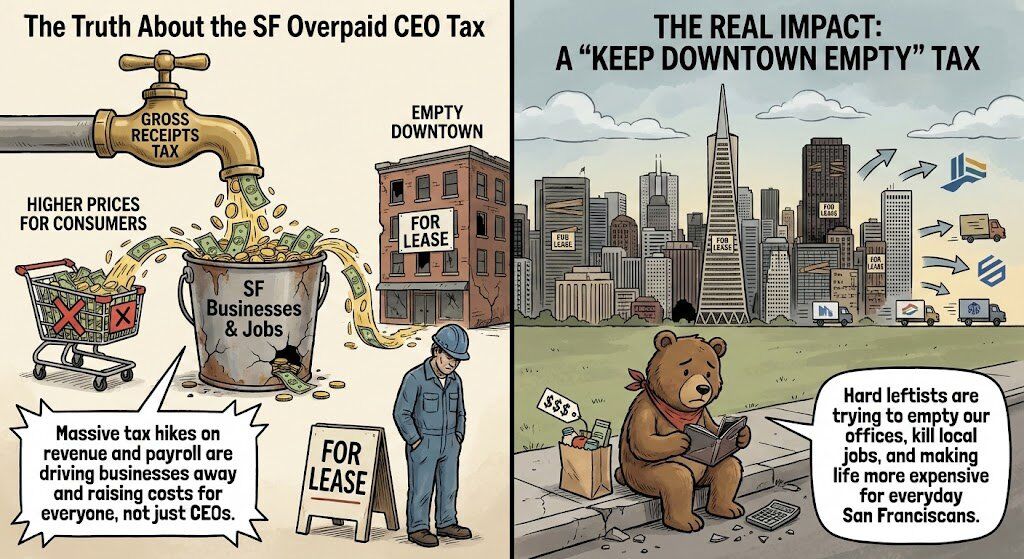
While some are dreaming up art projects, progressive groups are pushing a so-called “CEO tax” that would deliver the killing blow to any hope of downtown recovery.

They're going to increase gross receipts tax by 800% and some people think the way to fill downtown with businesses is art? No, it's actually making a city that encourages business instead of forces it to move away Downtown will be empty forever if there isn't reform
Why does @sfchronicle publish such dumb op-eds? It would be great to reactivate the upper levels of Embarcadero Center, but installing a lot of public art isn't going to do it. Lowering the cost of doing business downtown will. sfchronicle.com/opinion/article/san-francisco-embarcadero-high-line-21305781.php
The name is a lie. According to GrowSF’s analysis, this isn’t a tax on CEO salaries—it’s a gross receipts tax increase of approximately 800%. It also jacks up the Administrative Office Tax (based on SF payroll) by nearly the same amount.
Do the math: A startup with 250 employees and $750 million in gross receipts would pay $10.4 million annually in San Francisco. That same company would pay $17,000 in San Jose. $3,600 in Sunnyvale. This isn’t a small premium for the privilege of a SF address—it’s economic suicide.
Worse, this tax would shatter the deal voters approved with Prop M in 2024, which was supposed to provide business tax relief. The hard left is breaking that promise before the ink is even dry.
$400 Billion Already Walked Out the Door
This isn’t theoretical. Schwab, Stripe, Square, McKesson—companies worth a combined $400 billion—have already fled San Francisco, citing gross receipts tax burdens as a major factor. The “leave before the B” mentality has spread like wildfire among startup founders: get out before your Series B, before the tax burden becomes unbearable.
An 800% increase wouldn’t just accelerate departures. It would ensure that no new headquarters ever locates in San Francisco again. Why would any rational business leader choose to pay millions more in taxes when better options exist 30 miles away?
Downtown SF’s recovery requires reducing the cost of doing business, not adding murals to empty buildings. If the CEO tax passes, no amount of public art will bring businesses back. The Embarcadero will stay empty—but at least it’ll have nice sculptures for the few tourists who bother to visit.
Follow @garrytan for more.
Related Links
-
Can San Francisco's Embarcadero become the new High Line? (SF Chronicle)
Comments (0)
Sign in to join the conversation.